Welcome back to ICE Watch. It's been a little over a month since I wrote last. A lot has happened since our edition on the master plan to fill ICE warehouses (and more since we highlighted women on the front lines of the ICE resistance). While our attention has been bounced between a war and data centers no one wants, increasing encroachment on our privacy, dismantling of our public services, gutting of our voting rights, the erosion of academic freedom, and the pivot away from science as the basis for sound environmental, health, and economic policy, one monumental piece of legislation has loomed over the heads and hearts of many Texans: SB4.
Grab your tea, coffee, Zoloft, or emotional support pet, and read on to learn more about how this hacienda novela unfolds. The once-blocked effort by Governor Abbott and crew to turn Texas into a massive immigration force on top of all those federal agencies is paused, albeit partially and temporarily. Read deeper for details. —Roxana Rojas
If this newsletter speaks to you, be sure to share it with your friends, family, and community. Is there a story not being covered that you’d like to see? Join as a paying supporter and engage in the comments below. Let me know what you want to see in the next newsletter!
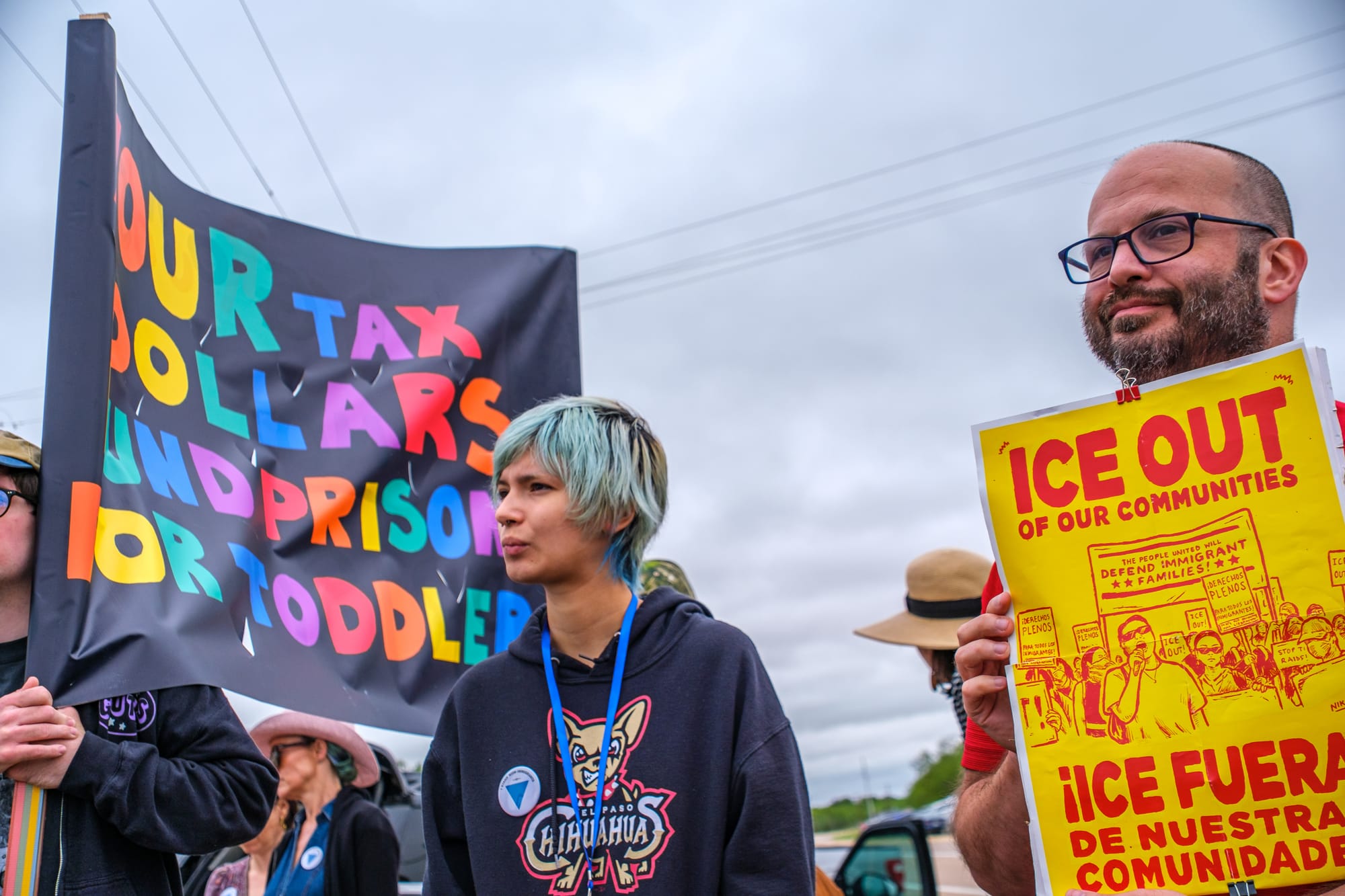
Judge Allows State of Texas to Take on More Immigration Duties
We have seen domestic violence victims targeted for immigration enforcement when calling for help. We've seen high schoolers getting sent to detention days before graduation for expired tags. We have seen terminally ill U.S. citizens make a life-threatening trip to Mexico to see their deported parents as their last dying wish. We have seen children waiting for the school bus get picked up and thrown into detention camps.
All of this under the guise of public safety, law, and order. Meanwhile the sick are not making it to their doctor’s appointments out of fear of getting detained because of the mandatory question health-care provider offices now have to ask in Texas: “What is your legal status?”
Meanwhile in the state with some of the highest domestic violence rates, people are not making the calls for help. Meanwhile DPS is stretched thin to respond to events such as highway car accidents because of its new marching orders to enforce immigration law. This is not making our state or our country safer. Clearly, there's much evidence to the contrary.

Related: 'Come In the Right Way!' — The U.S. Betrayal of Those Who Tried'
Apart from anecdotal cases, statistics show no correlation between immigrant population increases and crime rate increases. So it begs the question: what is the crime that the state must “crack down” on? The crime is driving while brown, walking while brown, speaking while brown, existing while brown. As sociologist and migration scholar Thomas Faist states:
“The links between international migration and security threats are inconclusive… In the end, the migration-security nexus is about values affected that are linked to perceived existential threats… In turn, stricter control and limits on civil rights of aliens further strengthens cultural divides between immigrants and natives.”
In a state where 65% of the population identifies as Hispanic or Latine this law, if in full effect, will impact everyone either directly or indirectly. So what is Texas Senate Bill 4 (SB4) and what does it do?
What is SB4 (88-4)?
Senate Bill 4 (SB4), also known as the state deportation bill, made its way through the chambers of the 88th Texas legislature (4th special session) and passed on December 18th, 2023, at a moment when the state government was looking to curb what many argued amounted to an “invasion” requiring swift and authoritative action at the state level.
The legal backing for this being that the state had the right to protect its territorial autonomy, sovereignty, and self-determination. State leaders argued that the federal government was failing to do so. 2o23's SB4, (not to be confused with SB4 from 2017, commonly referred to as the anti-sanctuary city bill) is already in effect but was paused due to a lawsuit filed by Las Americas Immigrant Advocacy Center, American Gateways, and El Paso County in March of 2024. That paused broke on April 24th of this year, when a U.S. District Court judge vacated the decision. This decision caused advocates and communities to spring into action in anticipation the law going fully into effect on May 15, 2026.
SB4 is one of the most anti-immigrant laws in the country—and one of the first of its kind to actually pass. The most striking parts of the law would violate constitutionally protected rights, rights that apply to all persons present in the United States regardless of their immigration status. In simple terms, it is a state law that violates federal law.
Essentially, it would grant the state of Texas immigration powers historically reserved for the federal government.
Namely the law would:
- Make it a state crime to enter Texas illegally from a foreign nation after May 15, 2026;
- Make it a state crime to re-enter Texas illegally;
- All state magistrates may issue orders of removal;
- Make it a state crime for failure to comply with a magistrate’s removal order.
SB4 would require all local law enforcement agencies take on the role of federal immigration law enforcement in a way that is far more extensive in its reach than any of the previous anti-immigrant laws such as SB8 the law that requires 287(g) agreements and that went into effect in January of this year.
It is important to note that, as opposed to the 287(g) agreements which require some level of training for deputized officers, SB4 does not include a training requirement for law enforcement officers on application of this law. SB8 requires all sheriffs to enter into these agreements with ICE for collaboration in enforcement of immigration law by December 1, 2026. Yet, we are seeing pressure from the Texas Attorney General and the Governor on cities and local governments to comply prior to the deadline. One example is the intimidation letter from Texas Attorney General Ken Paxton sent to the Dallas County Sheriff just two days ago demanding immediate compliance, a letter Sheriff Marion Brown promptly replied to.
Some cities like Austin, Houston, and Dallas are facing pressure from Republican state leadership to comply with SB8 (or face withholding of funding, fines, and even a threatened removal from office of elected officials) and are now working with their respective city councils and local law enforcement to land on changes to come into compliance. Yet, some local leaders are standing their ground, arguing that these laws are effectively redundant and unnecessarily burden local law enforcement.
SB4 would allow Texas law enforcement agencies to completely bypass federal immigration removal procedures by making it a state crime to illegally enter or re-enter the state of Texas and allowing the state to act on its own account for the detention and removal of those charged with being present illegally.
Effectively this would make the state judge, jury, and executioner on federal matters, an act that would violate the supremacy clause of the U.S. Constitution.
“The state of Texas is not its own country.”
—U.S. District Judge David Alan Ezra
In his comments at a hearing on Wednesday this week at the 5th Circuit District Court of Appeals, U.S. District Judge David Alan Ezra made clear that parts of the law are “superfluous.” He went on to say: “It just doesn’t make any sense to me unless one ignores the Constitution.”
And this is the core of the case, given that SB4 would essentially deputize every magistrate in the state of Texas to act as an immigration judge and require that these judges (including justices of the peace, who in Texas are not required to be lawyers) issue removal orders. The state then would allow peace officers to effectuate deportations.
Failure to be removed (even if this is due to Mexico not accepting an individual) would result in a felony charge for refusal to comply. As of publication of this article, all but the illegal entry provision above have been temporarily blocked due to a lawsuit filed by the American Civil Liberties Union and the Texas Civil Rights Project. This means that a person can now be charged with a state crime for illegal entry.
We have seen how immigration law enforcement processes have played out on a national level. The actions of DHS law enforcement agencies, ICE, CBP and HSI, are chaotic, riddled with error and violations of due process, and by design are terrorizing communities of color. The recent Supreme Court decision allowing for racial profiling is another layer of this context that is protecting bigotry and overriding our constitutional protections of due process of law.
SB4 does not require even proving that the person is present illegally before detaining them, they only must be “suspected” of being in Texas illegally, based on “indicators” that the Texas Department of Public Safety has not clearly specified.
But in practice we have seen this to amount to racial profiling given that Black and brown people are disproportionally subjected to this. Because the law only requires that there be a suspicion that the person is undocumented, the massive surveillance system of Flock cameras, automated license plate readers, shared databases, massive purchasing of data from private entities like LexisNexis, and these anti-immigrant laws work in conjunction to not only allow, but encourage racial profiling and violation of constitutional protections. As an ACLU staff attorney shared with the Texas Observer:
“When used in concert, DPS’s current tech capacity for open-source web intelligence gathering, license plate reading, facial recognition, and phone location tracking gives the agency the ability to look up a person or a car, figure out who they are, what they’re doing, where they’ve been, and who they associate with—all without a warrant.”
Even sworn testimony by ICE officers has included statements attesting to the use of license plate readers to detect people with Spanish surnames. So in a state with a majority that identifies as Hispanic or Latine that is a problem.
It is still unclear how the state would fund and execute SB4 as legislators have not shared any guidance for the implementation of this law. Advocates anticipate that although part of the law has been blocked, the pause is only temporary. It is unclear how the illegal entry provision that went into effect this week will be applied. For now the judge on the case has hinted at the unconstitutionality of the law and we will have to wait and see how the government responds to the injunction (pause) ordered by the judge on Friday. An appeal is more than likely.
A View from San Antonio Alliance
Deceleration spoke to Alejandra Lopez, president of the San Antonio Alliance of Teachers and Support Personnel, about the heightened vulnerability of families with school-age children in light of the uncertainty around SB4 and its implementation. We also spoke about the recent snatching by ICE of two children and their stepmother at a school bus stop in San Antonio (and released after a judge's order), leaving scores of families in fear that they could be next.
Lopez stated that she and the organization have been working with San Antonio Independent School District to ensure it remains a safe place for children even though places previously designated as sensitive such as schools, health care facilities, and places of worship are not necessarily protected spaces anymore.
Here is a bit of the interview:
“The roll back of the protected spaces policy was a real wake up call for all of us that have been organizing in these spaces since the first Trump presidency because it is something that we consistently pointed to in the first Trump presidency when we were speaking to not just our members, but also families and students. It was something we could concretely point to and say schools are these protected spaces and your children are safe at school.’
"Once that was rolled back we could no longer offer that kind of guarantee. To date, we have not had any situation where immigration enforcement has attempted to enter a school building in SAISD…but we do recognize the heightened risk and vulnerability that our students and families have. We have worked with our district to ensure that we have a strong policy in place for what should happen if immigration enforcement shows up at a campus.
"It is as strong as any policy you’d find anywhere else in the country, which is to say that it stops ICE at the doors, keeps them in the front office, and it does not allow access to any other spaces in the school.
"The campus is going to call the deputy superintendent and the police chief immediately who can come to ascertain what type of warrant they have…So we are honest with community members to say the policy is strong and it will be enforced and, to be honest, it is a stronger policy than you would have in place at any private business or anywhere else a family may be going about their day to day.
"We have been focusing our efforts on distributing Know your Rights information throughout our community, but the fact is that our district’s projected enrollment this year was down 1,600 students.
"And while it's difficult to pinpoint, we do feel very strongly that immigration enforcement in our communities has led to that decrease in enrollment, whether families are making the very difficult decision to move out of the city, to go back to their country of origin, or are just keeping their children home. Those are very difficult decisions and it's difficult to kind of know how many of those families are making those decisions, but for us we see that those two things are related.”
If this law (SB4) is allowed to go into effect in the future, if the injunction is lifted, it can lead to attempts at copycat laws in other states particularly along the border as those are the states that could, due to geographical proximity, physically deport people to Mexico.
What Can You Do?
ICE Watch spoke to Katy Murdza, senior Texas organizer at the Immigrant Legal Resource Center (ILRC) on what recommendations are still in place for communities in Texas. The ILRC focuses on providing technical resources, webinars, and written resources to attorneys and communities at the intersection of immigration and the criminal legal system. While Murdza works specifically on local city and county policy campaigns in San Antonio with the SA Stands Coalition and the Houston Leads Coalition, she shared with us what the ILRC recommends for individuals across the state.
“Everyone should know their rights and it's very important to know that we already see rampant racial profiling in our communities so regardless of race we should all know our rights so we aren't making it easier for law enforcement to normalize violating people’s rights if pulled over.”
— Katy Murdza
- Know Your Rights! The first recommendation is to educate yourself and your neighbors on basic rights that apply to all individuals regardless of immigration status. Some of the available know your rights materials have been shared in previous editions of ICE Watch, but you can click the hyperlink and scroll down for more, including specific information for folks traveling for the World Cup.
- Carry a Red Card- A wallet sized card with bulleted version of your basic rights that you can hand to an officer during an interaction or stop while you assert your right to remain silent.
- Watch for trends in your community! Communicate with and get to know your community and learn what groups you can tap into to be able to share vital information regarding enforcement activity in your neighborhood.
- Organize with your community to decrease the number of people caught up in the system, by supporting your neighbors or community members in their basic needs.
- Be prepared for the worst: Complete a Family Preparedness Plan.
- Observe and document ICE presence or immigration law enforcement activity in your community and join your local group organizing to keep tabs on this activity.
- Consult an attorney if you think you or your family may be at risk.
FURTHER RESOURCES
- Criminalizing Immigration: The influence of SB4, Texas’ Regressive State Deportation Law
- The Many Ways Local Law Enforcement Works With ICE
- Texas Travel Advisory Map
- Know Your Rights when traveling for the World Cup
- Texas Immigration Law Council SB4 Info
- Toolkit to demand funding for the Bexar County Immigrant Legal Defense Fund
Letter to an ICE Agent
Click to hear ‘La Cancion de Nosotr@s,' written by Dr. H.H. Coyotl and read by Roxana Rojas. Follow Deceleration on YouTube.
The heaviness of our current reality requires creativity and imagination to propel us towards the future we want for ourselves and future generations. In the same vein that painters, musicians, poets, and other creatives imagined a different world through their art during times of political strife, we too can participate in the coloring of our future and the creative analysis of our present. As the Zapatistas wrote communiques from the Lacandon jungle under the name of Subcomandante Marcos to expose the realities of neoliberal violence on indigenous communities, and as Albert Camus wrote letters to a fictional German friend during the Nazi occupation to argue for the French cause, this letter to a fictional ICE agent penned under the name of Dr. H.H. Coyotl is a call to the resistance of our time.
Events
Tip Jar

Buy Roxana a Coffee
Show your appreciation for all the information and energy ICE Watch brings every month.