

The last several years have been brutal, advancing a trend seen the world over: rising heat, stronger storms, and punishing extended drought. And while water worries have understandably captured headlines of late, life-threatening extreme heat will soon be bearing down again across Texas. If recent trends are any guide, some of the hottest temperatures will likely be felt by residents of the Rio Grande Valley, where substandard housing and high poverty put lives at particular risk.
That was the message of a federal "warning coordination" meteorologist with the U.S. National Weather Service and two Texas health officials who have embarked on a new partnership to better understand the health impacts of extreme heat and better prepare communities to face it.
"Any people here from other parts of the country know that we have four seasons," said Barry Goldsmith, a Brownsville-based meteorologist with the National Weather Service.
"We don't have that [in the Rio Grande Valley]. Well, we do have four seasons. They are: Warm, Hot, Hotter, and Hell."

And yet it wasn't always so.
"Assessing Human Vulnerability to Extreme Heat in South Texas, 2020-2025." Full panel presentation, courtesy of Deceleration.
During a panel presentation in San Antonio last week at a three-day South Central Climate Resilience Forum, Goldsmith showed how temperatures have been rising — steadily since the 1980s and then "exponentially" beginning in the 2010s.
"[We] in the Weather Service [are] very reluctant and conservative to use the terms global warming and climate change. We want to be really sure the data are showing that," Goldsmith said. "And as the 2010s got closer to the 2020s, it became clear that there's something going on here that is beyond normal in terms of rises and falls."
Recent years rank not only among the hottest years ever recorded, but among the hottest in most of human experience on Earth.
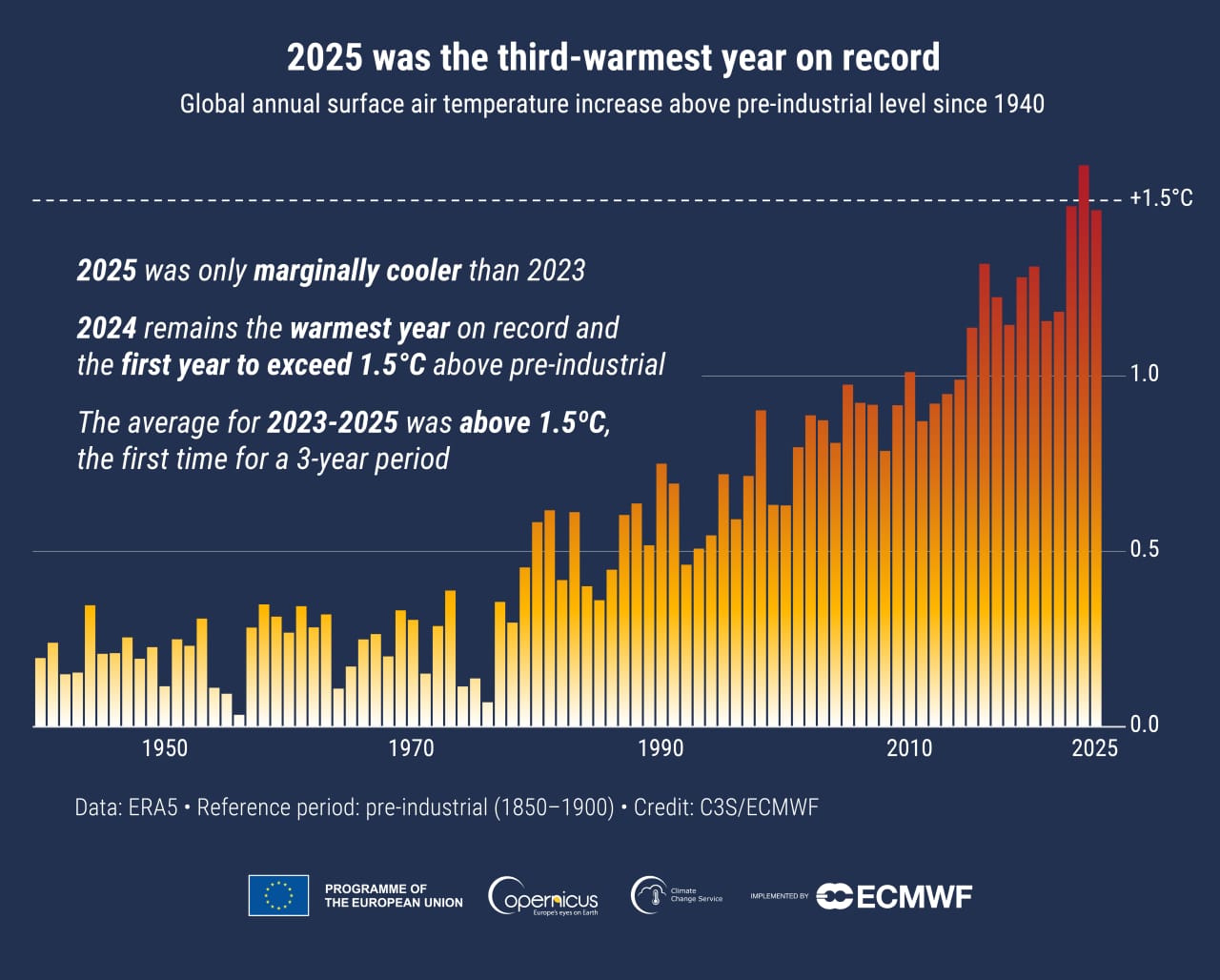
While temperatures in the 1980s across the RGV could be "hot," the heat people are facing today is something different. Referencing the extreme heat of 2023 — which was surpassed for the title of hottest year on record globally by 2024 (with 2025 now ranking as the third hottest ever) — Goldsmith said:
"Those numbers are astronomically high. They will kill. … This is really off the charts — even for us."
To better prepare local communities, Goldsmith reached out to his colleagues at the state health department to see if they had medical surveillance data showing why people were being seen in area emergency rooms. He had seen similar data being gathered and circulated in greater Maricopa County, Arizona, where a robust intergovernmental heat-tracking effort is well underway, and inquired whether Texas had anything similar.
It did.
Dr. Emilie Prot of the Texas Department of State Health Services, Public Health Region 11, recalled how Goldsmith "pushed" for the data. "He said, 'They have access to all this data. I'd really like to do something together. Do y'all have access to this data?' And we did. So it was a great collaboration and a great idea."
Extreme heat is the number-one weather-related killer in the United States. In 2023, there were roughly 120,000 heat-related ER visits, Prot said. On average, there are 1,300 heat-related deaths each year — though, she added, many more are likely unreported.
In a recent review of state health data, Deceleration found nearly 600 heat-related deaths in Texas in 2023 alone. Yet recent research by a Texas A&M climate scientist found that the state is still only capturing and recording one of every six likely heat-related deaths each year.
Reviewing the available 2020-2024 data, the group concluded that the bulk of heat-related illnesses across the RGV were occurring among young adults, likely outdoor workers. And the burden was clearly falling on Hidalgo County, with more than 2,000 documented cases of heat illness. Being more inland, Hidalgo is also isolated from the cooling Gulf breezes that temper conditions in Cameron and Willacy counties.
2023 also brought far more heat advisories from the NWS, which tries to be conservative in the number of warnings it issues. In a region known for violent and hot weather swings, to do otherwise risks being seen as "crying wolf," Goldsmith said.
"It's hot in the Valley and people will laugh at you if you say 'Heat Warning,'" Goldsmith said. "We want to make you say, 'Oh no. Heat warning? It's hot here, but it's really going to be hot today.' We want people to react to that."




Clockwise from top left: Dr. Emilie Prot, Texas Department of State Health Services; NWS meteorologist Barry Goldsmith; and Abdul Alphonso Kamara, Texas Department of State Health Services. Images: Greg Harman
A heat advisory is issued when temperatures reach 111°F or higher for two or more hours. Excessive heat warnings go out when temperatures climb to 116°F or higher for two or more hours. In a typical year, NWS staff expected to issue three to six heat advisories and no more than one heat warning. In June of 2023 alone the NWS issued 15 heat advisories and six excessive heat warnings.* For the year as a whole, there were 55 heat advisories issues and six warnings— far more than expected.
But all of them met criteria, Goldsmith said. And current forecasts suggest this summer will bring much of the same.
"It's warming, folks. It's really happening," Goldsmith said.
After a "jackrabbit" start of above-normal temperatures in 2026, a harsh summer is approaching.
"We're probably talking more 100-degree days [in McAllen, Texas]. Maybe not 97 of them, but maybe between 80 and 90 of them," Goldsmith said. "The length of hell will be pretty long this year."
To better inform the public about the intersection of heat and health, the NWS began supplementing their data with risk considerations: Is the heat arriving quickly before people have a chance to acclimatize? Are nighttime temperatures expected to stay elevated? What about humidity?
These considerations are embedded in the recently release NWS Heat Risk maps, which Deceleration frequently cites.
Deceleration asked the panelists what prevents better communication about heat-related deaths, which suffer from such chronic undercounts — a fact likely to temper public concern and resulting public-health action.
"It's difficult," said Dr. Prot. "A lot of the time [heat deaths] are masked by medications people are taking and chronic conditions they have. And that's most likely what will be reported on the death certificate. It's very difficult to be precise: There are only two lines — primary cause or contributing cause."
Better medical training for doctors and nurses so they can recognize signs and symptoms is important, she added. Though many unattended deaths are also still recorded by non-medical officials, including justices of the peace.
"Dying at home, which may be due to heat — it's not going to be reported," Prot said.
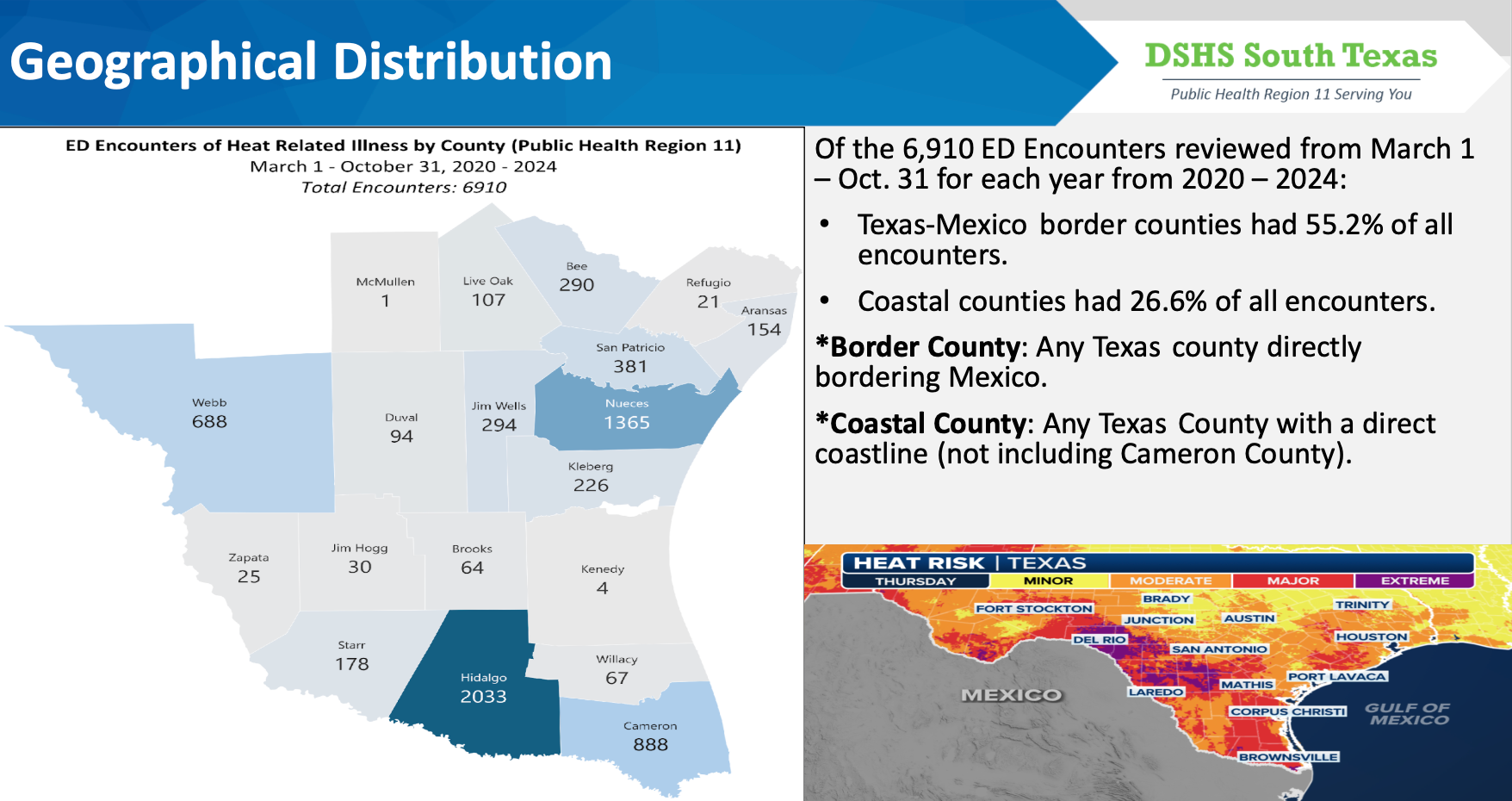
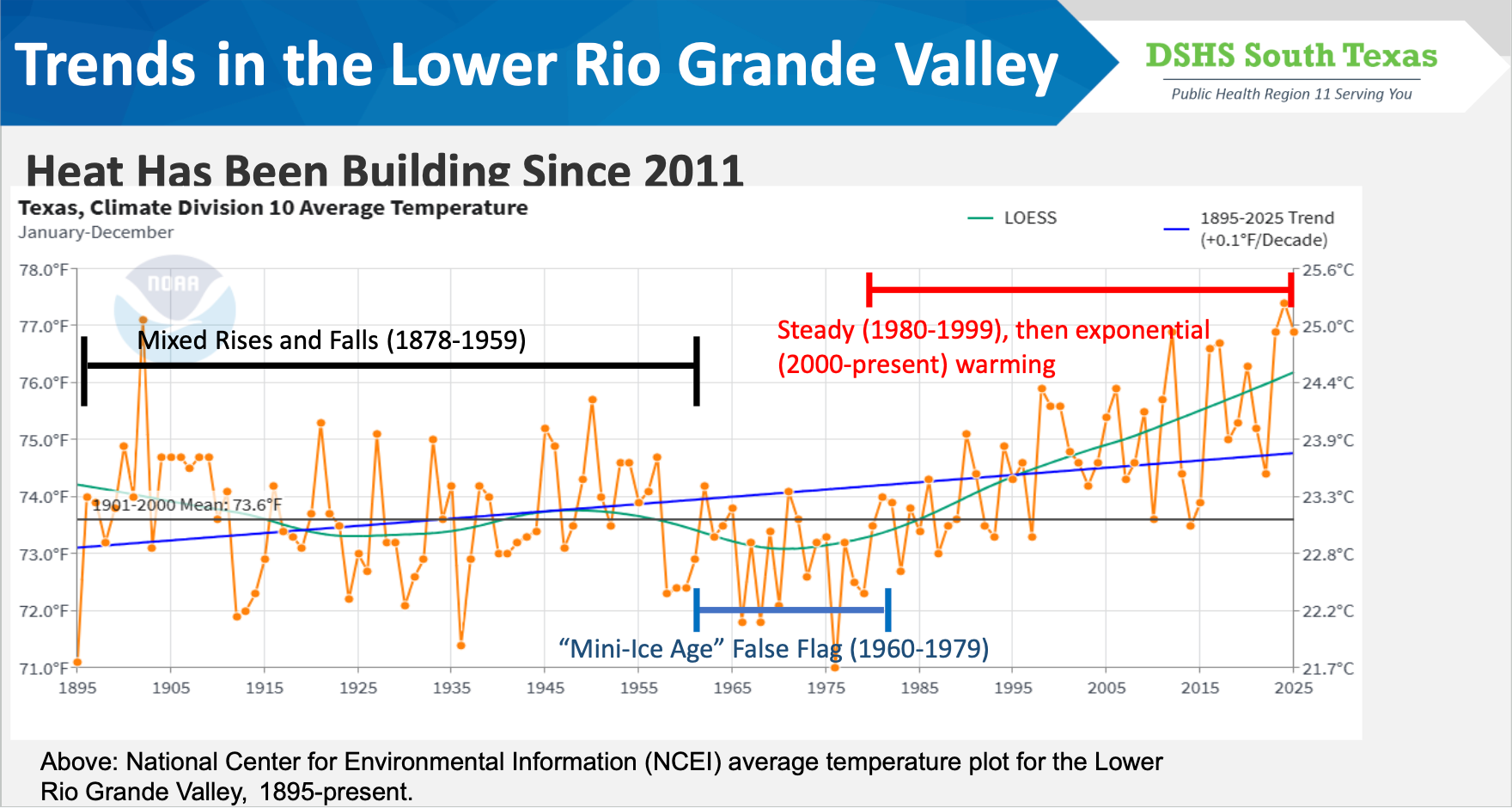
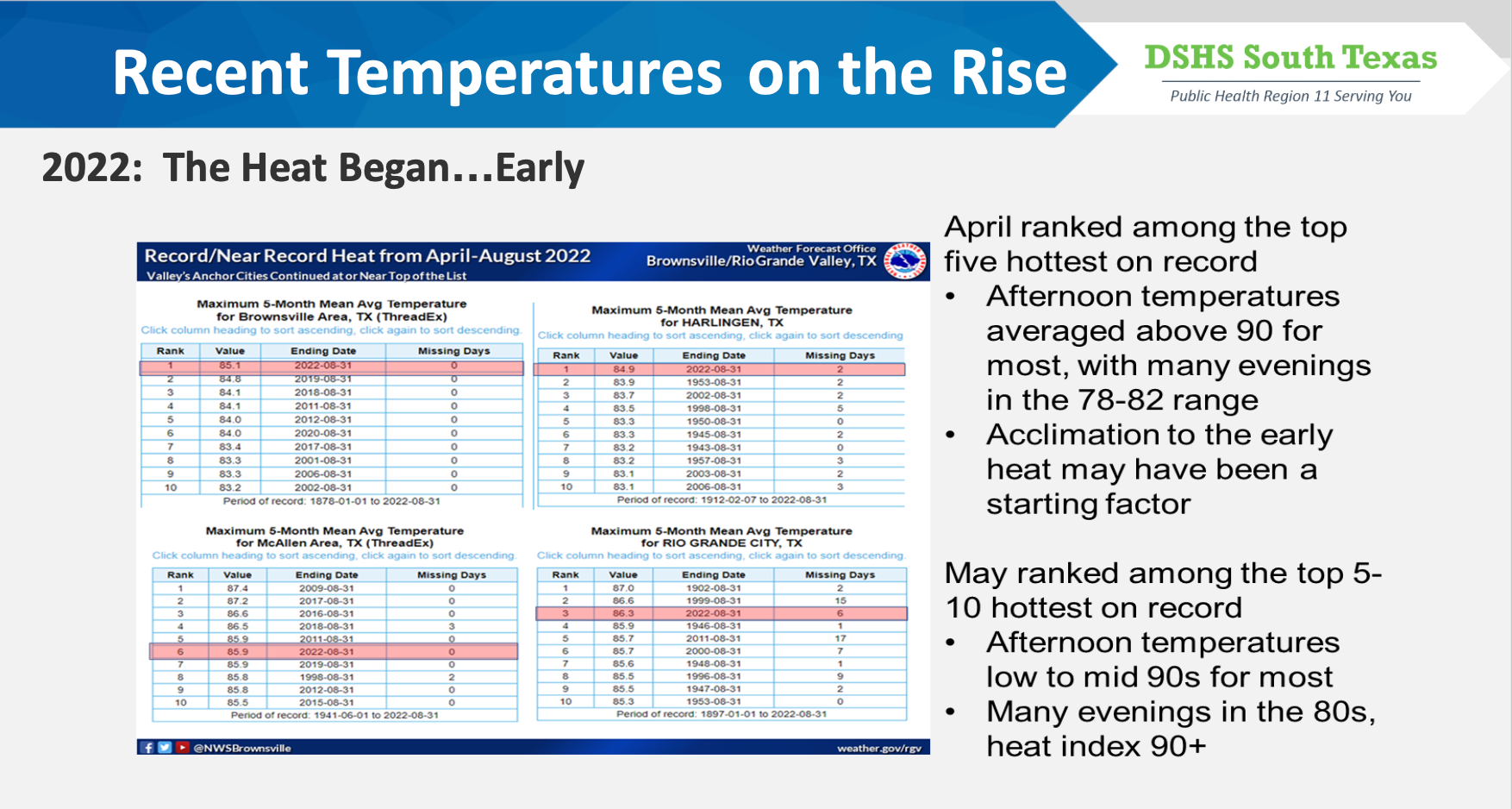
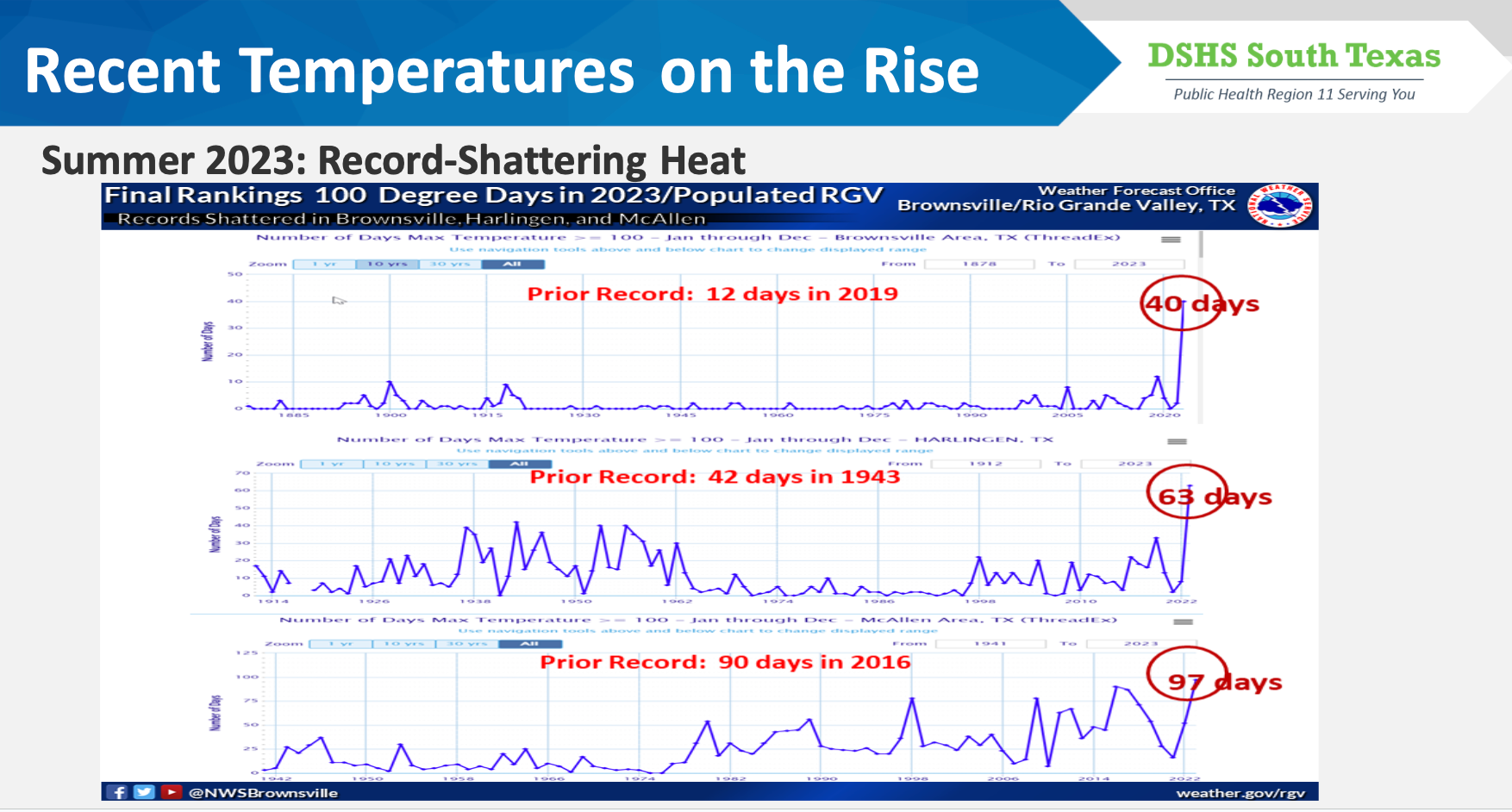
Charts shared at the South Central Climate Resilience Forum last week in San Antonio. See full slideshow.
One possible improvement, she suggested, could be found by replicating aspects of a state program for the prevention of childhood fatalities that involves close reviews of data to identify patterns.
Abdul Alphonso Kamara, also from the Texas Department of State Health Services Public Health Region 11, said everyone has a role to play in preventing heat illness and heat-related deaths.
"It takes a village. It's not just one person that should be championing this. I think we all have a role to play to make sure everyone understands the impacts of this on our communities," Kamara said. "Folks can die from this. So raising awareness through education is very important."
-30-
*Originally reported as 15 heat advisories and six excessive heat warnings for the year. Deceleration regrets the error.


