

Hey y’all.
I’m wrapping up my capstone for graduate school and will soon return to Texas. Or what’s left of what I can remember of it. I'm contending, like many of you, with the momentous news that Brownville’s economic boosters have hitched our future to autonomous killing machines developed in league with none other than Palantir, AI-powered attack boats going into mass production in a time of wanton targeted extrajudicial killings across the Caribbean and Pacific oceans.
And so with as much certainty as anyone who’s had to report on the region’s asinine politics, let me offer this observation:
Our future has been jettisoned by the RGV’s elected and business leaders entirely for their own personal legacies. For an idea of immortality. The long-term health of people and the landscapes enfolding us, for them, always comes second, if at all.
There’s a doublethink happening among the Valley’s elected officials that I haven’t seen acknowledged, including by a local news ecosystem so busy manufacturing consent for the region’s transformation into the next U.S. military industrial complex/colony. So let me give it a stab.
These so-called boosters are engaging in doublethink when they talk about bettering our lives. They should know full well that the industries coming to the Valley–oil and gas, more space commerce, and now the Saronic war machinery company–are death throes investments.
These companies reach for the southern tip of Texas because there is nowhere else to go, no one else easier to please for so little. And yet these elected and economic development suits are trying to enshrine themselves before they, too, are lost to memory damnation, their names spoken only when referring to who’s responsible for the betrayal.
That’s the only way they can tell you (because maybe they earnestly believe it) that an oil refinery is a great opportunity for poor old Brownsville. Then, two weeks later, one will blow up on the opposite end of the Texas coast, because sometimes the universe provides an inarguable truth when it's needed most.
This month’s newsletter comes from late nights in a string of hotel rooms, Washington, D.C., Boston, and St. Paul, Minn. Penned when I’d be too pissed off to sleep after reading news from Brownsville and beyond over the last few weeks. This is my attempt to define what drives an ongoing murder-suicide of the Rio Grande Valley, a unique mix of apathy, ignorance, and enabling end-times fascism that now defines the politics of the region. As I write below: It's all done in the name of living forever while destroying our collective futures.
— Gaige Davila
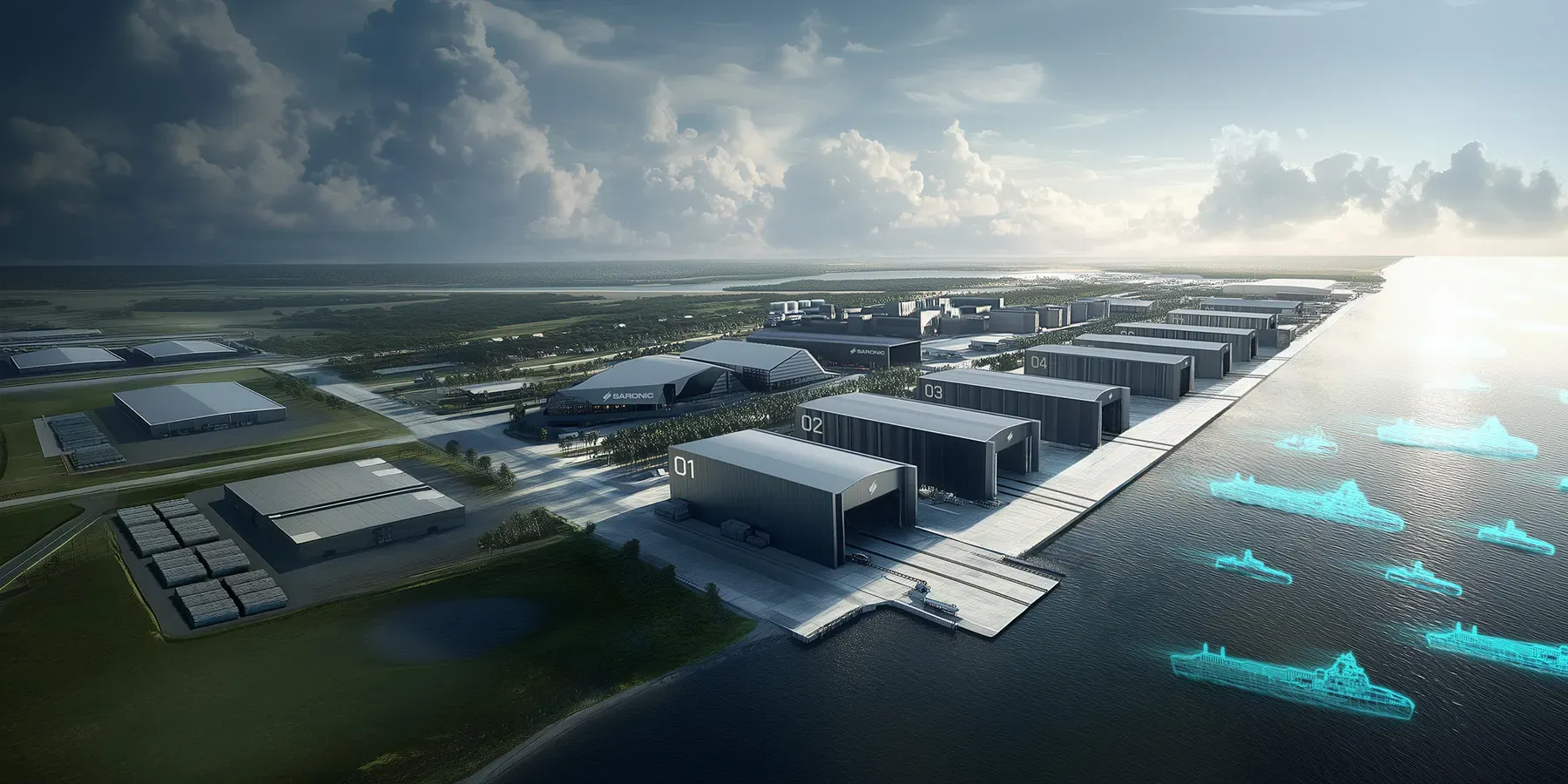
Saronic illustration of planned autonomous shipbuilding yard at the Port of Brownsville. Courtesy image
The Last Land Battle of the Civil War Happened Near Boca Chica Beach.The Motivations Behind the Needless Killings Are Surprisingly Current.
Gaige Davila | Deceleration
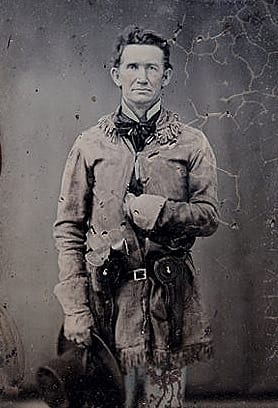
A month after the Civil War formally ended, Union and Confederate soldiers killed each other in Brownsville, near Boca Chica Beach, for two days in May 1865. An informal truce had paused the warring for months before what would later be named the “Battle of Palmito Ranch.” At least one historian attributes this truce breaking to the insecurity of John Salmon “Rip” Ford, who was leading the Confederate forces in Brownsville at the time.
Ford likely knew the war was over, but formal declarations mean nothing to people who have have profit and posterity top of mind.
“What was at stake was honor, money, and perhaps a bit of racism,” Texas A&M International historian Jerry Thompson wrote in 2003. “With a stubborn reluctance to admit defeat, Ford asserted that the dignity and manhood of his men had to be defended.

“Having previously proclaimed that he would never capitulate to ‘a mongrel force of Abolitionists, negroes, plundering Mexicans, and perfidious renegades’ who would ‘murder and rob ... with impunity,’ Ford was not about to surrender to invading Black troops," Thompson wrote.
"Ever more important was the large quantity of Richard King and Mifflin Kenedy's cotton stacked in Brownsville waiting to be sent across the river to Matamoros. If Ford did not hold off the invading Federal force, the cotton would be confiscated by the Yankees and thousands of dollars lost.”
Ford would later become the mayor of Brownsville and edit some of its long-gone newspapers before dying in San Antonio.
But his legacy is most attached to the Battle of Palmito Ranch, which is considered the last land battle of the Civil War. Hundreds of thousands of people were killed in the war’s four years, the last dying in Brownsville after the war had already ended. Ford’s reasons for initiating this killing hold only political or wartime merit for those who detach such things from dead people, as the worst historians do. Ford had no moral justification for the killing. Ford had a blood oath against being lost to history—and if there was a chance to make money, he was going to get his.
This same arrogance is embedded in Brownsville’s, maybe in the entire Valley’s, political consciousness today, a historical memory that plays out over and over again as if the city has been cursed for the many sins of its forefathers. Recently, leadership in Brownsville, Harlingen and even Port Isabel’s school district sold out their communities to Saronic for essentially nothing. The linkage to Palantir didn’t make a single wave.
“Palantir is committed to accelerating the American manufacturing renaissance and partnering with companies like Saronic that are able to say the same” said Emily Nguyen, Head of Industrials at Palantir Technologies. “Warp Speed will unify Saronic’s manufacturing processes, providing the insights and operations that will give Saronic greater control, visibility, and agility as they continue to rapidly scale.”
Founded on CIA dollars in the wake of 9/11, Palantir has surged into a full embrace of surveillance-state fascism and marked most obviously for its work with ICE and its “unwavering, ongoing technological and ideological support for the Israeli military” and facilitation of genocide, according a company profile maintained by the Palestinian-led BDS Movement. So much so even Palantir employees are rattled by actions taken by their leadership in recent years, according to a Wired investigation.
And in this I can’t help but think of Ford and the political prophecy he’s bestowed upon the Valley.
I’m tempted to say that Brownsville having the last battle of the Civil War preceded, maybe even created, the sometimes-true cultural superlative that the Rio Grande Valley, especially its lowermost county of Cameron, is always behind the times. But if the Good Word can reach Brownsville from Appomattox in 1865, so, too, can endless reports, journalism, and science from all over the world in 2026.
But this bunch jettisons inconvenient facts just as easily as Rip Ford.
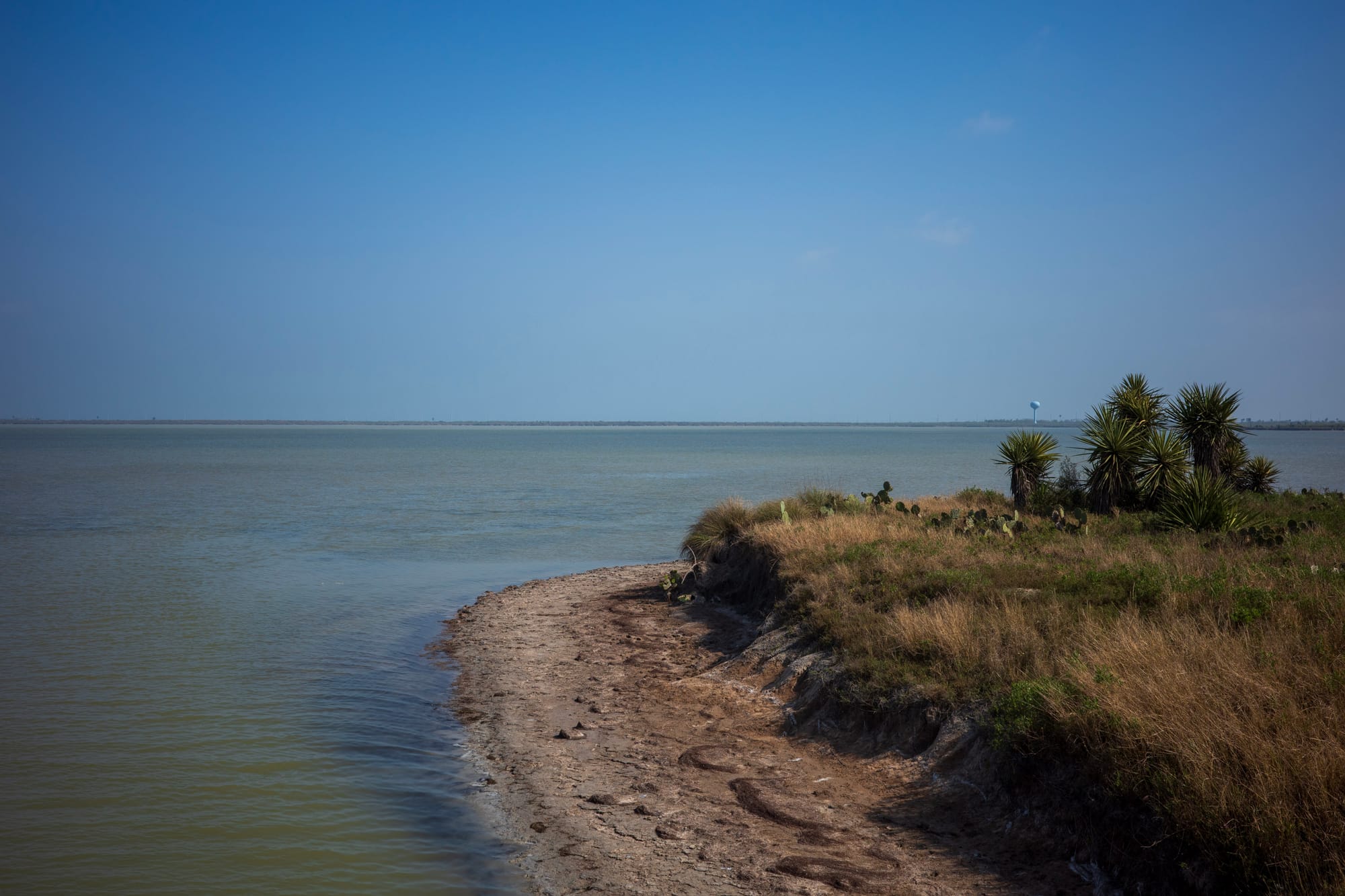
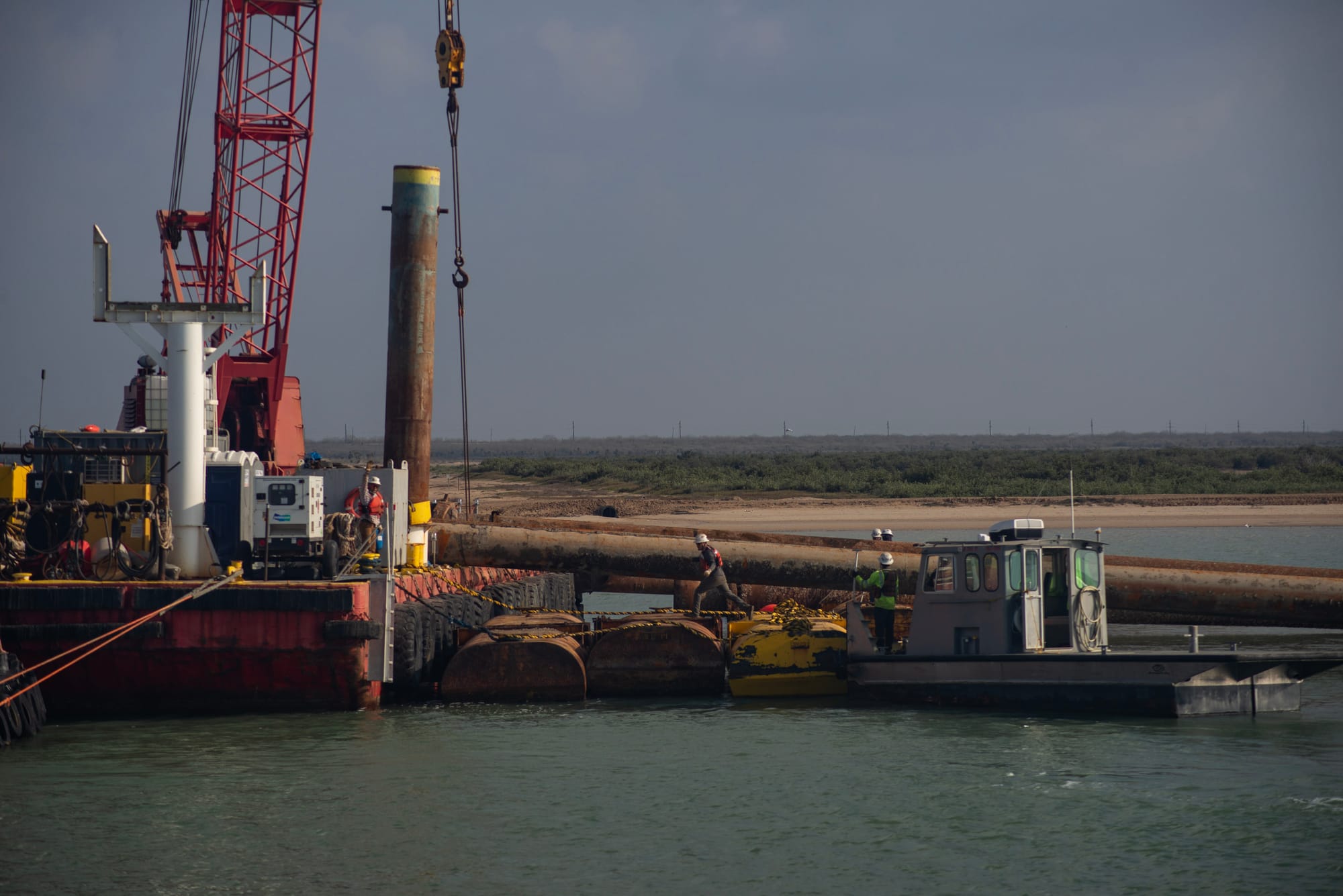
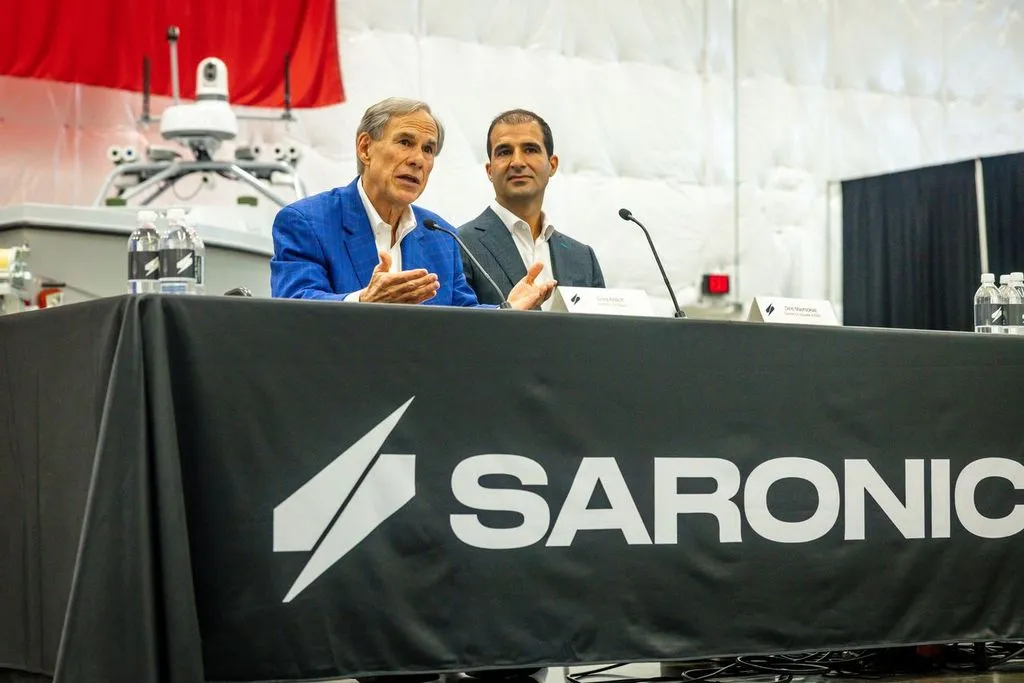
The Bahia Grande Unit of the Laguna Atascosa National Wildlife Refuge in Port Isabel, Texas (Gaige Davila). A dredge barge in the Brownsville Ship Channel on February 27, 2026 (Gaige Davila). Press conference announcing the Saronic location decision (Office of Governor Abbott).
Today the most powerful among us choose to ignore the thousands being poisoned by liquified natural gas export plants and their emissions, the heat islands from endless strip malls and subdivisions with non-native plants, and flooding that never seems to end no matter what new drainage project arises.
They do this for money and ego. And in alignment with the state’s fossil fuel autocrats, they place their bet on which side will write the history books in hopes that those books look kindly upon them.
These are powerful anxieties. Powerful enough for Ford to betray humanity, including what was left of his own. And they’re powerful enough that Brownsville, Cameron County, and the rest of the Rio Grande Valley’s growth coalitions are doing the same in an attempt to live beyond physical life by angling for their names on buildings, parks, proclamations, and sycophantic news broadcasts.
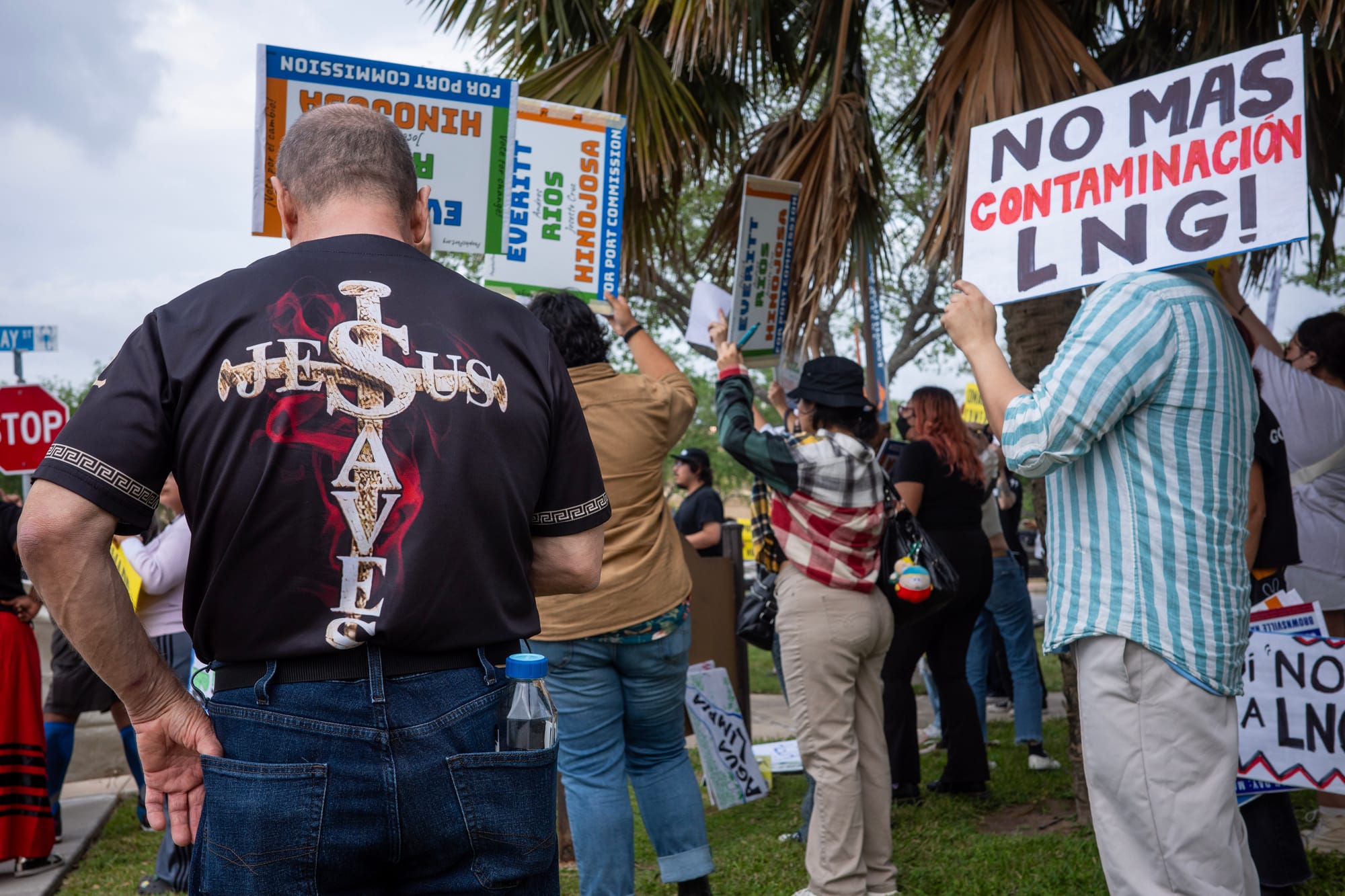
The language used to support these projects or give up tax revenue (a $211 million tax break for Saronic in the hopes of 10,000 jobs spread out over 10 years) is mostly corporate speak: overly general and obfuscating. But one can parse enough from these linguistic lockboxes what’s really being said, and it’s all some version of trapping future generations to provide labor for industrial projects.
It’s not so they can have local opportunities. If that were the case, then there’d be an equal drive for non-STEM fields: artists, writers of all kinds, social workers, dentists, lawyers, musicians, wildlife biologists, or reversing the withering of local media. No, welders and hospitality workers are what we need, they insist. There’s a status quo to maintain, and critical thinking only gets in the way. Because if too many people could truly do what they wanted in the 956, no one would work in a goddamn refinery.
Most of the officials in the Rio Grande Valley, elected and not, are scared to death.
They’re scared of death, too, just not their own. And not the death of human life or the region’s flora and fauna or of memories and shared culture. It’s the death of stories that they have believed since they were young, ones that say the measure of people is weighed in concrete, plaques, and diplomas from cities up Highway 281. Stories that say there are winners and losers and that people must earn their right to exist.
Such stories are harder to tell, because it is clear that working hard and staying in school does not guarantee survival. Nor does it enable one to contend with how power actually works or who holds it.
Said another way: 250 years after this nation’s creation, that dream is just another story. So are phrases like “job creator,” “economic engine,” and “game changer,” and whatever else that people from Brownsville’s EDCs say when a new project comes to town not wanting to pay taxes.
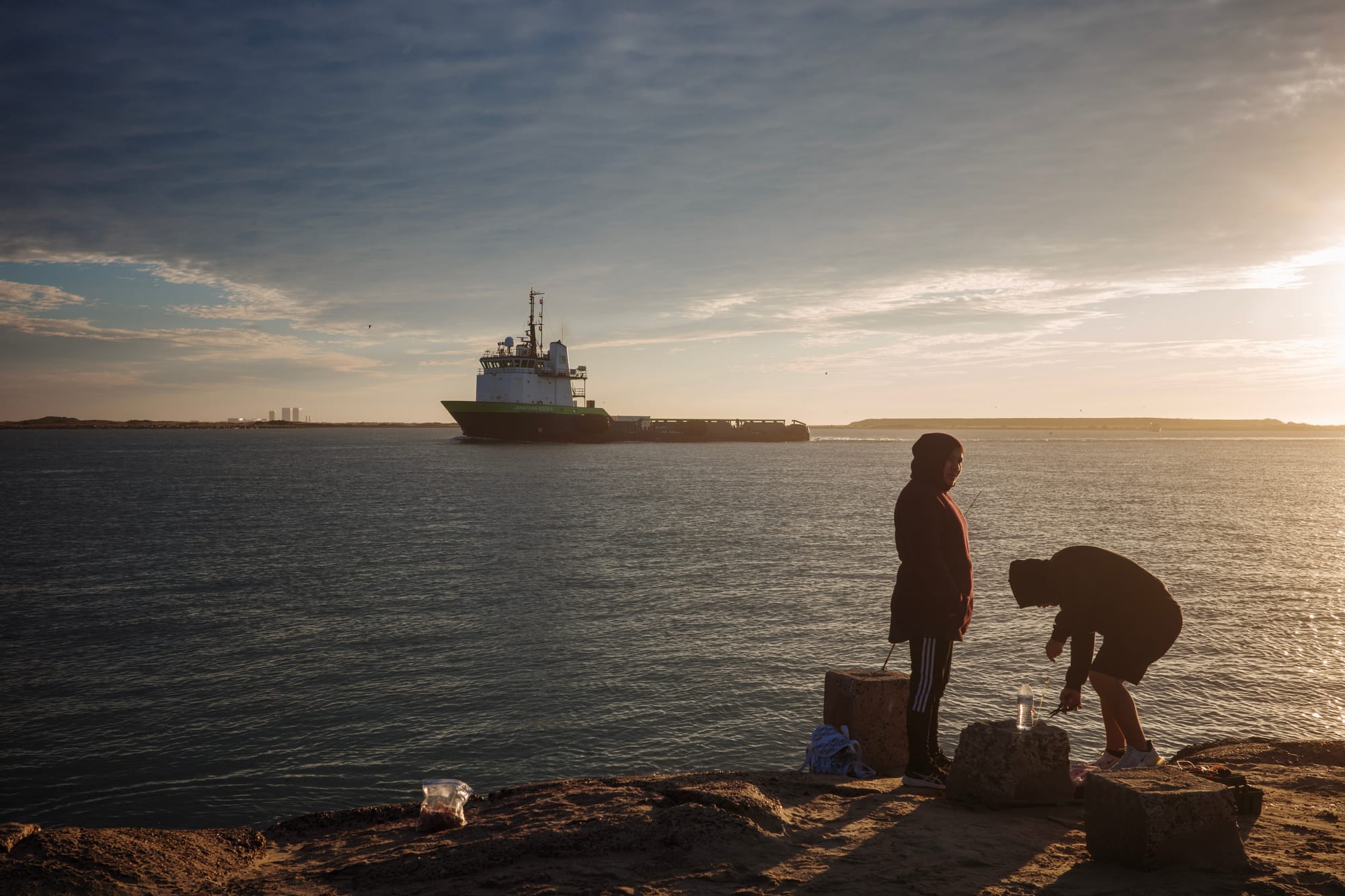
Especially when they still can’t show that the tax money the county lost out on from SpaceX and Rio Grande LNG was worth it. Stories about how we have more industries than ever, a momentum that must not be stopped. For whom? Who is actually benefiting here?
Most of all, they’re scared of their stories losing hold. Not those of the Carrizo Comecrudo tribe, of local shrimpers, of the generations who have gone to Boca Chica Beach to enjoy the right of their existence. And not of anyone who lives in Laguna Vista, Port Isabel, South Padre Island, and especially Laguna Heights, who will disproportionately suffer the negative consequences of these industries. Because it is actually these communities that the projects are closest to, not Brownsville. That is a story that they love most of all: how much these projects will do for one of the most storied places in Texas, despite it not actually being in said place.
This is not to say that Brownsville is not impacted. As I pointed out in a previous edition of this newsletter, the Brownsville metro has not changed in any real socioeconomic way since the arrival of SpaceX and everything else that followed. It has only gotten more expensive to live there, and many people are still living in poverty.
Yet we’ve watched Cameron County give Saronic, whose sole, distilled purpose is to build machines to kill people this massive tax break; Texas’s Supreme Court side with said county (and SpaceX) and against residents and the Carrizo Comecrudo tribe fighting to sustain their beach access, despite a state constitutional amendment that allows said access as a right; and the City of Brownsville celebrate getting an oil refinery, an antiquated facility announced by a president who realized he had lost the narrative on gas prices and needed a quick win, a playbook Brownsville knows well. When, or if, all this gets built, the city’s air quality will suffer more than it already does.
This rush to industrialize the Valley through tax incentives and industry-written propaganda reveals that fear. It’s an attempt to be associated with something that they believe is more true than the Earth they walk on, a final chance at absolution for their perceived sin of being from, or living in, the Rio Grande Valley.
“We need to do a better job of shedding that tagline of the poorest city in the United States,” Gilberto Salinas, the president and CEO of the Greater Brownsville Economic Development Corporation, said on June 16, 2026, during his public comment supporting the tax abatement for Saronic.
This isn’t the first time he or others have said this about why they support an industrial project coming to the area. It’s also disingenuous.
Again, as I pointed out last time, higher wages for people moving to the area, getting paid by companies who are making money from huge federal or global contracts, only inflate the averages. There’s no true socioeconomic improvement for the people who need it the most.
The 6.7% intergenerational mobility figure from The Economist study that Brownsville fawned over last year isn’t evidence of real improvement either. Someone from Brownsville making a couple more grand a year ($31,000 to $33,000, according to the study) now than the generation before them is more a marker of inflation than of earnestly earning more. That increase doesn’t matter when local utility bills keep rising, housing, groceries, and all the other things that are never mentioned.
Is the world not seeing Brownsville as poor more important than actually alleviating poverty?
To support these industries despite years of evidence that they are harmful is enabling the end-times fascism that Naomi Klein and Astra Taylor wrote about last year. The political and business class of the region seem to have some hope that they will be alongside Elon Musk as he and other billionaire societal architects construct a segregated, post-climate-collapse future, as if they are not just means to an end, as if their pursuit of immortality will be respected in the same way. Whether they know the consequences of these decisions is missing the point. Even an apathetic enabling of the end of the world as we know it is taking a side. Supporting those methods definitely is.
It shows me and anyone else who wants to exist in their home regions without risk of death from speeding cars, pollution, displacement, and militarized police, that the Valley’s elected officials know what they’re saying is unbelievable.
This recent attempt to rename Boca Chica Beach to “Cyber Beach,” and the sudden, unified front against it by local elected officials of every level of government is a good example. I don’t see it as a sign they will ever actually dismay SpaceX. I see the performance as them knowing they can’t convince Brownsville or anyone else into believing that the company is not colonizing the area and acting with impunity.
Elected leaders across the Valley continue to enable both, a core tenant of a politics that doesn’t think of the future outside of what can be developed over, what value can be extracted from the land with the hope that maybe, possibly, some marginal improvement will happen to a few people’s lives. And because hardly anyone votes in the area, that’s all you need to remain in power. It is the bare minimum in a political culture that rewards the mediocre and incompetent. But when the goal is legacies, this really is sufficient enough. It is the Real Thing.
Every ribbon cutting for some forgettable chain restaurant is another signpost, signaling the welcoming of places that remind them of somewhere-else places, of not-the-Valley places.
Because anybody who is sincere about improving the Valley, enjoying it for what it is, would not spend every part of their existence turning it into what it isn’t. Just like you cannot claim to want to improve the lives of people while enabling systems and industries that inevitably shorten those lives and the quality of them. All that says to me is that if some people in the Rio Grande Valley want to live forever, those extra years must be drained from everyone they see as beneath them.
Already, Saronic is talking about a 4,000 acre expansion at the Port of Brownsville, which would be about the size of four Rio Grande LNG plants. It would be a complete physical erasure of these important wetlands and environments. But that is only the tangible manifestation of an erasure that happens every day in the Rio Grande Valley, where the stories of our collective existence and where we came from are written over by people who have no connection to the earth or each other and have signaled that they don’t want either.
SpaceX’s IPO launch a few weeks ago was the first time I saw that the collective faith that Cameron County, the City of Brownsville, and whatever the hell RioPlex is (which shamelessly claims SpaceX as a “RioPlex-based tech company”) has in Musk, or in the story he tells, was not just a local delusion but a global one.
What possibly makes the Valley’s political and business class’s faith in Musk is generations of subservience, of politicians saying that there will be an answer to ailments physical, financial, and political just around the corner, como Dios quiera. A history shaped by war and displacement, of “strategic” locations for supplies and the movement of people, the waste of spaces natural. All sequitur and a given now, the predictable cycle of Ford’s original sin at Boca Chica Beach.
So when wind and solar eventually become so good at producing energy that the oil and gas industry abandons their projects for good, just as they’ve done in Louisiana, just as the nuclear industry abandoned their uranium mines in the Navajo Nation, I’m earnestly curious what the current leadership of the Rio Grande Valley will say, if any reporter will even be around to ask them, on whether it was worth it.
I’m expecting the same thing that the people told me while scrounging Boca Chica Beach for broken pieces of rocket and Starship’s launchpad: this is the price of “progress,” broken eggs for omelets or whatever.
What surrounds the U.S. is hubris, the natural reaction to a geopolitical existence whose sole goal is subjugation. The regional leadership of the Valley— elected, EDC, admin, what have you—are in lockstep with that. Because after more than a decade of not listening to residents across the gulf coast, the Rio Grande Valley’s leadership has turned inward, convincing themselves that they are the ones who are right. That they are the ones who know what’s best for a region they seem to understand so little. They hear what people are saying and, yet, fearful that their stories are going to be erased are dead set on destroying everyone else’s.
Brother Curtis said There’s No Place Like America Today, and I swear on what will undoubtedly be a short life that I live that there was no place like the Laguna Madre, no place like Brownsville, no place like home.
Buy Gaige a Coffee
Buy Gaige a Coffee...or three!
If you enjoyed this newsletter, let the author know by hitting the tip jar.


