

Hey, y’all!
I am newly returned to Texas from my Arizona-based master’s program, and I’ll be wandering the coast from a home base in the central part of the state for the foreseeable future. Is there something happening on the coast you think I should know? Let me know in the comments below or at gaige@deceleration.news.
— Gaige Davila
Rio Grande Valley Horrorculture and the Fight to Protect & Restore Native Roots
Gaige Davila | Deceleration
Two seemingly unrelated things have captured my attention of late, both of which are related to Texas’s sins: miswritten Hemingway quotes circulating on Twitter (X, whatever the hell), and Joey Santore’s war against non-native plants in the Rio Grande Valley.
The miswritten quote, attributed to Hemingway, is written as:
“Dying for your country is a patriotic fairy tale. In reality, you will bleed out in the mud like a butchered dog for absolutely nothing."
The actual quote is better, and I can’t imagine bastardizing it in a way that doesn’t even sound like Hemingway wrote it. I also can’t imagine surveying the Rio Grande Valley or the Texas coast’s last remaining expanses of natural native beauty and bulldozing it, replacing it with flora from somewhere else, then believing that one is doing a good thing, making a good country. But there are people that happily do all of this, intentional distortions serving the same sanitizing purpose.

It’s not just plants, but people, too. Because the only political imagination around the Rio Grande Valley is one where there’s no politics at all, only the appearance of it. And that appearance becomes something more detached from reality every day, the consequence of elected officials not capable of responding to the needs of their communities or not wanting to. That couldn’t be more obvious today. People are being chased and kidnapped off the streets of Texas by Immigration and Customs Enforcement (ICE) agents.
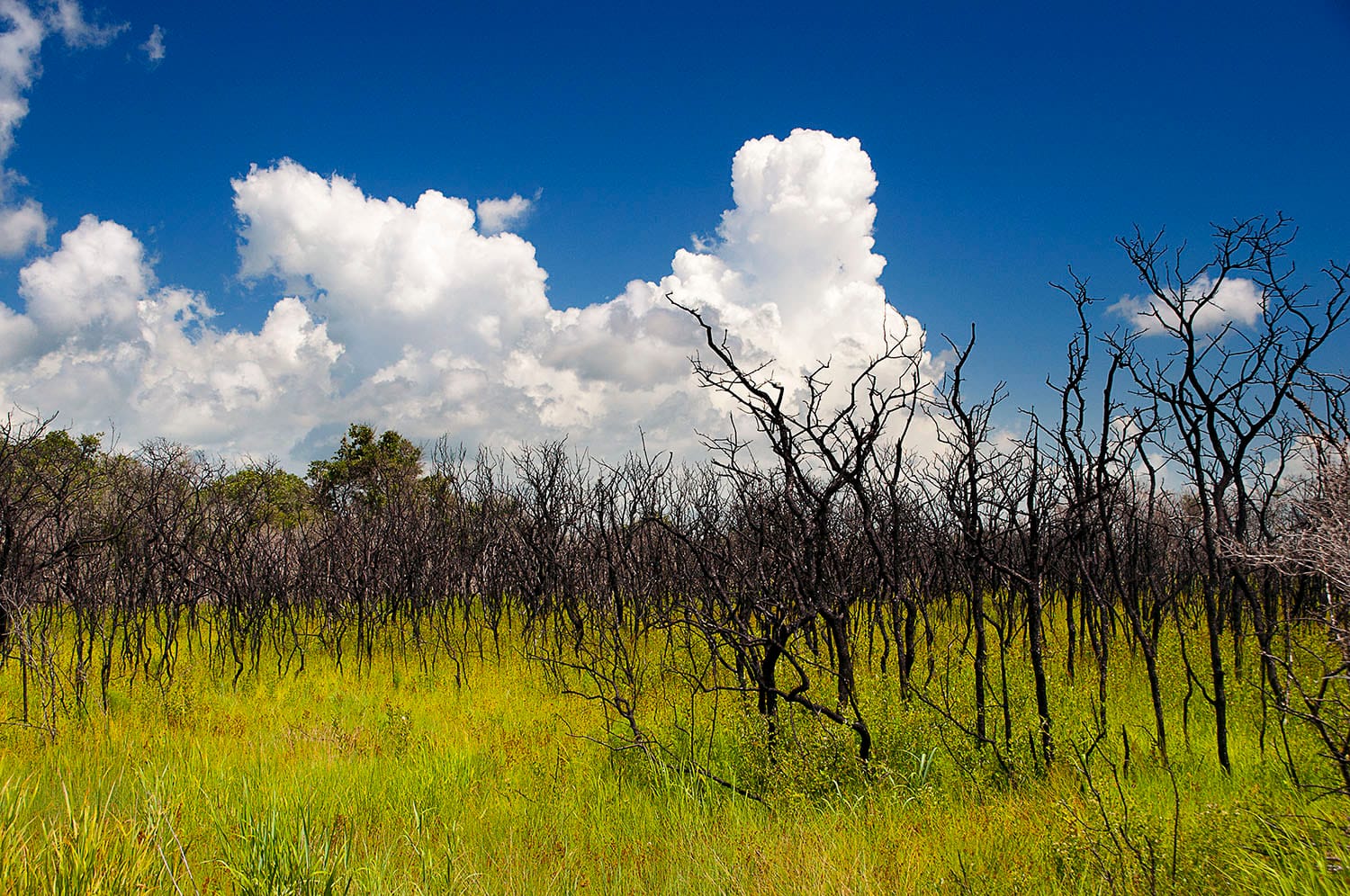
Most elected officials in the RGV say nothing about it. To understand why, just look to the metastasizing suburbs and strip malls in any of the Valley’s four counties, and the sapling oak trees and St. Augustine grass installed in them that so often die before construction is even finished.
Tamulipan thornscrub is just “brush;” brush is “undeveloped land;” mesquite, ebano, coyotillo, coma, and hackberry trees are all one amorphous entity, something to be removed; neighbors, los cocineros, Don Juan de la tienda, Southmost, el sur de la condados Hidalgo, Cameron, y Starr, are just “Mexicans;” Mexicans are “illegals,” “wetbacks,” “prietos;” and all of them must go.
How we describe these things matters. And obscurity—that is, erasing of living beings through generic or imprecise language—is a key tactic of developers. Obscurity is also a core tenant of the political and social culture of the business and political classes of the Rio Grande Valley and the United States at large. Obscurity is in the language elected officials and even some members of the community use as their neighbors disappear into the border deportation industrial complex, a system that is centered and perpetuated in the Rio Grande Valley’s detention centers and Harlingen’s airport, where the federal government regularly flies people out to countries to which they have no connection.
Kidnappings are “enforcement operations”; people are “encounters” or “aliens”; thousands of dollars, tests, and years of waiting just for the chance at citizenship is the “right way”; running for your life is “resisting”; harassment is “enforcing the law”; turning a steering wheel is “ramming” someone with a vehicle, a reason to empty a clip like its your first day at the gun range; exercising your rights to document these arrests becomes “interfering” with a federal investigation; and saying any of this is somehow, according to the most racist and colonized of the Rio Grande Valley’s residents on Facebook, “being a Democrat.”
This language intentionally hides the roots of the area, whether those of plants or people. It hides the multiple kinds of ongoing violence that came from the area’s first colonization. This “horrorculture,” I’ll call it, is the only prism that our governments, their sycophants and the misguided alike, use to resolve problems. People passively watch films fictionalizing maiming and death for entertainment and stimulation, and this is no different.
Desensitized, apathetic politicians and their constituents live in a reality that doesn’t recognize the humanity of people being taken from their communities. So it all becomes online fodder to dismiss or “debate,” a conditioning centuries in the making to ensure that anyone who speaks the truth of our condition is discredited. It is a conditioning so goddamned pervasive that it’s beyond a historic baseline. Because it seems like there has never been a time in the Valley’s written history where a majority of its people were not taught to hate themselves and the world around them.
But there’s another use to this kind of language. It obscures war and doctrine, to convince countless people to welcome their segregation from the area’s business and political elites while believing the opposite is happening. It also further dehumanizes the most vulnerable in our communities, where a friend, family member, neighbor, colleague can become an A-Number and never be seen again and, most importantly to those classes, no one ever says a fucking thing about them again.
Speaking of war, this is the full Hemingway quote, one that comes from “Notes on the Next War,” which was published in Esquire in 1935:
“They wrote in the old days that it is sweet and fitting to die for one's country. But in modern war there is nothing sweet nor fitting in your dying. You will die like a dog for no good reason.
“Hit in the head you will die quickly and cleanly even sweetly and fittingly except for the white blinding flash that never stops, unless perhaps it's only the frontal bone or your optic nerve that is smashed, or your jaw carried away, or your nose and cheek bones gone so you can still think but you have no face to talk with. But if you are not hit in the head you will be hit in the chest, and choke in it, or in the lower belly, and feel it all slip and slide loosely as you open, to spill out when you try to get up, it's not supposed to be so painful but they always scream with it, it's the idea I suppose, or have the flash, the jamming clang of high explosive on a hard road and find your legs are gone above the knee, or maybe just below the knee, or maybe just a foot gone and watch the white bone sticking through your puttee, or watch them take a boot off with your foot a mush inside it, or feel an arm flop and learn how a bone feels grating, or you will burn, choke and vomit, or be blown to hell a dozen ways, without sweetness or fittingness; but none of this means anything. No catalogue of horrors ever kept men from war. Before the war you always think that it's not you that dies.
"But you will die, brother, if you go to it long enough.
“The only way to combat the murder that is war is to show the dirty combinations that make it and the criminals and swine that hope for it and the idiotic way they run it when they get it so that an honest man will distrust it as he would a racket and refuse to be enslaved into it.”
I wrote last month (See: "Brownsville’s Saronic Autonomous War Plans Echo a Confederate’s Post-Civil War Profit-Seeking Killings") that I believed that elected officials in the Rio Grande Valley were afraid of death and wanted to live forever. They aspire to immortality in the way that many of those before them have done through securing their names on parks or proclamations or plaques, not in the way that many billionaires now aspire to literally live forever. Instead they look to something more localized, something to get praised for by backslapping peers while they’re at Sea Ranch on the island or whatever pseudo-haute cuisine is in downtown Brownsville now.
The consequences of that immortality drive are much graver now. Because to not see the connection between what ICE is doing to our neighbors, what SpaceX is doing to Boca Chica, what NextDecade is doing to the exterminated wetlands of Port Isabel, what Saronic will soon do to South Bay, and whatever else is being worked out and yet to be revealed in a circle jerking press conference by the area EDCs, is, as politely as I can state, arrogant. So much so that they don’t see that they, too, will die, having gone at it long enough.
Some elected officials in Texas may lose their seats over what ICE is doing to our neighbors. In Austin and elsewhere in the nation, local and congressional officials are trying to file criminal charges against the agency. At the very least, these officials are telling them that they are not welcome. But Valley officials aren’t doing that, at least not in the same way. They’re focused on, for example, property developers not having anybody to build the suburbs that, undoubtedly, will have non-native plants and streets that won’t drain for days after storms. They talk about how people from other countries will do these jobs but citizens won’t, which is true. But it took that labor going away, that potential profit now gone, for these people to be worth speaking for.
I watched a similar thing happen when I was reporting on COVID-19 in the Laguna Madre area, as editor for the Port Isabel-South Padre Press. Once local businesses started losing profits, because so many people couldn’t work, policies started changing: the restaurants reopened, the stores too. People around the Valley and from all over the state were going to the beaches and restaurants of South Padre Island in a revenge travel fervor. In 2020, this is what Memorial Day looked like.

Nobody was wearing masks or distancing, of course. It was the area’s working class, undocumented and documented alike, that had to expose themselves to these people in their roles as servers, bellhops, front desk clerks, and so on, creating a contagion that killed more people in the Valley than anywhere else in the state. Not coincidentally, the Island was the first place that COVID-19 was discovered in Cameron County. (COVID-19 is still very much a problem in South Texas, by the way.) If anyone is held accountable at all, it might solely be directed towards the area congressional leadership. But their role is just one factor in a large orientation, something I wrote about in the first installment of this newsletter. Whether local elected officials will feel this, and whether they can do anything at all, is something I explore in my reporting. I’m coming away from that in an emotional state that I haven’t found the right words to describe yet. A sensationless shellshock, maybe.
Perhaps this is why I and so many other people in the Valley are watching someone like Joey Santore correctly call out the self-hating horticulture/horrorculture of the Rio Grande Valley. Santore, who is originally from Chicago but now lives in the Valley, is a naturalist and the founder of the Thornscrub Sanctuary. His YouTube Channel, Crime Pays But Botany Doesn’t, has several videos on the landscaping sins of Texas and beyond. It’s an informative, and refreshing, approach in an area where people can’t seem to stop talking about restaurants and other forms of consumption. It’s also a nice confirmation that, on top of impotent politicians and infrastructure with no real purpose (but to the automobile industry), even the plants are immiserating us all.
Maybe it requires someone like Santore to show people that what we have is enough. Not in a volume sense, because we do need more native plants and more restored and healthy functional ecosystems. I mean in the celebration of the fact that these natural species still exist at all. I mean that our lives are better because these plants are there holding us in place. The mesquite is better because it is dark and harder than stone and it is right there, shading a world we all share below it.
Most people drive through South Texas and see nothing — scrubby brush, dry heat, thorns. I used to see it that way too. Then I met Joey Santore. Video: Corey Ames
The renowned writer Hemingway committed suicide at his home in Ketchum, Idaho, in 1963, a town that now has almost as many people as who live in coastal Laguna Vista, Texas, today. Before he permanently moved to the area, he had fished and hunted its rivers and forests. Only a few hundred people lived there at the time, even with its proximity to the Sun Valley ski haven, and it never seemed to change. It was not his hometown but it was the closest thing to it. Ketchum had the river and the trees and they were there and good still.
Hunter S. Thompson, of all people, pondered Hemingway’s return to Ketchum in an article with the now-defunct National Observer shortly after Hemingway died. I’ve never found it online, but you can find it in print in The Great Shark Hunt: The Gonzo Papers Vol. 1.
A 27-year-old Thompson wrote: “Ketchum was perhaps the only place in his world that had not changed radically since the good years. Europe had been completely transformed, Africa was in the process of drastic upheaval, and finally even Cuba blew up around him like a volcano. Castro’s educators taught the people that “Mr. [Heming]Way” had been exploiting them, and he was in no mood in his old age to live with any more hostility than was necessary.
“Only Ketchum seemed unchanged, and it was here that he decided to dig in. But there were changes here, too; Sun Valley was no longer a glittering, celebrity-filled winter retreat for the rich and famous, but just another good ski resort in a tough league…“Hemingway was not a political man. He did not care for movements but dealt in his fiction with the stresses and strains on individuals in a world that seemed far less complex, prior to World War II, than it has since. Roughly or wrongly, his taste ran to large and simple (but not easy) concepts–to blacks and whites, as it were, and he was not comfortable with the multitude of gray shadings that seem to be the wave of the future…
“Ketchum was Hemingway’s Big Two Hearted River, and he wrote his own epitaph in the story of the same name, just as Scott Fitzgerald had written his epitaph in a book called The Great Gatsby…
“Standing on a corner in the middle of Ketchum it is easy to see the connection Hemingway must have made between this place and those he had known in the good years. Aside from the brute beauty of the mountains, he must have recognized an atavistic distinctness in the people that piqued his sense of dramatic possibilities. It is a raw and peaceful little village, especially in the off season with neither winter skiers nor summer fisherman to dilute the image. Only the main street is paved; most of the others are no more than dirt and gravel tracks that seem at times to run right through front yards.
“From such a vantage point a man tends to feel it is not so difficult, after all, to see the world clear and as a whole. Like many another writer, Hemingway did his best work when he felt he was standing on something solid–like an Idaho mountainside, or a sense of conviction. “Perhaps he found what he came here for, but the odds are huge that he didn’t. He was an old, sick and very troubled man, and the illusion of peace and contentment was not enough for him–not even when his friends came up from Cuba and played bullfight with him in the Tram. So finally, and for what he must have thought the best of reasons, he ended it with a shotgun.”
Read in full here.
It sort of pains me to mention two of the most revered writers in the white literary machismo canon here, but Thompson’s point is well made. Things changing beyond your control can be disorienting and even fatal, particularly when it's geopolitical. Hemingway’s money and status prevented him from being unhoused and destitute, which is how most people would fare from the synonymous enterprises of war and gentrification. But it partly explains his mental decline and maybe even my own while I watch this acceleration towards death by the Rio Grande Valley’s leadership.
I have hope that learning about native plants and recognizing the power of your own memories are two small factors in existing past the dollar-sucking dumbness of Brownsville, Austin, and Washington, D.C. It’s what gives me reason to wake up in the morning when there’s no hope left, which I believe to be the case. There is only doing the right thing, which Santore and you all reading this and beyond are exercising.
Event

Video
In this podcast-style interview, Gaige Davila speaks with David Zamora, a home-care provider who he grew up with in Port Isabel, Texas. Due to rising rents, utilities, and a changing culture, Zamora has migrated to Brownsville in the Rio Grande Valley. Ironically, it's the city leaders of this city who have most helped facilitate the high prices in Port Isabel and the rest of the Laguna Madre area, making it increasingly unlivable. Follow Deceleration on YouTube.
Buy Gaige a Coffee

Buy Gaige a Coffee...or three!
If you enjoyed this newsletter, let the author know by hitting the tip jar.
Further Reading
- As Texas Destroys Its Wetlands, the Risk of Devastating Flooding Increases (Capital & Main)
- Corpus Christi Withholds Water to Wetlands While Lifting Restrictions on Lawns (Inside Climate News)
- Brownsville Commissioners Approve Disannexation of Future SpaceX Property (The Brownsville Herald)


