

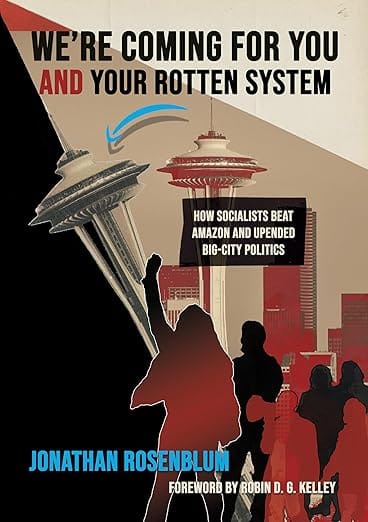
WE’RE COMING FOR YOU AND YOUR ROTTEN SYSTEM:
How Socialists Beat Amazon and Upended Big-City Politics
by Jonathan Rosenblum
OR Books (October 7, 2025)
As American city dwellers are assailed by masked federal agents while the Trump administration attends not at all to the actual crises of housing, food, and healthcare plaguing every single metropolis, along comes a steadying, even encouraging, new book— part movement history, part collective political memoir —that lifts up a fascinating, decade-long municipalist experiment in Seattle for scrutiny and study.
Originally articulated by social philosopher Murray Bookchin, municipalism is a people’s politics that seeks to undermine and erode the ruinous power of capitalist states by building an alternative to them, rather than attempting their overthrow. Almost 40 years ago, in a response to the neoliberal order quickly consolidating under Reaganomics, Bookchin published “Municipalization,” a quick and dirty essay proposing a new model for achieving community control of the economy. Instead of vainly waiting for a worker’s revolution unlikely to materialize, libertarian municipalism or communalism, he argued, offered a vehicle for peoples’ movements beyond the factory walls, one organized far away from establishment forces and at the level of the local.
Under municipalism, movements are self-governed by neighborhood assemblies that when confederated not only can win real gains, but also build dual power (creating “a new world in the shell of the old”) by showing what can be done but hasn’t been. The most essential pillar of municipalism is the practice of direct democracy, which Bookchin had espoused since co-founding the Institute of Social Ecology in 1974, believing that the urban neighborhood or rural town was where community self-management could best be activated.
People’s movements in Seattle have embraced the neighborhood assembly as a vehicle for directing their policy demands, strategies, and tactics, as have the Malcolm X Grassroots Movement and the New Afrikan People’s Organization 2,500 miles away. Directed by a people’s assembly and guided by a theory of liberatory change outlined in the Jackson-Kush Plan, the Black-majority state capital of Jackson, Mississippi in 2009 modeled a directly democratic municipalist alternative to a level of state domination no longer tolerable ecologically or morally. Another notable example of municipalist practice from rural communities would be the Carbondale Spring movement in Southern Illinois, whose food autonomy projects endure as a basis for ongoing community renewal.
Seattle’s municipalist experimentations have emerged most directly from the city’s deep wealth inequality. Home to ten Fortune 500 companies including Amazon, Boeing, Costco, Expedia, Microsoft, Nordstrom and Starbucks, whose glass towers and sprawling campuses cannibalized formerly working class neighborhoods, Seattle’s average monthly rent for a one-bedroom, 650 sq ft apartment is now $2,100.
In 2023, the top 20% of city households had average earnings of $439,000, while the bottom 20% of households earned just $21,000. And when counted last year, Seattle’s King County had 16,868 unhoused people (itself likely to be an undercount). For those still able to pursue home ownership, the median sale price is $880,000, almost three times the current median price in San Antonio, for instance, and double the price of homes in Seattle in 2013, the year organizers decided that something had to give.
In October 2014, urban theorist Mike Davis, another proponent of municipalist power, might’ve been egging them on when he wrote in a Jacobin essay provocatively titled “B-52 Bomber Radicalism:”
Let’s be blunt: unregulated real-estate speculation and land inflation and deflation undermine any hope of a democratic urbanism. Land-use reforms in themselves are powerless to stop gentrification without more municipal ownership or at least “demarketization” of urban land.
The hypothesis of an organization called Socialist Alternative was that the city itself is a site for class struggle—and that a determined cadre of workers could build a movement to wrest power away from the ruling class. This movement would be bold enough to use all available leverage to extract concessions, and steadfast enough to go the distance to deliver real material relief to the city’s bottom 73,000 households. And to serve as a counter-power, a people’s power, to the militarized power of the nation-state and the corporate interests it has tended to serve.
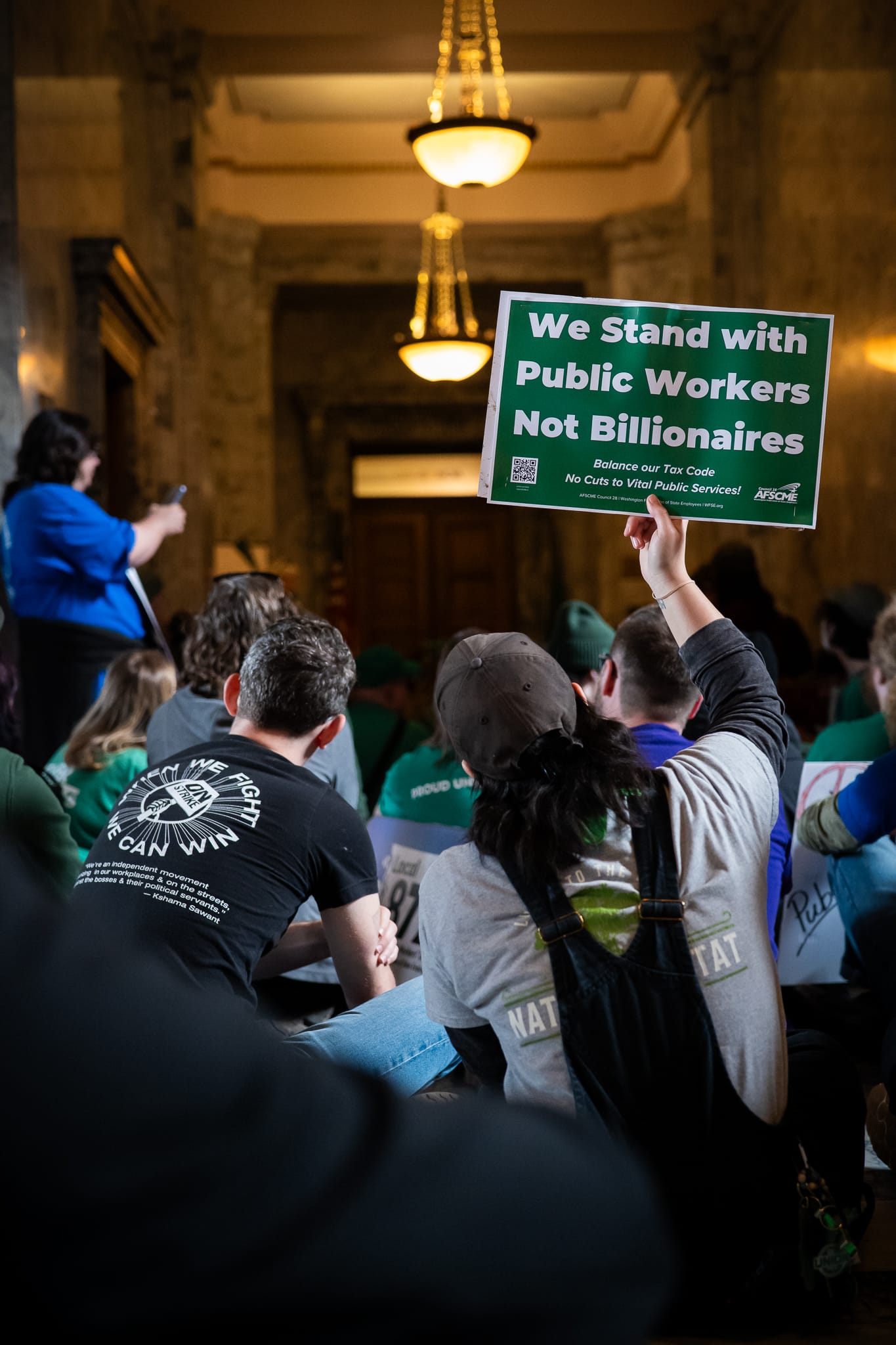
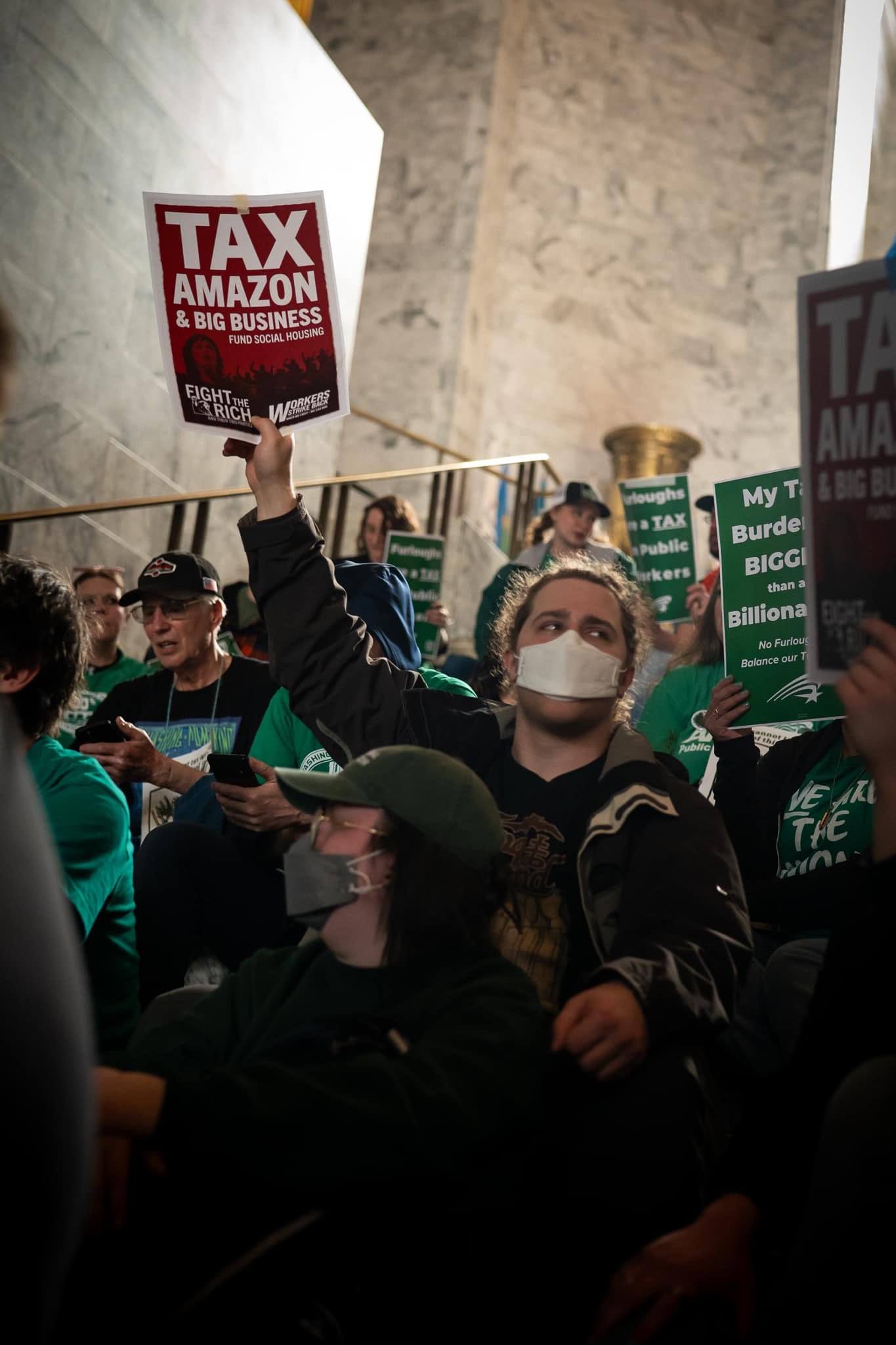
They’d agitate for wage increases, renter’s rights protections, and increased corporate taxes. Having lived through the bank and auto bailouts in 2008 and 2009, and having learned a thing or two about the 1% from Occupy in 2011, Socialist Alternative organizers were going to bring to a close the long, sad era of working people settling for crumbs and Band-Aids. The working people of Seattle’s most disinvested communities would need to exercise political power differently now that economic conditions were so dire.
Uncomfortable as it was to do, they’d distinguish their tone from the polite community advocates and professional lobbyists the city council was accustomed to dealing with—and modulate as needed. When the going got heated, rough, or just plain crazy, they’d get grounded in early 20th-century European socialist history, leaning particularly on the revolutionary polemics of Rosa Luxemburg, who reminded them that reformism and accommodating one’s class enemies never ever got the goods.
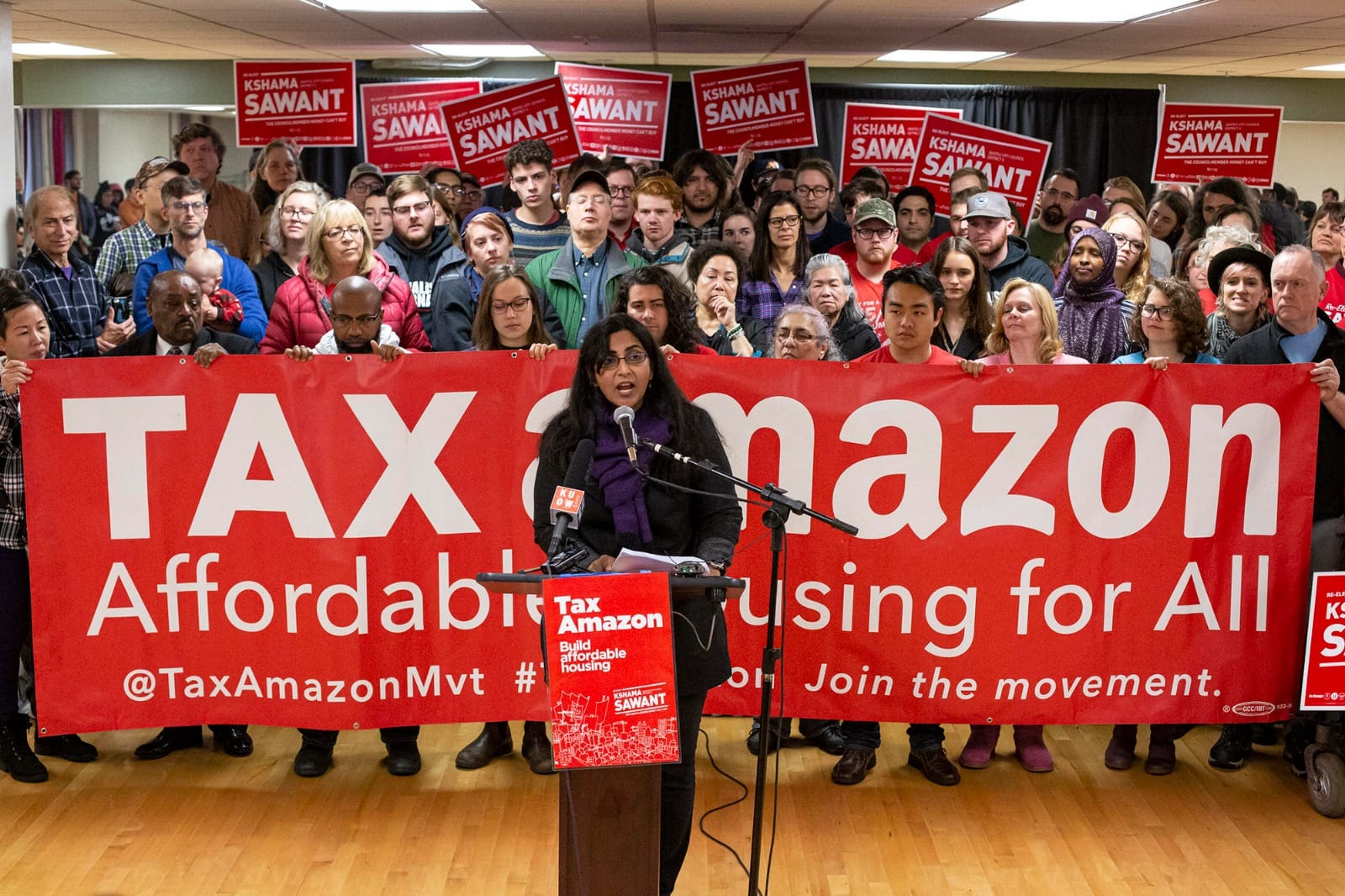
Weighing in at 364 riveting pages, Jonathan Rosenblum’s “We’re Coming for You And Your Rotten System: How Socialists Beat Amazon and Upended Big-City Politics” brings to vivacious life, via eye-witness vignettes and a union organizer’s canny analysis, just how the workers movement he’d had a hand in expanding from 2013 to 2024 was so relentlessly successful in breaking the stranglehold of neoliberal governance at the local level. The book also tracks Socialist Alternative candidate Kshama Sawant’s unexpected city council wins, including her first upset, and later a recall vote.
An Indian-American political economist and former software engineer, Sawant, now 53, ran against well-financed opponents who aggressively tried to neutralize her [editor’s note: in San Antonio this lobby is known as “the 17 white men who run the City,” as coined by former councilwoman María Antonietta Berriozábal]. It’s impossible not to delight in the many (sometimes wacky) ways she and Socialist Alternative kept outmaneuvering their opponents—like the time they collected signatures to get a rival candidate on the ballot by a certain date, all so they could definitively beat him.
In his foreword, historian Robin D. G. Kelley writes of the mutual trust between Socialist Alternative and Sawant, and the solidarity and even identification that was engendered over many years:
[Sawant] trusted the people and earned their trust by recasting her role as ‘the shop steward of Seattle’s working class.’ Where and when she entered, the people followed. They took over city hall, flooded meetings, held rallies, and challenged the status quo in the open, not behind closed doors.
Echoing some of municipalism’s emphasis on direct democracy, Sawant has said publicly that she wanted to function more like a union delegate accountable to her people’s assembly than a representative on her own.
In 2014, political scientists Martin Gilens and Benjamin I. Page sounded representative democracy’s death knell, when they found that only the richest 10 percent of Americans had any influence on lawmakers. They wrote:
“The central point that emerges from our research is that economic elites and organized groups representing business interests have substantial independent impacts on U.S. government policy, while mass-based interest groups and average citizens have little or no independent influence.”
As for the titular rottenness of the system, Rosenblum doesn’t name this specifically. But the U.S. Supreme Court’s “Citizens United v. Federal Election Commission” decision, which overturned restrictions on corporate donations to political campaigns, is important context. This ruling came only two years after capitalism’s 2008 meltdown, in which nearly 9 million people lost their jobs and at least 10 million lost their homes. Within four years, the number of US residents living in poverty swelled by nearly 10 million, from 36.7 million in 2007 to 46.2 million in 2010.
In Rosenblum’s telling, Socialist Alternative saw the local establishment’s refusal to make policy to better Seattleites’ material circumstances in the aftermath of a capitalist crisis not of their making as both an opportunity and an imperative. In a rare moment for the book where Rosenblum speaks about himself, he shares that the first time he heard Sawant’s sharp rhetoric, he recoiled. But the SeaTac Airport workers he was organizing with on their Fight for $15 campaign were drawn to her.
“Sawant’s lashing assault on corporate greed had stirred their passions and provided a level of moral clarity that had been absent from our polished talking points,” he wrote.
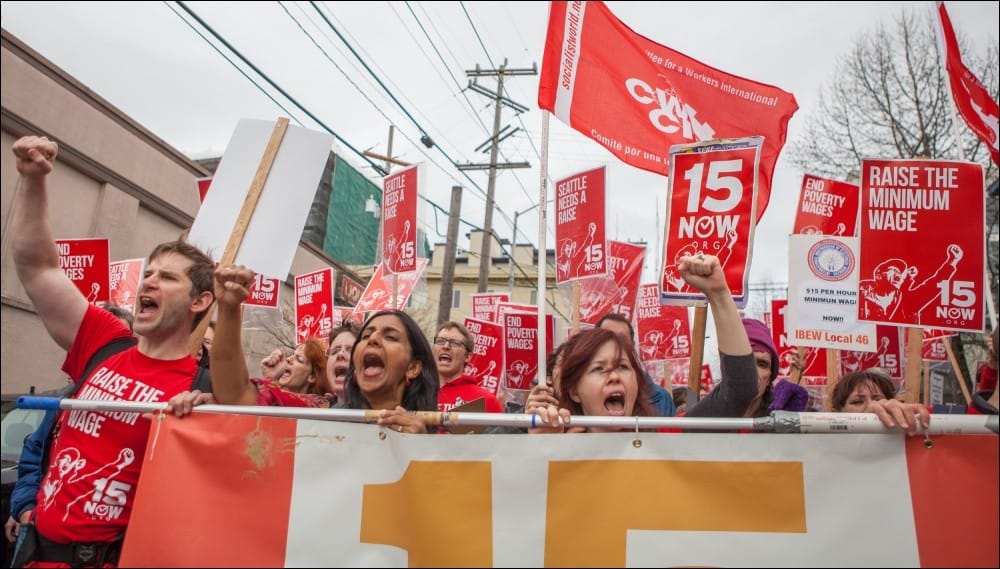
Written for a general audience rather than just for organizers, We’re Coming For You is a narrative page-turner populated with heroes and villains, gut-wrenching setbacks and almost unimaginably tangible triumphs. Whereas the federal government hasn’t raised the miserly $7.25 federal minimum hourly wage since 2009, Sawant’s first year in office saw Seattle becoming the first city to raise it to $15, with scheduled hikes that have pushed it up further to $20.76.
Likewise, the federal corporate tax rate was reduced in 2017 and again on July 4, 2025, shrinking the funding available for social services nationally. But Socialist Alternative pushed the city to find more revenue. Dubbed “the Amazon tax,” in 2020 the council levied a payroll tax on the top 3% of corporations doing business in Seattle. In place until 2040, this tax already has garnered $315 million in 2023 and $360 million in 2024, which the city used to build social housing and fund weatherization. Seattle’s City Council also passed bans on rubber bullets and police use of chemical agents like tear gas and pepper spray. True to the tenets of municipalism, the city enacted what the state and federal government would not.
Rosenblum has a genuine talent for condensing events to their historical essences, summarizing pitched contests, and explaining political stakes in human terms. At times We’re Coming For You reads like a military history because the battles are intricate, recurring, and fierce. Over 10 chapters, we see residents evolve into confident class warriors who will not accept “no” from their city when their demands are for basic human necessities the “free market” won’t provide.
For any city facing the same old rehash of billionaire-driven trickle down “economic development” plans—even as state and federal governments increasingly slash their social safety nets—Rosenblum’s movement history is a must read. Our social movements simply do not have enough of these intimate, longitudinal histories—effectively a how-to guide for municipalist thought and practice—especially one so lovingly observed and finely wrought in perpetually energizing prose.


