I’m writing you from Phoenix, Arizona, but much of what comes below was written in Port Isabel, Texas, and Tokyo, Japan. A decade ago I would’ve never assumed a link between the two latter cities would develop. But when I was walking through the wetlands surrounding the edges of Brownsville and Port Isabel a few weeks ago, I wasn’t thinking of Rio Grande LNG metastasizing by the day. Nor was I thinking of Brownsville’s wedded political and business leaders.
I wasn’t even thinking about the lobbyists paid to convince these decisionmakers that they were getting the deal of the century with LNG plants and their networks of pipelines and piers. I was thinking of skyscrapers in Maranouchi, Tokyo, and the people inside them, who spent every day ensuring a parade of mega tankers filled with liquified natural gas (LNG) would depart South Texas in the next few years.
Then I thought of what else was to come, what is working in the background only the Brownsville economic development corporations know, the projects they hope to attach their names to forever in a history already constructed in their image. Then I thought about what was already here. NextDecade, the Houston-based parent company of Rio Grande LNG, is required to start operating next year. In line with every other LNG facility in the gulf coast, they’re already trying to expand their project, despite not having produced anything yet. Texas LNG, owned by Houston-based Glenfarne and right next to the Rio Grande LNG project, is hoping to get the financing for its facility this year. SpaceX is trying to annex over 7,000 acres into Starbase, Texas.
Speaking of which, on March 4, the Texas Supreme Court held a public hearing in Edinburg on Save RGV et. al v. Texas General Land Office et. al, a lawsuit alleging that the state, at SpaceX's behest, is violating the Texas Open Beaches Act. This is the longest ongoing lawsuit against SpaceX in the Rio Grande Valley, first filed in 2022. The reason behind the lawsuit began when Brownsville legislator Rene Oliveira drafted a state bill in 2013 that allowed rocket testing to usurp the state Constitution’s guarantee of “free and unrestricted right” for Texans to enjoy the beach.
Oliveira wrote his bill to attract SpaceX, which was already lobbying the state and Cameron County, to cut a significant legal barrier to the company’s launch pad development. The bill passed with an additional gift to SpaceX: a clause stripping people of the right to litigate any potential damages to their homes, health or property from the launches. It is one of the most brazen acts of corporate capture at the coast to happen in my lifetime.

Oliviera died a few years ago, as did Carlos Cascos, the Cameron County Judge who signed off on the company’s tax abatement with the county. Before he died, I was supposed to visit Cascos in his downtown Brownsville office.
He had criticized SpaceX not paying out invoices in an article for Reuters. I wanted to speak with him again to understand the evolution of this thinking. No Valley elected official, current or former, ever criticizes SpaceX publicly. But I never made it to that meeting: Texas Public Radio laid me off; then I tore a tendon in my knee for the third time in as many years of jiu-jitsu. While recovering from the latter, I opened my emails that late June 2024 day and read that he had died the night before. That’s when I remembered I had an unanswered text from him telling me to let him know when I was free. Oliveira died the same year.
The regional flavor is shifting fast, melting into a sort of "super collider" of apocalyptic fever dreams (LNG's climate collapse meets the Terminator's soul-less robot warriors). Worse: This is all happening, as Syris reminds in Alternative Futures this week, when what the world needs most is steady stream of billion-dollar investments geared toward healing—instead of evacuating, a la SpaceX—the planet.
I often wonder what Cascos or Oliveira would think of SpaceX’s expansion now, the company’s impunity now undeniable. It’s clear that SpaceX intends to expand its site however far into Boca Chica Beach they want, along with how often they launch. I haven’t been to that beach for almost a year, even though I’ve visited a couple of times since moving to Arizona for graduate school. Truthfully I don’t want to see it, even if it’s my responsibility to do so. Thankfully others continue to bear witness, such as those attending a concert out there that South Texas Environmental Justice Network hosted this month.
At the public hearing on beach access, more locals attended than they could have if the hearing was in Austin. The state dismissed this lawsuit once before, but it was successfully appealed a few years ago, which is why it’s being heard at the state supreme court. The court will likely issue a decision in June. I’ll be speaking soon with Save RGV’s attorney, Marisa Perales, for a podcast with Deceleration about the case and how the legal system defers to economic development.
— Gaige Davila

Port of Brownsville’s Billion-Dollar ‘Pyramids’ Forcing Locals into a Bad Terminator Prequel
The Austin-based war machinery company Saronic is eyeing the Port of Brownsville for its “Port Alpha” project to develop an autonomous “fleet of the future” (see the Navy contract here). It’s another billions-of-dollars project in an area that just can’t seem to stop getting them.
Brownsville officials, of course, love the attention, while many residents near the growing SpaceX shadow are feeling the “Terminator Skynet vibes.”
Local elected officials wouldn’t name the company when asked by the Rio Grand Guardian because of the NDAs they have with Saronic, but some are using the phrase “game changer” to describe Port Alpha. It seems the growth coalitions of the Rio Grande Valley are living in their own reality, one where benefits are assumed to follow each billion-dollar enterprise…But the rest of us aren’t sure how exactly.
They always mention the jobs that’ll come, as if every person who is without one in the Valley has idle–but skilled–hands, ready to construct the next pyramid for the Port’s vision of “progress." No explanation is given as to what these corporations are providing the Valley outside of “jobs,” “economic development,” “growth,” and a litany of other terms that are both the question and answer for developing these things.
Cameron County will have a public hearing on whether to grant Saronic a tax abatement next week. I don’t deny that these companies help people living here make money that wasn't possible before. I have friends that are employed by some of them. But when you look at Census data, nothing has fundamentally changed about the area’s socioeconomics in the last decade.
Hospitals and clinics, school districts, and retail are still where most of the people in the Brownsville-Harlingen metro work. The wage growth in Cameron County is from the six-figure jobs in industries like aerospace and construction. But the rest of the industries, where the majority of people who live in the county work, did not see wages increase. In other words, high-wage jobs in certain industries, which are being paid to both people who have moved here and are from here, are inflating the average. The new wealth is not spreading, and the legacy industries of the area are hardly adjusting for inflation or rising costs generally, if at all.
Construction and science jobs are higher than they were a decade ago, most likely from SpaceX and the Rio Grande LNG project, and that’s about where new jobs in the area end. This isn’t news to anyone there, of course. Even Cameron County had to account for the area getting more expensive, giving a cost-of-living adjustment to its employees for the third year in a row.
Those new high-paying jobs in those sectors are likely why Cameron County’s poverty rate decreased by 10 percentage points since 2014. But 25% is still double the national average, despite SpaceX and NextDecade being here now. Local elected leaders exempted both from county property taxes—money that would go to schools and county services and truly be invested in the community.
Property values in the Brownsville area are also rising, which is translating to higher rents, effectively cancelling out these wage increases for locals. From 2014 to 2024, the median property value went up 76%. The average rent in Brownsville is now the same or more than San Antonio, according to Zillow. Having lived in both cities, the thought of paying San Antonio rents in Brownsville, without any of SA’s qualities but all of its burdens, is asinine. But those rent prices mean nothing to the people who are moving from elsewhere to work at SpaceX, Rio Grande LNG, or any of the other industry projects coming to the Rio Grande Valley. Compared to California, Colorado, or Florida, South Texas housing is still a steal. But for the 10,000 Cameron County households who are paying half their salaries on housing, it’s theft of another sort. Texas LNG once again didn’t get a tax abatement from the Point Isabel ISD, my alma mater. The school board, some of the members of which had denied the company its first tax abatement attempt years ago, unanimously denied the state abatement program, which would have allowed the company to forgo $160 million in taxes to the district over 10 years. A Texas LNG spokesperson said in a statement to local media that the ISD didn’t understand the rationale of the decision because the district would’ve gotten, allegedly, $15 million a year from the agreement. The district didn’t think the supposed $15Mx10 was worth forgoing $160M.
“Our responsibility is to ensure that every decision we make reflects the long term financial stability of the district,” Heather Scott, PI-ISD’s school board president said in a statement. “After thorough evaluation, the Board concluded that this proposed agreement did not sufficiently align with those priorities.” Two weeks ago, I was in the land where Texas LNG is supposed to set up their scaled version of its neighbor Rio Grande LNG. There’s a small pull-off on Highway 48, just as the road lifts before curving towards Port Isabel, that used to be a picnic area before the road became the traffic artery it is now. I was taking photos of how large the under-construction Rio Grande LNG facility, which seems to spread much beyond what anyone thought it would. I went to all of the boat ramps and walked along the edges of Highway 48 closer to Brownsville. There was construction litter everywhere: paper purchase orders, plastic wrap, plywood, and shipping materials. It didn’t come from the few people fishing there.
Highway 48 itself is pockmarked with potholes, more so than usual. Similar happened years ago when SpaceX was just beginning its own malignant stretch toward Boca Chica Beach. Rio Grande LNG is only different in that its making its growth a central part of its narrative, despite not having finished its first of 6 “trains,” the machinery that liquifies the gas they’ll receive from Central Texas’ pipeline network before shipping the product to sea. That pipeline is also starting to carve across the landscape to the east side of Highway 48, running from the plant to just before Port of Brownsville’s shrimp basin. That pipeline continues into the ranches and farms in the most rural areas of Brownsville, where Bechtel is storing equipment and pipeline segments.
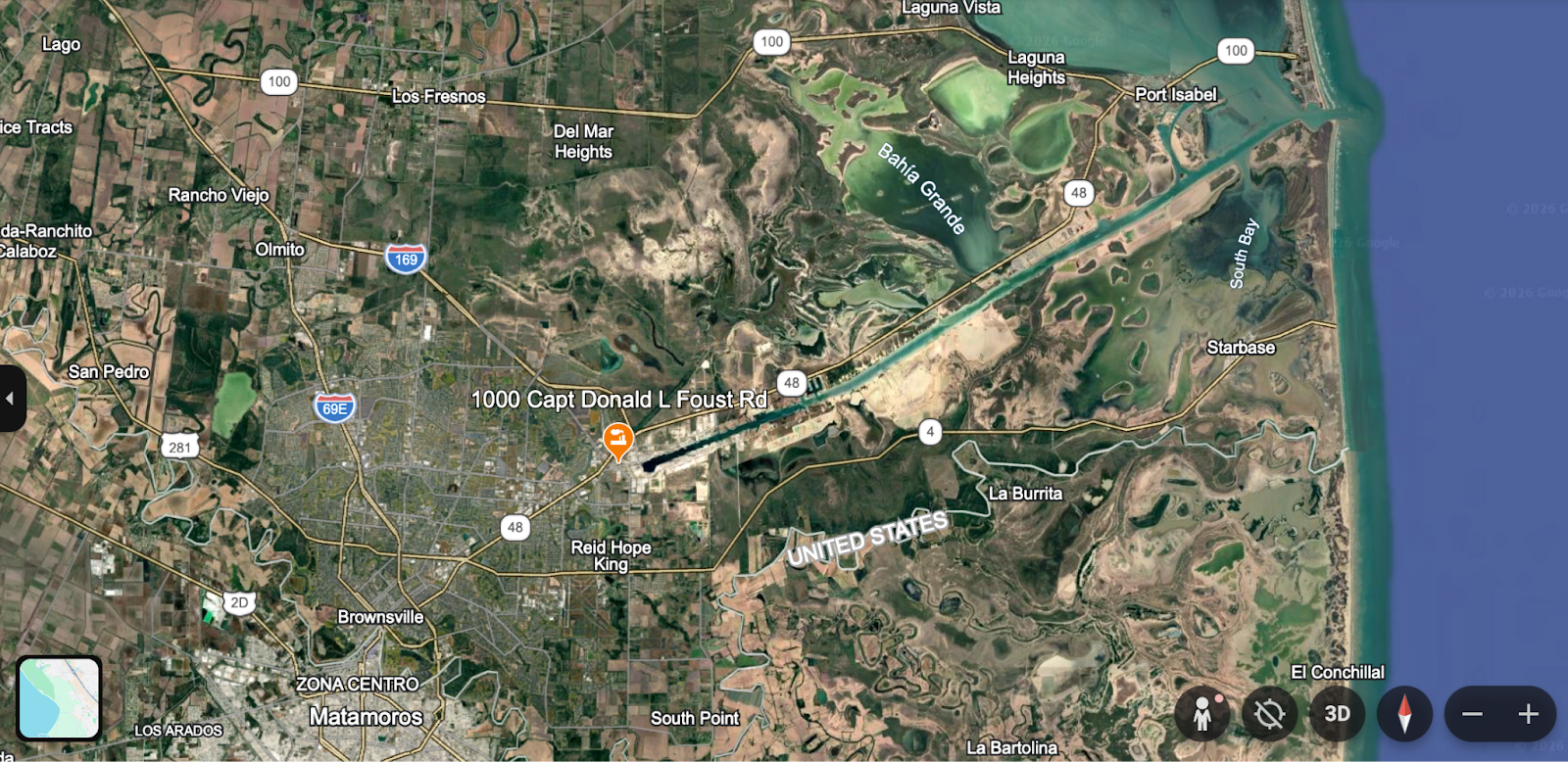
The all-consuming image that the pipeline and plant conjure is fitting for an area that has now staked most of its future on this project. The Port of Brownsville used NextDecade, the parent company of the Rio Grande LNG project, to make the Brownsville ship channel deeper and wider for larger ships and the international commerce they bring. Steve Guerra, the Port of Brownsville chair, wants the rest of the county to look that way, too, as he vies for Cameron County Judge. He’ll be going to runoff with incumbent Eddie Trevino Jr., who has been just as instrumental for this industrial remaking of the port, in the same way a coin can pay no matter what side it's facing. Whoever of the two is elected will change only the speed of the port’s current direction but nothing else: one fast (Trevino) and one faster (Guerra).
Once I reached the old picnic area off 48, I saw someone had cut the barbed wire fence that leads into the wetlands. It looked like it was done years ago, maybe when people started watching SpaceX launches from the side of this road. I crossed past this rusted splintered boundary line attempting to segregate the state property from the port and walked onto land wild, first down the loma split by the construction of Highway 48’s expansion and onto the dry basin that was once traversed for the fresh water wells deep below. And dry it is, layered in dust from the nearby imposition of metal and gasoline and unmet deadlines. Acres of brown sea oats and saltgrass move in waves. It reeks of bobcat piss and the gulf waters.
Had there not been cars speeding just a few hundred yards away I’d have thought I was in the time before land like this needed defending. The end of our wild spaces. If the Texas LNG project succeeds, it will all be gone. Its wild return, if it were to ever, will not be in our lifetime. Nor, perhaps, anyone’s.
Video
What is Coastlines/Faultlines. Deceleration's Greg Harman and Gaige Davila discuss the roots and vision of the newsletter. Follow Deceleration on YouTube.
Events
 Deceleration Staff
August 31, 2026, is the public comment deadline for a land swap deal between the U.S. Fish and Wildlife Service and SpaceX. Public comments are open until March 31, 2026.

Further Reading
- Diane Wilson Takes on Another Plastics Plant in Texas (Inside Climate News)
- Green Light To Pollute In Texas (Bullard Center)
- 'Time is Up': Corpus Christi Careening Toward a Water-Shortage Catastrophe (Inside Climate News)
- Governor blasts Corpus Christi leaders over looming water shortage, threatens a state takeover (Texas Tribune)
- Corpus Christi’s water woes will be center stage at City Council meeting (Texas Tribune)
- Clearcutting the Borderlands Threatens Native Rio Grande Habitat (Inside Climate News)