

Hello!
Whenever I take a long walk around my city, Seattle, I feel like I always find one of three things: a new building going up in a lot cleared of an old one, an old building mid-demolition, or an empty lot in the middle of a neighborhood that clearly once held a home.
It’s made me constantly wonder what happens to the materials that made up that now-dismantled building and what was lost to clear the way for the sparkling new structure.
Those questions led me toward the world of deconstruction, where buildings are un-seamed and as many materials as possible saved. And when I first reported on the policies that enable this, I expected a fairly straightforward story, until I learned that some organizations have found a way to pair the practice with historic preservation.
That’s the story I’ve prepared for you all today.
Enjoy!
— Syris Valentine

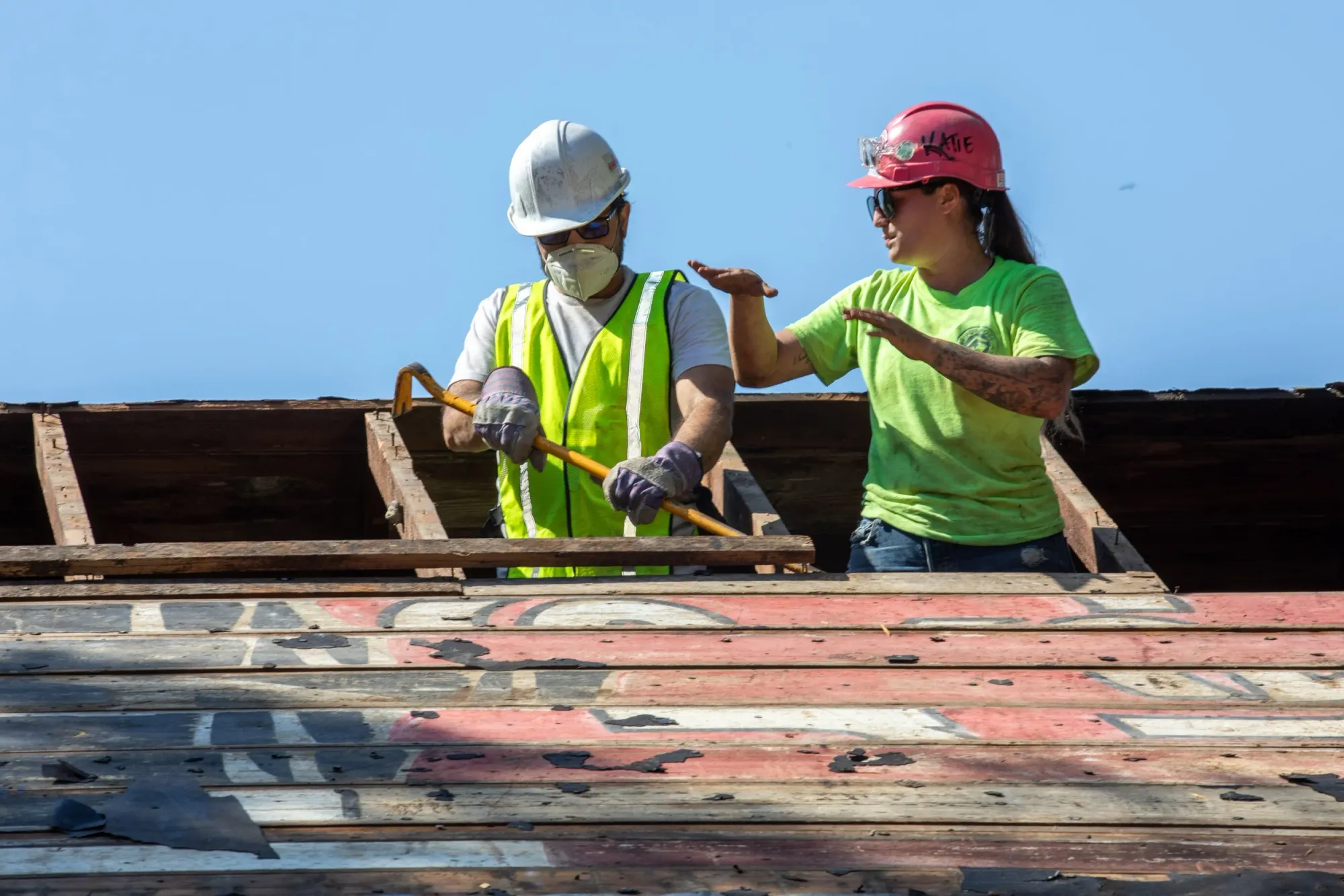
Deconstructing buildings keeps histories alive while salvaging building supplies
Syris Valentine | Deceleration
Hundreds of thousands of buildings are demolished every year in the United States, many of these nearly a century old. When the last board and nail are removed, destined for the landfill, the stories that the home once held—the plates passed from hand to hand during a Sunday barbeque, the lines notched up a wall as record of a growth spurt, the midnight whispers swapped between children rebelling against bedtime—all of those are erased forever, never to be reclaimed.
“We're not just throwing away our buildings, we're throwing away all that history,” said Mae Bowley.
Bowley is a preservationist at heart. She even got a certificate in historic preservation from Savannah Technical College in Georgia. And after she had her Come-to-Climate moment, she saw an opportunity to pair her love for preservation with the work of addressing a huge environmental challenge: construction and demolition waste.
Americans toss out a lot of trash: 292 million tons worth in 2018 alone, according to the Environmental Protection Agency. But the construction and demolition industry is a beast all its own. In 2018, the EPA estimates that the industry produced some 600 million tons of debris. Most of that comes from tearing structures down. “So it becomes urgent that we get creative” about how we take buildings down, Bowley said.
Folks like Bowley represent a growing assortment of nonprofits and city agencies working to make sure that even if a building is lost, its stories are saved.
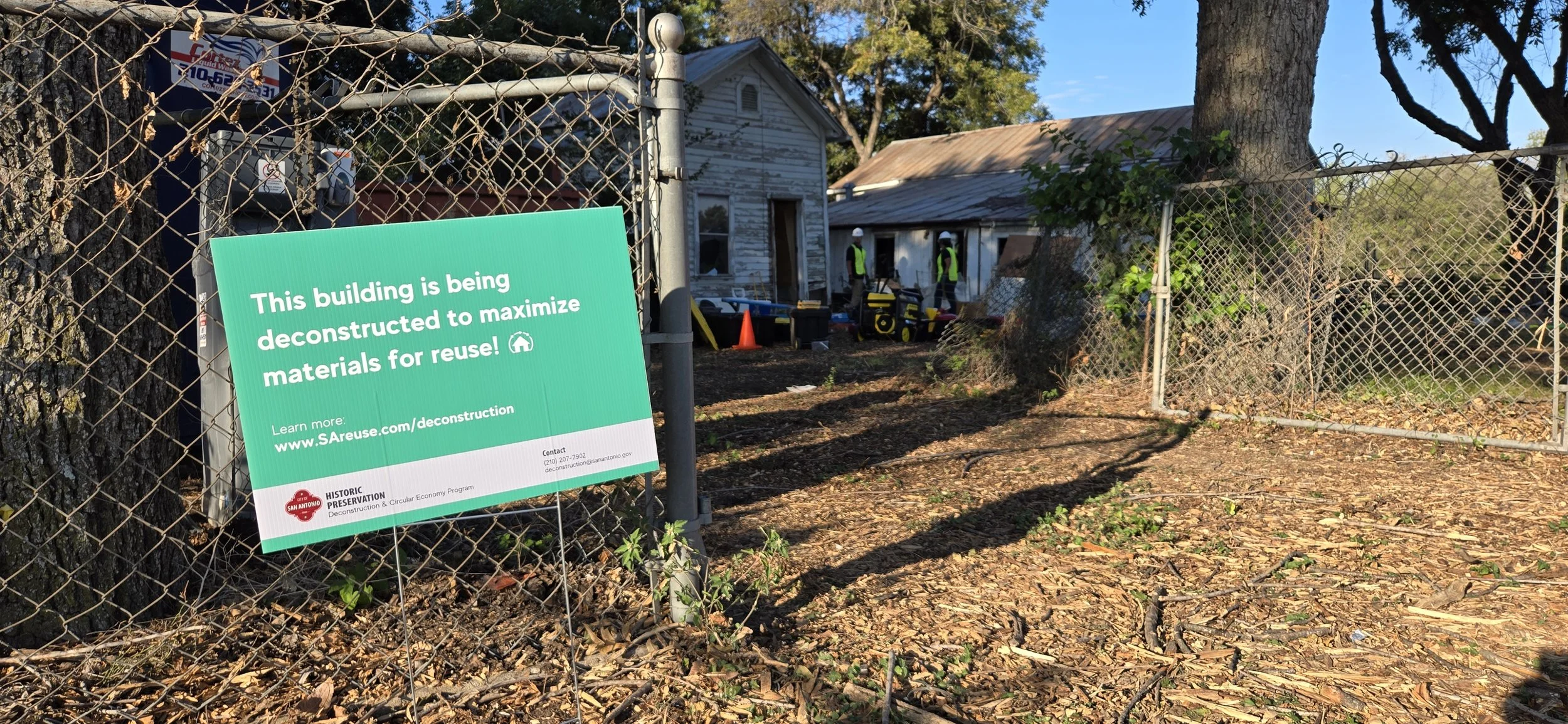
Her creative solution was to help grow Re:Purpose Savannah, a nonprofit in Georgia dedicated to deconstruction, the practice of taking apart buildings at their seams instead of breaking them to bits. While Re:Purpose Savannah is far from the first organization to focus on deconstruction, Bowley helped them bring a unique lens to it that makes an effort to salvage not just the materials from the buildings, but their stories as well. This is something of particular importance to Savannah, the oldest city in Georgia and a unique example of early-American urban planning.
As a result, Re:Purpose Savannah focuses most of its attention on taking down older buildings that, though not legally protected, have age and character enough for their owners and neighbors to see them as historic. These buildings are not only made of higher quality and more durable materials than what’s on the market today, Bowley said, “but they also mean a lot for our communities. They're connected to our histories.”
“We're looking to marry the ideals of historic preservation research and documentation with the practice of structural removal,” Bowley said of Re:Purpose Savannah:
“When a building's going to go away, how is that an opportunity to document that building? How is it an opportunity to research its history, to share all of that with our community, to contribute that to local municipal archives, and to attach all of that to the materials so that when they go back out into the world, that meaning is multiplied instead of erased?”
Bowley has since moved on from Re:Purpose Savannah, but during her five years as executive director she and her team conducted that research by looking through deeds, tax records, building plans, permits, family photos, newspaper clippings, historic maps, oral histories, and whatever other materials they could get their hands on related to the history of the building itself and the parcel it sits on. This documentation allows them to chronicle the histories of each project they undertake and document them in detail on their website. They then seek to connect each board and beam they remove back to those histories.
“We make sure that we know where every stick of lumber at our lumberyard came from,” said Bowley. It took them a while to figure the best way to do this with the tons upon literal tons of wood that they salvage and sell. They looked into all sorts of technical solutions. “But at the end of the day, we realized that the easiest way was to write on the end of every single piece of wood with a sharpie,” Bowley said.
They give each project a simple two-letter code (such as T.M. for their Texas Manor project), label the lumber as they take it out of the project, then when they sell a plank, they look it up as though it were a barcode and give the customer a URL to the history of the building along with their receipt. “It’s an inextricable part of the sales process,” she added, “or, as we say, re-homing process.”
Re:Purpose Savannah’s sales team doesn’t just wait to get to the cash register to tell these stories, though. “You can’t not hear about the history of the materials when you’re walking through our facility,” said Bowley. The people who sell products are often the exact same ones who pry the planks out, and they’re the same ones who supported the research. So it’s natural for them to talk about it. “It brings a lot of joy to the process of selling this stuff,” she said.
They’re as often selling the stories as they are the supplies, often without realizing it. Sometimes customers will come in with a specific shopping list in mind, but the tour they’re taken on through the lumber yard causes them to buy something completely different because they fall in love with the story of the property from whence the wood came. It becomes something they can remark upon, telling the stories of the now-dismantled building again and again, ensuring that its memory lives on.
For instance, when a guest walks into Wright Square Bistro in downtown Savannah, they’ll see a dining room filled with gorgeous tables of lacquered wood. Each tabletop is made from boards that came from Mama Lizzie’s House, a quaint brick home framed in wood located on land owned by the same Black family since 1882. The bistro’s owners were apparently so enamored by the story of Mama Lizzie’s House, “they printed the history and framed it in the restaurant,” Bowley said. “So now all the customers that come through can learn about the history of the table that they're eating at.”
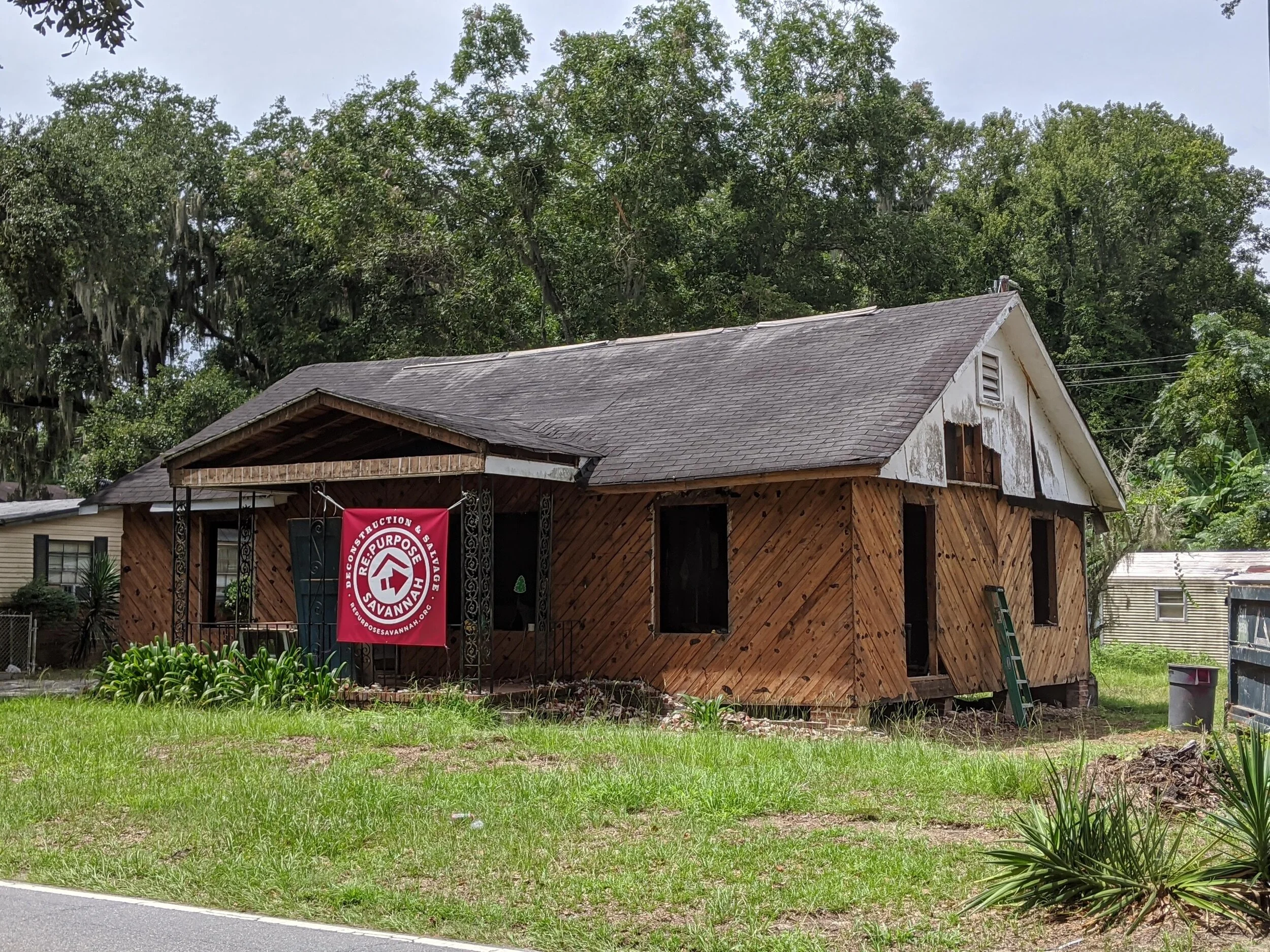
Re:Purpose Savannah’s success has helped to inspire and inform similar efforts elsewhere. In 2022, for instance, the City of San Antonio followed the lead of Portland, Oregon, and adopted a deconstruction ordinance to ensure historic buildings are deconstructed, not demolished, and the city hired Re:Purpose to train the city’s workforce.
Ahead of each deconstruction, San Antonio’s Office of Historic Preservation does archival research on the property to document the stories attached. They also require contractors to take photos throughout the process to document all they uncover in the dismantling. “Every single building that’s deconstructed is its own little treasure trove,” said Stephanie Phillips, the City of San Antonio’s deconstruction program manager.
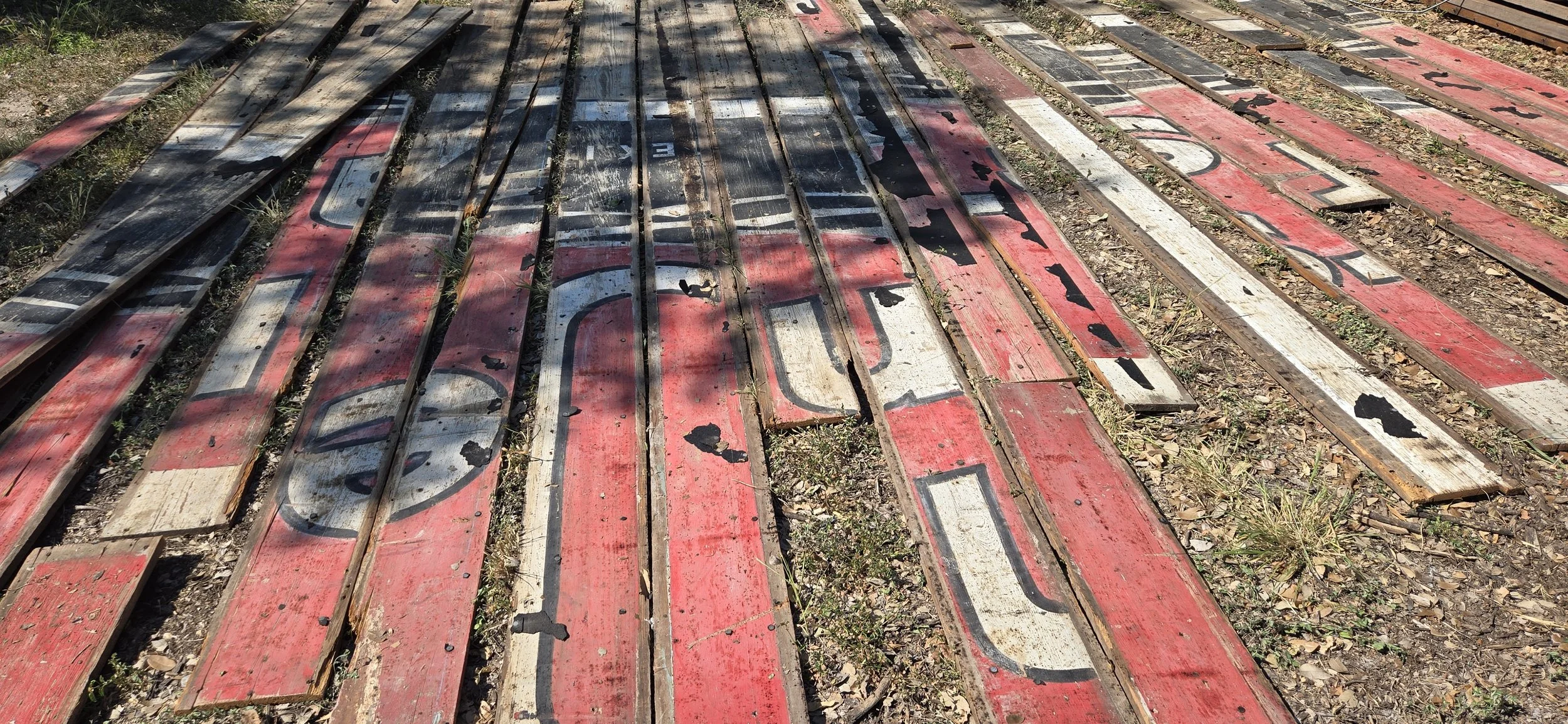
One building dated to the 1870s was deconstructed as part of a training led by Re:Purpose Savannah for contractors in San Antonio. Crews there removed the metal roof only to find an additional layer of sheathing beneath that was made out of planks that had clearly once belonged to a billboard. “EXIT NOW,” read the only portion of the billboard the crew managed to puzzle together.
Phillips has found that a lot of preservationists are hesitant to talk about deconstruction. “There’s this perception that if you talk about buildings being removed, it speaks it into existence,” she said.
But not all buildings can be saved, most often because decades of deferred maintenance have pushed the structure beyond even the possibility of rehabilitation, which is a preservationist’s preferred course of action. Confronting this reality and the need to align preservation with climate action and workforce development programs has led Phillips to become an advocate for deconstruction, when and where it’s appropriate.
Not only is it better than demolition for any number of reasons, but because she feels that her preservationist peers are well suited to steer deconstruction policies.
“We know how buildings weather,” she said. “We know how to date buildings. We know how to fix them.” And in the last few years, she’s seen her colleagues become more open to the conversation, particularly as they see how deconstructing one building that’s beyond saving can help to preserve another that still has life left in it. Phillips refers to those projects as organ donors: “One building may have to come down, but its parts and pieces could help extend the lives of other buildings.”
Because deconstruction is a more active and involved process than demolition, it also creates spontaneous opportunities for collecting oral histories. “It’s a spectacle,” said Phillip. People are drawn in by an old building suddenly deprived of its roof. “And every single project, whether it's us leading it or a private contractor leading it, people will stop by, and if you are willing to listen, they will tell you their entire history with this building.”
People are, ultimately, deeply connected to the homes and structures that surround them. Particularly in richly historied cities like Savannah and San Antonio, which Phillips and Bowley understand well. People would love to be able to understand the fate of a beloved neighborhood building, and Phillips knows that.
She has a dream of one day creating a map that shows people what buildings have been deconstructed and the pocket-sized histories of each of those structures, while also drawing lines that show where the materials from the project went and what they’re being used for today. She’s already seen how meaningful this can be for neighborhood character.
An urban farmer in east San Antonio, which has long been a food desert, wanted to build kiosks and shade structures in a vacant lot to help her grow and distribute food. She asked Phillips if the City had any wood at their Material Innovation Center that was from a building on the east side. It turned out they did, from a structure that had been taken down just two blocks from the lot where the farmer was building her garden.
“There are people out there that are really, really committed to telling that kind of neighborhood and cultural story,” Phillips said.
Of course, not all deconstruction contractors are eager to spend time thinking about the history of the building they’re tearing down. While reporting on deconstruction projects in Seattle, I toured a warehouse for salvaged lumber. I asked the director of operations for the salvage and deconstruction company that runs it if they think about historic preservation at all through their work. He told me, “It's really important, to me, that we stay focused on the materials that come out of a building.”
That’s not to say he doesn’t care about history, but that to keep his company running and profitable in a competitive industry, he can’t allow himself or his team to get too distracted.
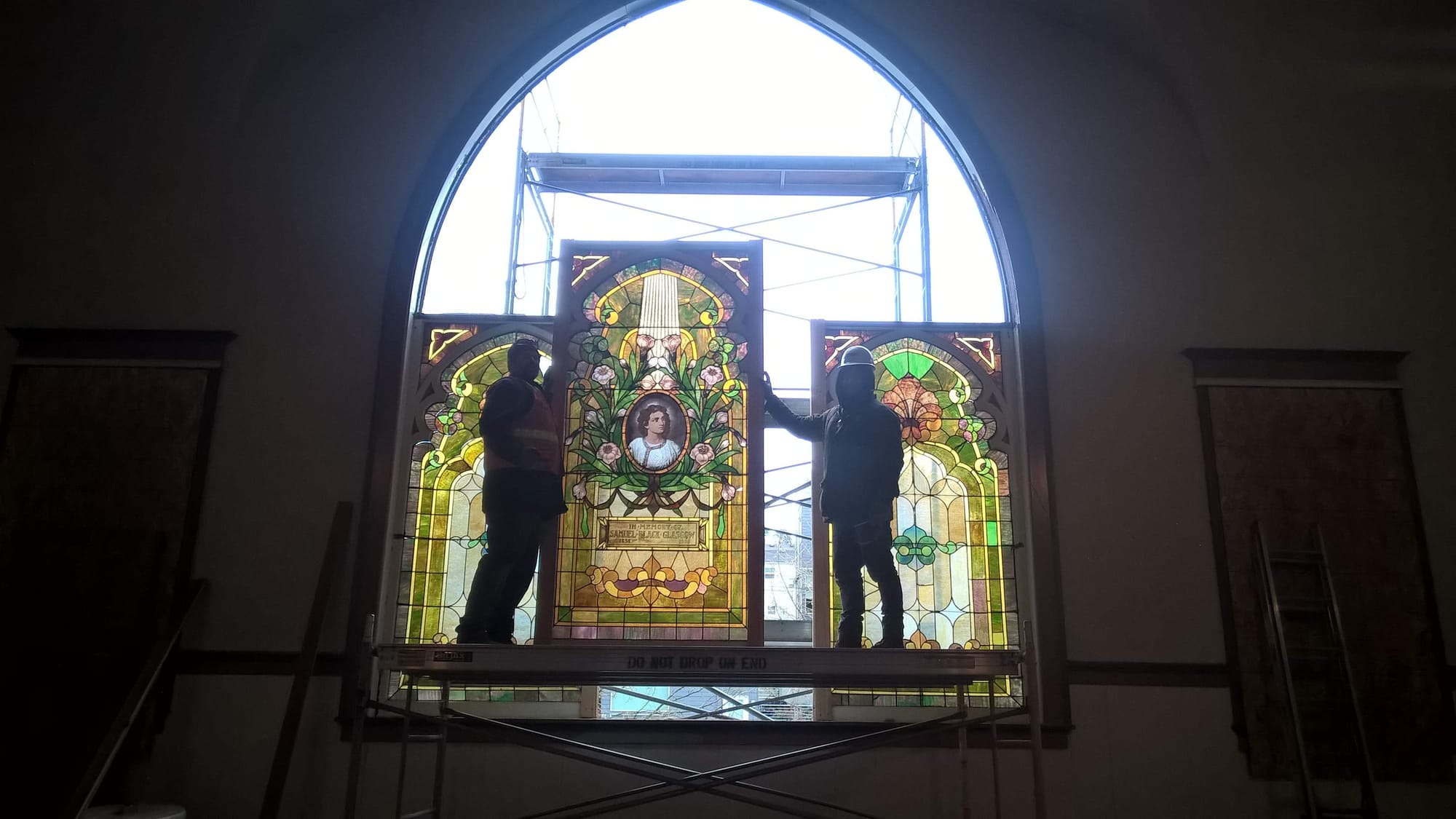
Bowley has run into similar sentiments when trying to tell other contractors about the history of the lumber that her and her team were selling. “It turns out it's like speaking Greek to people in the lumber industry, this idea of tracking provenance,” she said. “It's more like a wine industry conversation.”
If more contractors buy into deconstruction and learn to speak the language of provenance, the potential impact is huge.
One deconstruction contractor, David Bennink, estimates that over his 30 years in the industry, his work dismantling buildings and moving their materials into other projects has reclaimed and repurposed lumber equivalent to 10,000 acres of standing forests, an area larger than a national park that spans three islands in American Samoa.
And Re:Purpose Savannah has helped preserve the histories tied to more than two dozen condemned buildings across the neighborhoods of Georgia’s former capital.
The more these actions come together, the greater our chances are of preventing urban development focused on novelty and growth from tossing tons of lumber into the landfill—and discarding cherished memories along with them.

Alternative Futures Video
Event
With private banks so intent on using their financial resources in ways that oppose public interests, a movement has been growing to build publicly owned banks that serve people first and invest in local projects.
In October, the Public Banking Institute is convening a conference in Philadelphia to discuss how to continue to build momentum in this movement.
Learn more here:


News for the Future
- Pairing solar panels and batteries doesn’t just help save electricity bills and lower carbon footprints, it promotes climate resiliency. The school district in Roanoke, Virginia, has recognized this and chosen to build dedicated microgrids for its two high schools, so that they can serve as shelters in case of emergencies. (Canary Media)
- Chum salmon were once threatened in the Puget Sound of Washington State, with fewer than a thousand chum running up river in the 1990s. Thankfully, after a multi-stage, decades long recovery plan, they could rebound to a population of 35,000. (Magic Canoe)
- The Skeetchestn Indian Band in present-day British Columbia has established a building company that has pioneered “Dodeca-Homes,” 12-sided modular buildings inspired by their traditional architecture that can be easily assembled anywhere using lumber harvested by their people on their ancestral territories and built for their people. (The Tyee)
- Forest fires have devastated Southern Europe summer after summer with more than a million hectares ravaged across the continent in 2025 alone. In Portugal, the nonprofit EcoActivo is working to combat that by healing the water cycle through stream and wetland restoration and by installing faux beaver dams to promote green corridors resistant to fire. (Ecosystem Restoration Communities)
- 18 species of endangered birds call a farm in the southwest of England home because the land is stewarded with biodiversity in mind. The farmer’s approach involves not only planting tens of thousands of trees and restoring wildflower meadows, he has also sown heritage grains that are resilient to the heat and drought threatening England’s landscapes. (The Guardian)


