Hi folks!
I’m excited to be back in your inbox this month because I’ve got a fun story to share with you.
I’m by no means a “gamer,” but I enjoy a good game night with friends every now and then. So when it came to my attention that a climate change-focused board game existed and that I could chat with one of the game’s creators, I jumped on it.
In a world rife with false climate solutions and woefully inadequate levels of urgency, there is yet a universe of solutions large and small being pushed out. Alternative Futures is dedicated to making these seen.
Maybe you've never thought about the gaming response to climate crisis, but now I've rolled the die for you: Read on!
Enjoy!
—Syris Valentine

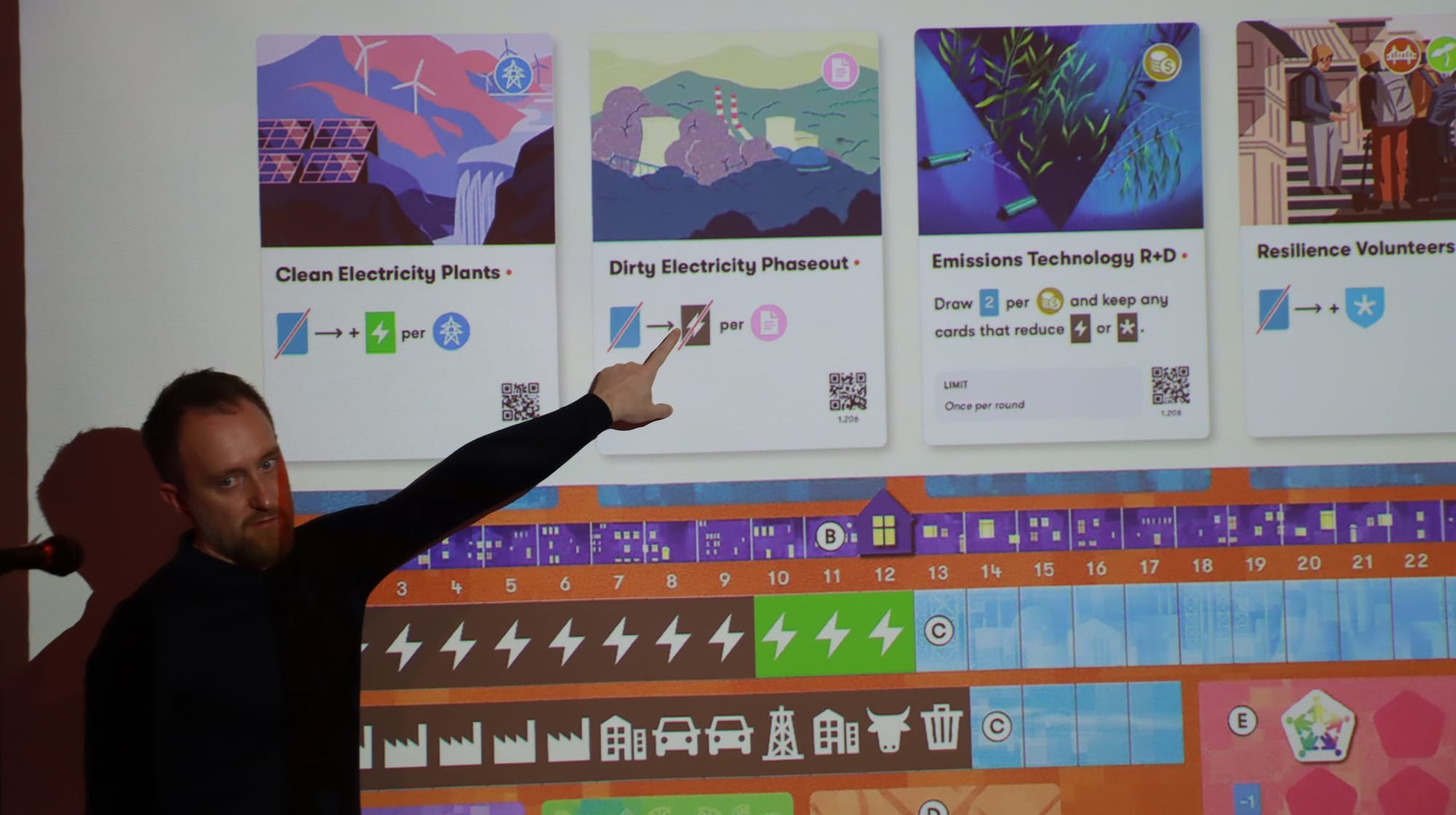
Players Race to Usher in a New Sunrise in 'Daybreak,' a Board Game of Climate Change Solutions
Syris Valentine | Deceleration
My girlfriend called Daybreak depressing and impossible to win the first time we played it.
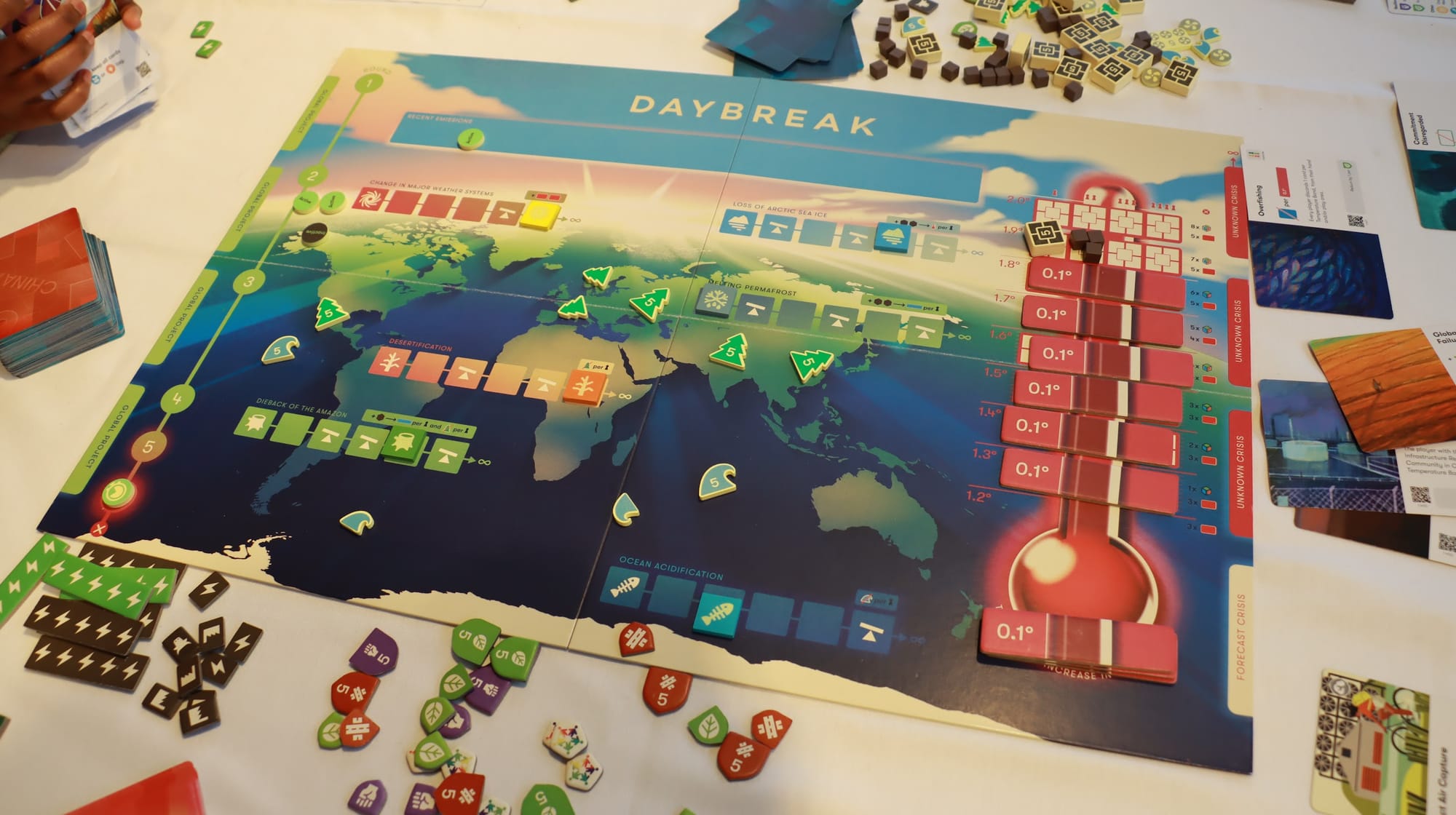
The board game tasks players with cooperating to eliminate emissions, increase carbon sinks, and bolster their resilience to withstand the disasters that strike round after round. It’s a race against time to draw down more climate pollution than the players collectively produce. All this before global warming hits 2℃, before one of the player-managed countries collapses from crisis, and before the round counter strikes midnight on the Doomsday Clock.
It’s by no means an easy undertaking.
It compels players to grapple with the challenges of an expanding climate crisis. Yet the creators would be disappointed to hear their game had left its players disheartened. According to the rule book, the creators developed Daybreak to “tell an uplifting story about decarbonizing the world.”
That ethos of optimism appears in the game’s very name, which one of the creators, Matt Leacock, has previously said is intended to reflect, “this inflection point, this new day, this moving forward: a sunrise, not a sunset.”
Discovering Daybreak
Daybreak hit shelves with its plastic-free, FSC-certified paper packaging and pieces three years ago. Not one whisper of it graced my ears until late this May when Korby Sears, a Seattle-based game designer, asked if I’d help co-host a conversation with Matt Leacock during the mid-July Pacific Northwest Climate Week. Given my professional obsession with climate change and my amateur interest in board games, the request was easy to accept.
Ahead of the conversation, I played Daybreak with Korby twice, bought my own copy, played twice with my girlfriend, once with two other friends, some half-dozen times solo, and made plans to play with four other friends.
Suffice it to say, I love Daybreak.
Despite my affections, it’s admittedly easy for the game to induce a dose of despair if you find yourself repeatedly losing. After all, loss implies apocalypse.
I find Daybreak thrilling, however, and more than a little hopeful.
The game makes an earnest attempt to reflect the complexity of solving the climate crisis, which makes winning hard — players need not only eliminate emissions, they must also prepare for the disasters that strike each round — yet, despite Daybreak inherent difficulty, those who play it remain, from the first card to the last, dedicated to the mission of climate action.
Combatting the existential crisis of our time takes center stage with no distractions as long as the game is in play: a hopeful, if idealistic, scenario that I only wish were real.
Experimenting With Optimism
“Daybreak is perhaps over-optimistic on our ability to get our shit together,” wrote climate scientist and board game geek Haley Staudmeyer in a 2023 review of the game.
Unlike the climatized version of the timeless classic Catan, the only way Daybreak’s players can increase their energy supply to meet their country’s growing demand for electricity is with renewables. Adding fossil fuels is never an option in the world of Daybreak — a sharp contrast to the real world where 314 more gigawatts of fossil energy fed the global grid in 2025 than did the year the world adopted the Paris Agreement.
But while Daybreak gives solutions an unrealistic boost in this way, the game and its counterparts aren’t meant to directly capture the real world, even as they grapple with real-world problems.
Instead, as a trio of researchers who investigate the most effective ways to educate people about science and climate change wrote in a 2025 paper, games like Daybreak create the space for players to “experiment with roles, try out different actions, and experience alternative future realities.”
When players step into the world of Daybreak, the fraught and dysfunctional nature of climate politics all but evaporates. Crisis cards flipped at the end of a round may signal that climate extremes have eroded democracy or that the fossil fuel industry has launched an aggressive lobbying campaign, but by and large, everyone around the board is engaged in the grand challenge of generations present and future. Everyone agrees to cooperate and act fast.

Coming together is key. Though each player leads their own country, every round starts with an opportunity for the players to confer and embark upon a global project that, once invested in, can make it easier for everyone to act. But doing so requires players to put global goals ahead of national interests and forgo an opportunity to take immediate action within their own metaphoric borders. It’s a tricky trade-off, but such investments and sacrifices are necessary for victory, Leacock said during our climate week conversation:
“If all you do is focus on your own board and you don’t cooperate with other players, you tend to do worse.”
Thinking Beyond Carbon
Resilience and adaptation are key qualities the game promotes. So often conversations about climate change focus on two topics: the disasters we face, and the ways we can and must eliminate emissions to prevent them. Far less attention goes toward how we can best prepare for what can no longer be prevented. The initial iterations of Daybreak suffered from this same misunderstanding of climate action.
“It was just a war on the carbon atom,” Leacock said of the game’s origins. This mitigation-only mindset meant players needed not concern themselves with the disasters that our excess emissions induce. But as Leacock and his co-creator Matteo Menapace introduced early versions of the game to climate experts, those experts highlighted the importance of adaptation and resilience. After that, Leacock said, “we tried to put communities at the center of the game.”
Players now need to worry about people as much as pollution.
“You’re rolling out different solutions that increase your people’s resilience, and those are represented as shields,” Leacock said. This shift not only made the game more realistic and more interesting, it breadened their idea of what climate action could be. For Leacock, it meant “being able to see how something like universal healthcare could be seen as a climate solution because it builds up social resilience.”
Still, the world can only adapt to so much, so mitigation remains the central challenge of the game.
Both the hope and the despair that Daybreak inspires derives from the complexity of that endeavor. Mitigation demands expanding clean energy, removing dirty energy, and eliminating the pollution produced by cars, buildings, industry, and agriculture all while working to restore the planet’s carbon sinks.

Pair this with the task of building resilience to stay ahead of the crises compounding as the players inevitably fail to achieve the rapid reductions they yearn for, and the herculean nature of the mission that we, as a world, must fulfill becomes clear.
Such clarity can disturb those who have never confronted it before. Yet, as actions amplify each other from round to round, it may also encourage people to see what’s possible.
Building the Engines of Change
“The game is kind of like two competing positive feedback loops,” Leacock told Deceleration. “You’ve got the climate, and things are getting worse as the temperature gets hotter and things continue to exacerbate. But there’s also this other one where, as you roll out your projects, they get stronger and they get even stronger. And it’s in a non-linear way.”
In the jargon of board games, this mechanic is called “engine building.” In the jargon of climate action, we might think about it as systems change or movement building.
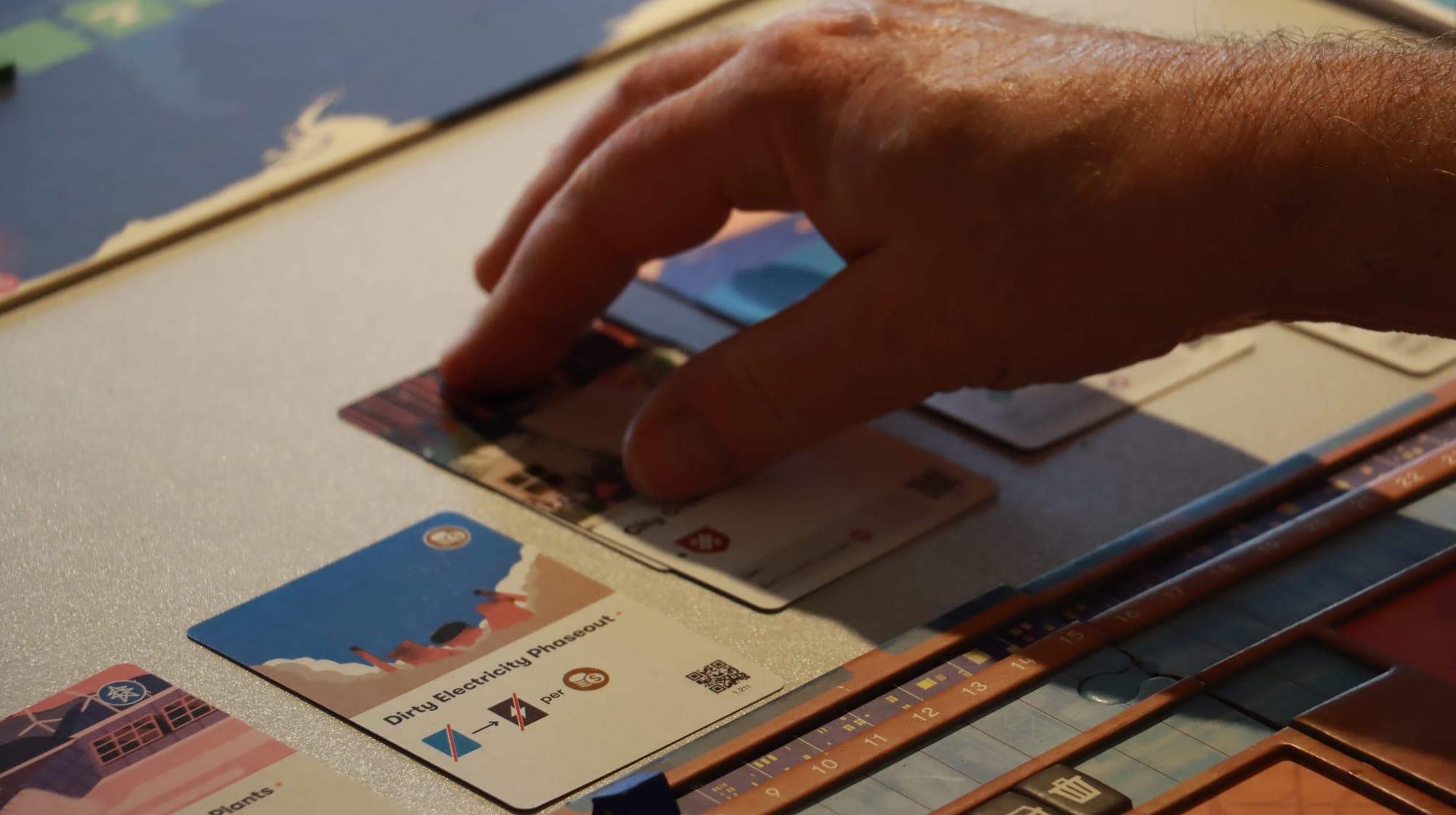
Each turn, players draw five cards. These they can add to one of five stacks. As the stacks grow, subsequent actions taken upon them become more impactful. This captures real world dynamics effectively.
Trump continues attacking cleaner energy sources, yet American utilities and energy developers remain well positioned to install solar and wind. Over the past half-century since global warming leapt into headlines, the investments that have been made into lower-carbon technologies—however insufficient and inadequate those investments may have been—have made solar power the cheapest form of energy in history.
Had the programs established under Biden’s marquee climate law, the Inflation Reduction Act, not been demolished by Trump’s climate-denying federal trifecta, the ensuing investments of both private and public dollars would have built an engine capable of accelerating the deployment of the technologies essential to reducing emissions.
Instead, Trump has jammed the transmission, locking us in second gear until we can clear the blockage and once again work the clutch to get into a higher drive.
Acting Swiftly and Aggressively
Stalled as we are, we must act as best we can. My playthroughs of Daybreak reminded me of that.
The game’s most important lesson is simple: Early, incremental, and ongoing actions matter—even when they seem paltry. In the game, as in real life, doing as much as you can, as soon as you can, is invariably better than sitting hands on haunches.
Doing something, anything, in the here and the now that might make a difference, even if that means being imperfect or even making a minor compromise, is nearly always preferable to waiting and praying all the pieces will fall into place soon enough for our idealistic projects to finally be achievable.
The more incremental steps we take today, the more we soften the violence of what we can no longer avoid, and the more opportunities we will have tomorrow (and the day after that) to chase the dreams we yearn to grasp and reach a future where we begin to clear the air of all the carbon we’ve put into it.
Alternative Futures Video
The board game 'Daybreak' tasks players with cooperating to eliminate emissions, build carbon sinks, and prevent global warming from reaching 2°C before time runs out. Follow Deceleration on YouTube.
Events
More great events at Deceleration's Bioregional Events Calendar.
Tip Jar

Buy Syris a Coffee
Show your appreciation for all the positive energy and actionable intelligence that Alternative Futures brings every month.
News for the Future
- For the last year, North Carolina’s Department of Environmental Quality has put $5 million toward supporting 26 communities recovering from the devastation of Hurricane Helene by helping them build local, solar-powered microgrids that will help them to maintain power should another storm hit in the future. (Grist)
- With coastal cities along the Chesapeake Bay sinking at the same time sea levels rise, the threats of flooding and shoreline loss are mounting. To combat this, local authorities in towns like Norfolk plan to invest in “living shores” that use plants, sands, and oyster shells to fight erosion and break the strength of storm surge, while also attracting wildlife and filtering runoff. (Inside Climate News)
- In 2021, a group called the Deschutes Partnership began restoring a creek in Central Oregon to provide more habitat for salmon by connecting the creek back to its floodplain so water could spill the banks, meander, and form small pools. A fire rolled through the canyon in which the creek sits in August 2025. 23,000 acres were scorched, but the area along the restored creek and salmon habitat remained green. (Magic Canoe)
- Though court justices and lawmakers around the world have begun to recognize the legal rights of nature, a report shows that these bills and ruling alone are not enough to overcome the systematically ingrained notion that nature exists for human exploitation. What needs to happen, in addition to these rulings, Indigenous people and local communities must be given the authority to enforce those laws and decide how the ecosystems and waterways around them are governed — at the same time that we begin to imagine a new philosophical basis for our legal and economic system. (Inside Climate News)