When I first moved to Seattle, few knew what an “air quality index” meant. It wasn’t something meteorologists and weather apps yet had any reason to include in their daily updates. But as climate change steadily dried the region and large wildfires expanded across the U.S. West, wildfire smoke began to creep into the city so frequently that late summer became our de facto smoke season.
I grew tired of having to check clunky government websites to understand how breathable the air outside was. So one year I built my own personal air monitor, spending the better part of six months learning how to program an Arduino microcontroller that would automatically ping its readings to my computer.
That entire experiment would not have been possible, however, without the free and open source software movement that has grown steadily since the 1980s. Much of the basis for this movement was inspired by the principles adopted among early hackers who believed, among other things, “All information should be free.”
Even the infamous torrenting website The Pirate Bay has published its source code online.
The borderline anarchist ethos baked into a lot of online hobbyist do-it-yourself spaces allowed me, through repositories like GitHub, to bring my device to life. It’s not only amateurs like me who leverage those codebases. Academics also use and contribute to them; as do major corporations. Research suggests that at least 97 percent of today’s digital infrastructure depends on open-source software. The internet would not exist without that free and open exchange.
This is the third installment in a series about degrowth in theory and practice by Syris Valentine.
PART 1: ‘Degrowth’ Principles Have Charged the U.S. Climate Movement—the Name Not So Much
PART 2: Peasant-Led Movements Hold the Model for Restoring the Land
PART 3: How Co-ops and Open-Source Can Help Create More Just Energy Systems'

An Open-Source Approach to Energy
For years, I’ve wondered how the world would look if we applied the same principles to climate tech. What might we accomplish if the designs for solar panels, wind turbines, home batteries, and the like were freely available, no strings attached, to anyone with an internet connection? Given how slow many states and private utilities have been to deploy renewables, making the technology widely available is a potentially transformative proposal that some see as critical to the success of a rapid clean energy transition.
“If it’s proprietary, if one company owns climate tech, it cannot scale worldwide,” said Tobias Ausperger, a software engineer who co-authored a report about the potential for, and importance of, open source technologies in environmental sustainability.
He and his collaborators also compiled a directory of existing open-source projects in the sphere of climate change and climate action. Most of them focus on either climate science or the energy system. Despite coming across thousands of efforts, Ausperger’s team realized that there was a major gap in the universe of projects they cataloged: Only a handful looked at hardware and manufacturing—arguably the most important part.

The vast majority of open-source solar energy projects, for instance, look at how you might forecast, simulate, or operate solar panels once they’re assembled and installed. If you want to learn how to build your own solar panel, you’re on your own.
Powering Rural Communities Worldwide
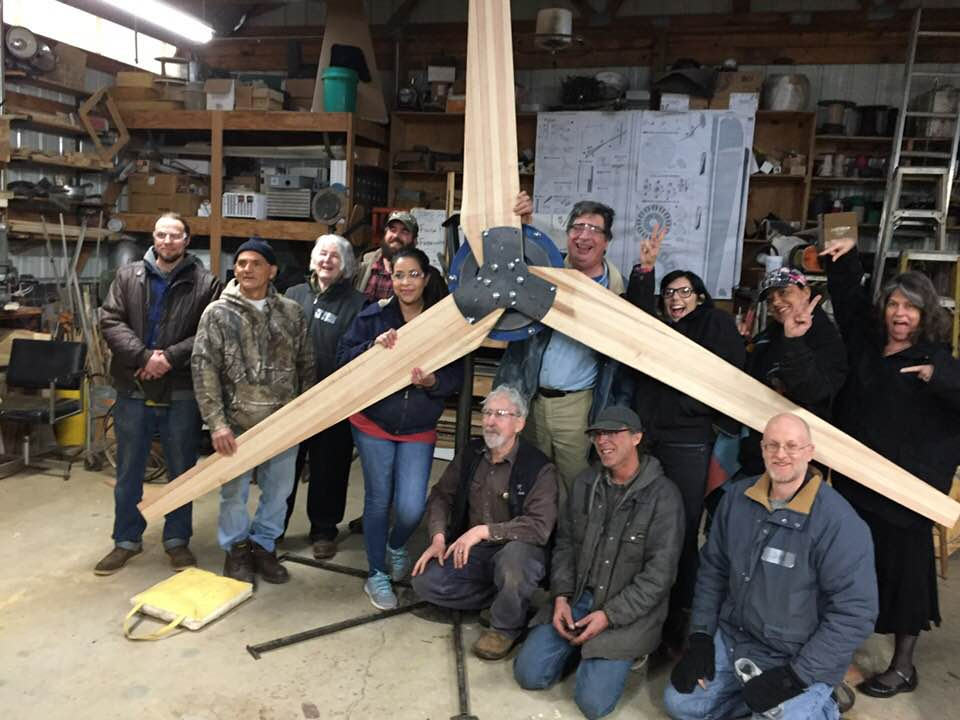
In the world of wind power a few different examples of “open source” wind turbines exist that people can access to build, modify, and experiment with to become a small-scale producer of their own energy. Open-source-derived wind power, along with freely accessible designs for small-scale hydropower, have been critical for supplying electricity to isolated rural communities, such as in Laos and Nepal. It’s also a critical component for enabling an energy system that meets our collective global climate goals.
Around 40 percent of the world’s emissions today come from the energy sector. But eliminating those emissions comes with an added challenge. As the building, transportation, and manufacturing sectors all work to decarbonize, they must plug themselves into the grid in a bid to procure “green” electrons that replace the fuels they’d otherwise burn.
That challenge is steeper than it seems given that even as cleaner energy deployments accelerate year after year, the world continues to construct more buildings, more cars, and more stuff—not to mention the energy drain posed by the explosion of data centers. Ridding the world’s electricity grid of carbon emissions faces a dual dilemma: it must add enough capacity every year to meet those new demands while also building enough solar and wind to replace the terawatts of fossil fuels that serve as the backbone of the global economy.
Getting people to rig up DIY wind turbines in their yards and solar systems on their roofs won’t solve the fundamental problem; even if it provides the social infrastructure for, potentially, doing so.
Decentralized and Democratic
The core obstacle is that the economy’s demands for energy are growing without relent, and everyday people all over the world have no control over the electrical infrastructure that enables modern life. Even people who are served by municipally owned power companies have little, if any, influence over the assets that are deployed or the buildings allowed to tap the grid.
For those who envision what a post-growth approach to the energy system might look like, creating a forum for democratic grid governance is a primary principle of it—as is free- and open source energy hardware.
The central premise of post-growth and degrowth discourse is that there are very real, finite limits to how large the world’s economy can be without posing an existential threat to the planet, even if the economy runs on renewable energy. Right now, research shows that humanity has already exceeded most of those limits. The only option then, degrowth scholars argue, is to undertake a democratically planned effort to reduce how much energy and how many resources society as a whole consumes in a way that aims to improve wellbeing worldwide by shrinking or eliminating wasteful or outright harmful industries.
Deciding what industries and activities deserve to be maintained and which can be downsized or discarded would be no simple effort.
How Much Energy is 'Enough?'
“It becomes about what kinds of values are centered in decision making,” said Daniel Petrovics, a social scientist at Erasmus University Rotterdam, who is interested in community-led climate initiatives. In the energy system, one of the main debates around values considers whether we should prioritize efficiency or sufficiency.
Most energy initiatives today for reducing emissions focus on efficiency. This approach foregrounds installing LED lights, buying EnergyStar appliances, adding new insulation, or adopting a heatpump. And while each of these efforts has merit, Petrovics points out that the benefits of these well-intentioned projects often are undone by what economists call “the rebound effect,” where energy savings in one area lead to new or increased consumption elsewhere.
Taking a “macro view,” as Petrovics urges, shows that despite the myriad efficiency improvements in recent decades “there are more resources and more energy consumed overall.”
If sufficiency was centered instead, we’d have a greater chance of stopping that growth and reducing consumption over all, he added. “It’s focusing on what is enough, what forms of consumption and energy are necessary for a given level of comfort and wellbeing.”
But how can we learn to distinguish one from the other? Where can people go to discuss, define, and codify what is necessary or not?
Becoming Global 'Energy Citizens'
Right now, everyone is an energy consumer. A privileged few are also energy producers. But almost no one is an energy citizen empowered to have a voice in the shape the system takes.
For Petrovics and other post-growth scholars, that is where energy communities and cooperatives come into play. Cooperatives have baked democracy into their DNA. Regardless of how much a member invests into the project, each only gets one vote; and they discuss their priorities before providing a mandate to their board and executive leadership. It is then up to that leadership to carry out members’ directives.
This approach also has the potential to benefit from peer-to-peer energy production that takes advantage of the “desktop manufacturing” of wind turbines to create a local energy commons. And whether or not someone contributes in design or manufacture, collective ownership empowers people to contribute to the repair and maintenance of the infrastructure that they share.
But clearly norms have to change too when it comes to the core problem of reducing energy use. Petrovics and his colleague Federico Savini from the University of Amsterdam have argued that these communities would not just create spaces to discuss what it means to be energy sufficient. They have the potential to create reinforcing dynamics of peer pressure and imitation capable of driving people toward a shared value of moderation and energy sufficiency.
At the same time, Petrovics said that he’s cautious about the extent of the promises these energy cooperatives hold. His time spent studying more than two dozen energy communities in countries like France, Belgium, and the Netherlands has helped him understand the potential benefits they bring for deploying clean energy, but he still doesn’t have complete confidence that they will inherently lead to a sufficiency-focused future.
“I wouldn’t treat them as a panacea,” he said. “It’s a step in the right direction, but there’s not yet proof that they’re fully encompassing all the degrowth principles or that they actually lead to a reduction of energy use.”
When a separate group of degrowth researchers investigated the impact of such cooperatives operating on Greek and Spanish islands, they concluded that, though the projects might indeed help revitalize local economies, the cooperatives, at the moment, fail to advance an agenda of degrowth.
Ultimately to ensure the principles of sufficiency and energy democracy are upheld, individuals and groups must make these questions increasingly political and pressure decisionmakers until they have no choice but to redesign systems in ways that make these reductions possible.