

CORPUS CHRISTI, Texas—Recent rainfall in South Texas has pushed off the projected date of emergency water restrictions in Corpus Christi by three months, the city announced Tuesday, amid growing hope that a powerful global climate phenomenon this year could wash away the region’s historic drought.
Lake Texana, the smallest of Corpus Christi’s three reservoirs, rebounded from record lows last month when it received its first inflows in eight months. Worst-case projections in mid-April showed the lake going dry by summer. Now it should last until early next year, at least.
“We are pleased to share the positive news,” said Nicholas Winkelmann, chief operating officer of Corpus Christi Water, in a Tuesday announcement.
It’s one small step in a regional water crisis that has developed over decades. But the short bridge that recent rains provided goes a long way to helping the region narrowly avoid a disaster, local water planners say. Expectations of a powerful “super El Niño” event this year suggest that intensely wet weather could return to the Coastal Bend of Texas this fall, potentially putting water into the region’s largest reservoirs, which have fallen to critical levels.
El Niño is a cyclical climate pattern driven by warm currents in the Pacific Ocean that shift jet steams and weather worldwide. Typically, El Niño has brought cooler and wetter weather to the Gulf Coast in late fall and winter. This year, record warm water in the Pacific Ocean could produce the strongest El Niño pattern in a century.
Forecasts from the National Oceanic and Atmospheric Administration’s Climate Prediction Center indicate “increased probabilities of a strong to very strong El Niño possible this fall.”
Earlier this year, water planners in Corpus Christi worried their reservoirs could empty before El Niño appeared to save them. The recent boost to Lake Texana significantly lowers that likelihood, according to John Michael, an engineering firm executive who has spent 44 years working on water infrastructure in the region.
“We’ve just got to get through this year,” said Michael, local vice president of Hanson Professional Services, an engineering firm with offices around the country. “I’m much more optimistic today than I was three months ago.”
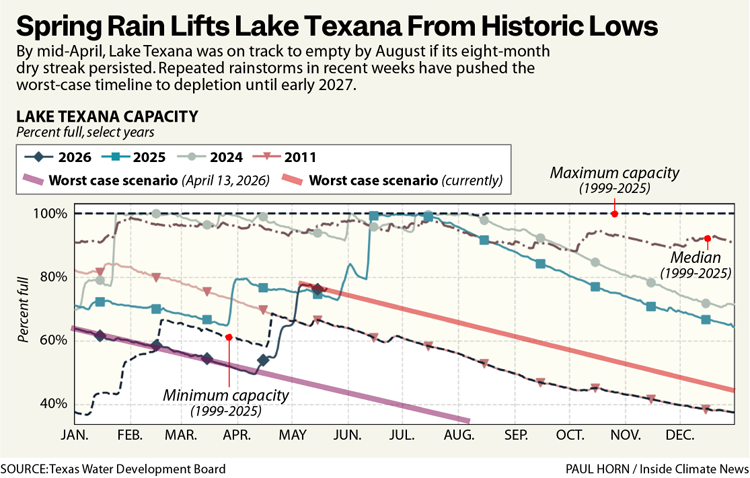
The city of Corpus Christi initially projected a “Level 1 water emergency” in November. As drought deepened, the city said in March that the emergency could come as soon as May. Then in April, it said the emergency would come in September.
If levels continue to rise in Lake Texana, 100 miles northeast of Corpus Christi and linked to the city by pipeline, it could meet the region’s domestic and industrial water needs well into next year. By that time, planners hope El Niño will end five consecutive years of record-breaking heat and drought.
Dry spells in Texas have been known to conclude with deluges, said Matt Lanza, a longtime Houston meteorologist and co-founder of the website Space City Weather.
“We’ve had some false starts the last couple years,” he said. “We are hopefully beginning to see the end of the drought in South Texas, but only time can tell.”
Narrowly avoiding a water disaster doesn’t mean that Corpus Christi has solved its water crisis. The region’s largest source of water, the Choke Canyon Reservoir, has received three minor inflow events and zero major inflow in the last 15 years, according to Texas state climatologist John Nielsen-Gammon. The next-largest reservoir, Lake Corpus Christi, hasn’t logged inflows in five years.
Both reservoirs combined are about 8 percent full, as the region’s industrial complexes continue to draw large volumes of water daily. A return of moderate rainfall could keep Corpus Christi from emptying its main reservoirs, but it wouldn’t likely fill them up anytime soon.
“We are in drought, but we also have the water shortage,” said Juan Peña, lead meteorologist with the National Weather Service in Corpus Christi. “Drought is … short-term. The water shortage is more long-term.”
For now, Corpus Christi remains at the mercy of rain. Almost all of the city’s emergency water supply projects are hung up with complications and delays. Last week, a state administrative judge sent the permits for Corpus Christi’s largest emergency project, in Sinton, about 25 miles north, into a hearing process that could take years. The city had previously said it needed the project to start producing by November and was already laying pipeline.
Corpus Christi also drilled emergency wells along the Nueces River but found the water saltier than expected. Now the city is urgently advancing plans for one of the largest groundwater desalination plants in the country, which could treat up to 21 million gallons per day of brackish aquifer water for Corpus Christi’s supply.
-30-
Previously published by Inside Climate News.


