

At 9:30 a.m. Friday, the previous press conference had run over—a phalanx of San Antonio movers and shakers decrying Mayor Jones's push to put Project Marvel to another public vote—forcing the crowd of data center critics gathered amid the swamp-hot exhalations of early August to mill around the plaza outside City Hall, chasing patches of shade.
We sweated through comments from the head of San Antonio’s Greater Chamber of Commerce, and from former Councilwoman Rebecca Viagran—now the president and CEO of the South Texas Business Partnership, but forever in my heart as the former D3 councilwoman who opted to forcibly remove residents of Mission Trails Mobile Home Community to make way for luxury apartments in her district.
Finally a D6 staffer asked Project Marvel attendees to skiddaddle to the plaza peripheries to continue their conversations and interviews. With the support of multiple environmental justice and labor organizations, District 6 Councilman Ric Galvan then took the mic. He called for a pause on data center construction in San Antonio until a community benefits agreement is in place, a call supported by at least two other council members.
UPDATE, AUGUST 20: On Tuesday, Aug. 25, 2026, there will be a "briefing" on a possible "building permit moratorium and Unified Development Code (UDC) amendments related to data centers." It follows a 9am meeting the same day ("Data Centers - Zoning and Land Use Discussion") geared toward defining data centers under the UDC.
His hope is that the reforms might curb the all-you-can-eat buffet that data center construction has made of Galvan’s Westside district. According to Galvan, District 6 today has “the highest concentration of data centers in San Antonio and Bexar County.”
The action comes several days after Texas Governor Greg Abbott’s own call for a state-level data center pause to facilitate a review of all data centers seeking to connect to the Texas power grid.
Growing Groundwork
Galvan described some of the groundwork building since last October toward the day’s moratorium call. At that time, Galvan issued a Council Consideration Request seeking to require that “all new data centers come before City Council for a vote of approval,” as he described it on Friday.
This process would also require community consultation and “full site plans” to be disclosed to the public showing “what this project is, how it will impact our energy and water resources, [and] how it will address environmental and neighborhood concerns.” Such modifications would empower Council “to push back” on plans if impacted residents had concerns, he said.

Co-signed by four other council members, Galvan’s CCR requested city staff research the water and energy demands of data centers in San Antonio; “the scope of the City’s authority to regulate” these demands via zoning, permitting, Unified Development Code regulations (UDC), and state laws; and how other cities have crafted policy responses to the data center rush.
While the CCR didn’t mention public disclosure or community consultation requirements, it does ask staff to explore how the City might amend the UDC to require a “special use authorization for regulating the location and development of data centers, along with strategies to mitigate impacts[.]”
Community Benefits Agreement
Beyond this CCR, Galvan added that his office also requested in May of this year that the city’s Economic Development Department and Workforce Development Office form a stakeholder group, comprised of representatives of local unions, school districts, and higher education “to develop a Community Benefits Agreement framework for data centers.”
“Our zoning and land use codes should benefit working class residents of San Antonio,” Galvan said to applause, “not tech billionaires here in our city.”
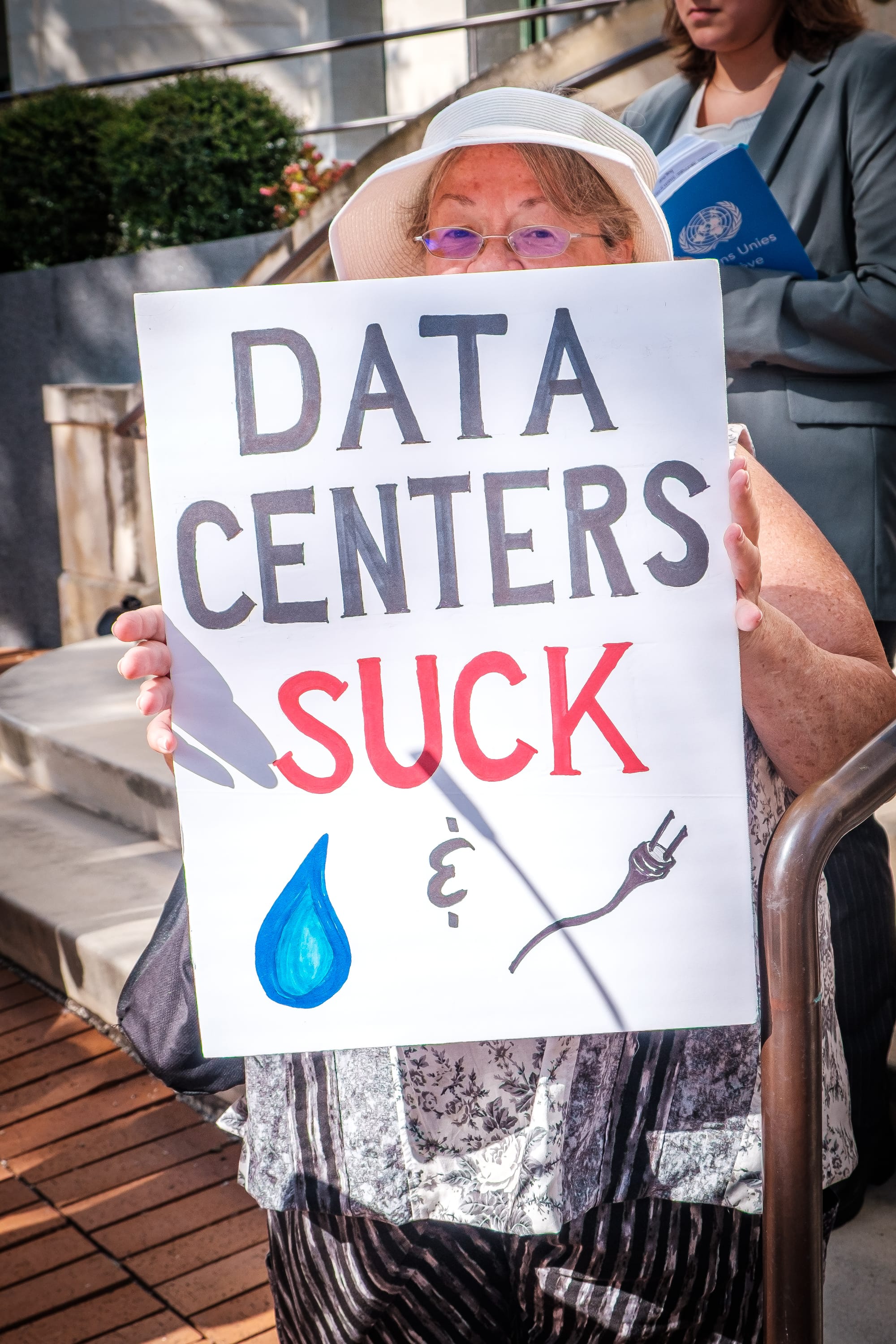
But to develop the new zoning and land use regulations that would make up a Community Benefits Agreement, Galvan is now seeking to pause new data center construction within city limits. This is expressed in a new memo signed by Councilmembers Galvan (D6), Teri Castillo (D5), and Ivalis Meza Gonzalez (D8).
In it they request City Manager Erik Walsh schedule a special Council session this month to vote on a 90- to 180-day temporary moratorium "on all applications for concept plans, site development plans, and permits, and on the issuance of any site permits... ."
The pause, Galvan said at the press conference, is necessary “until we can ensure that this industry does not damage our environment, creates local benefits for community, is built by union labor, and does not raise our residents’ bills.”
On Water & Power
Significantly, this new regulatory capacity would include the city’s two public utilities, Galvan said.
“I call upon CPS and SAWS to develop plans to require all new data centers utilize clean energy and recycled water for operations here in our city.”
Texas state Senator José Menendez (D-26), speaking after Galvan, offered support, agreeing that all new data centers should be built by union labor, powered by renewable energy, and cooled with recycled water or alternatives to water.
Menendez cast as opportunistic recent opposition of Republican state legislators to rural data centers, which are now also reviled by their voter base in spite of President Donald Trump's full-throated embrace of data centers and personal enrichment from crypto. This shift has come, Menendez noted, even as these legislators hamstring cities from making their own regulations via efforts like the so-called ‘Death Star’ bill “where we take away local control from cities and counties to evaluate what’s best for their communities.”
A deeper problem, however, is the speculative purpose of the data center “gold rush” itself, which “seem[s] to be lining up to suck up all the power and the water in our state.”
“No one’s opposed to data centers that we need for health benefits, health records,” Mendendez said.
“But what I am opposed is all these cryptominers that have decided that Texas is a place [where] they can come in under the guise of being a data center, and then use the Industrial Demand Response Program to make millions more from taxpayers.”
Such grifts as Menendez described are then shouldered by those who can least afford them. Referencing residents like his own 90-yr-old mother, who routinely sets her thermostat to 79 during the summer, Menendez recalled:
“I walk in and I go, ‘Mamá, hace muy caliente.’ The house is too hot. And she says, but, ‘es que, suben mucho la luz.’ The bill’s gonna be too high," Mendendez said. "Why shouldn’t those residents who are willing to sacrifice their comfort … get paid back, just like these cryptominers [who] have really gamed the system. There are so many reasons why we need to pause.”
What About Bexar County?
According to some press conference attendees, however, Bexar County is a critical voice missing from the emerging local regulatory tangle seeking to govern data centers.
Mattie Román grew up in D6 and now lives just outside city limits—as does the growing Vantage Data Center investment off Omicron Drive—where city efforts alone cannot reach.
Román described some of the public health risks of living near unregulated data center construction in their community, which began without notification of area residents. “When the first one popped up in my community, it’s like, ‘Oh, it’s there.’ And now we’re having to deal with the effects.”
Some of these public health effects have included “energy disruptions that we’re seeing on a regular basis, which were never an issue. Now … we’re continuously seeing power outages. And just even how intensive the construction processes were. Where there’s dust blowing into the area, because these are just massive construction sites.”
Román also described a "significant heat effect,” which public-health researchers (and Deceleration) have begun to document.
“The difference in heat [around the Vantage data center] is absolutely insane and exhausting,” Román said.
 Greg Harman
As far as Román has seen, the County has not publicly responded to concerns about data center construction.
Deceleration Video
AI data centers are driving a surge in new gas power plants—and the pollution is landing on nearby communities. Follow Deceleration on YouTube.
Heat Emergency MIA
Deceleration’s reporting on extreme heat has noted similar complications requiring but not receiving a coordinated city-county response, specifically around efforts to count and track heat-related deaths.
In May 2026, City Council Council members were informed that Metro Health will once again include heat-related deaths as part of its public health dashboard, but the deeper issue is that the Bexar County Medical Examiner’s Office itself doesn’t utilize a standard methodology for determining when a death is heat-related. So while the City can and should make this data publicly available, what it shares is still an undercount—until and unless the City can pressure the County to bring its heat mortality accounting into a new era that increasingly recognizes that climate change poses a public health emergency.
A similar regulatory complexity is at work on the issue of data centers—at least, the ones beyond city limits—which are fast becoming another front in the struggle for climate justice.
“I think we cannot be satisfied with a moratorium. I think what comes next is, what does it mean to recover these communities?" Román said. "What does it mean to have justice for these communities? If these data centers go, what is the process of decommissioning [them]? I believe that our representatives need to be creative with their use of power[.] … Because it is not enough to incrementally change things.
“These [data centers] are already having immediate impacts on people I grew up with in the communities I grew up in—and am in right now.”


