

This is the first installment in a series about degrowth in theory and practice by Syris Valentine. Read more about the series below. Jump to the second installment here:
PART 1: ‘Degrowth’ Principles Have Charged the U.S. Climate Movement—the Name Not So Much
PART 2: 'Peasant-Led Movements Hold the Model for Restoring the Land
After graduating college, Chad Baron worked in the nonprofit world for a few years, trying to address pressing environmental and social challenges, homelessness among them. “My work during that time felt very much like band-aid efforts,” he said, “placing band-aids upon wounds that had deep roots.”
Baron wanted to grasp those roots, so he pursued a master’s in international studies at the University of San Francisco. There, he studied at the intersection of economics and environmental and social issues, which included a course on sustainable development. “It’s in that class where I came across degrowth for the first time,” he said.
The ideas described by that school of thought captured everything he’d until then lacked the language to articulate.
“It cut to the core of the issues,” Baron said, “and really got to the systemic roots of the various challenges we face as a global society.”
Degrowth describes how an obsession with growth—as measured by limitless increases to a country’s Gross Domestic Product (GDP) at any cost—has led businesses and industries to damage human communities and ecosystems alike as they extract wealth and resources whenever possible. Baron leaned further and further into the work of degrowth after that initial exposure, and he eventually helped found Degrowth California in the early 2020s, precisely to talk about, imagine, and enact the changes that could move degrowth from theoretical framework to lived reality in the Golden State.
As a philosophy, degrowth exists to combat the widely held belief that growing the economy is the only way people can meet their needs and governments can provision public goods. Declaring that the United States needs to “degrow” its economy baffles many, as though such a proposal would return the world to a dark age absent any of the conveniences of modern life.
But most who advocate degrowth simply want the world to recognize that while growing the economy to a certain degree can free people from poverty and hunger, after a point continued growth does fewer and fewer people any good—especially when the wealth being produced is hoarded instead of shared.
Well-being Beyond Growth
As it turns out, the United States is the perfect poster child for the failures of a growth-first economic strategy.
“The U.S. is a shocking example where, basically, growth doesn’t solve anything,” said Aljoša Slameršak, a degrowth researcher at the Autonomy University of Barcelona.
“You could have endless growth, and by the political decision of how you share the benefits of that growth, you would always have abject poverty. You would always have people that are excluded from the benefits of that growth.”
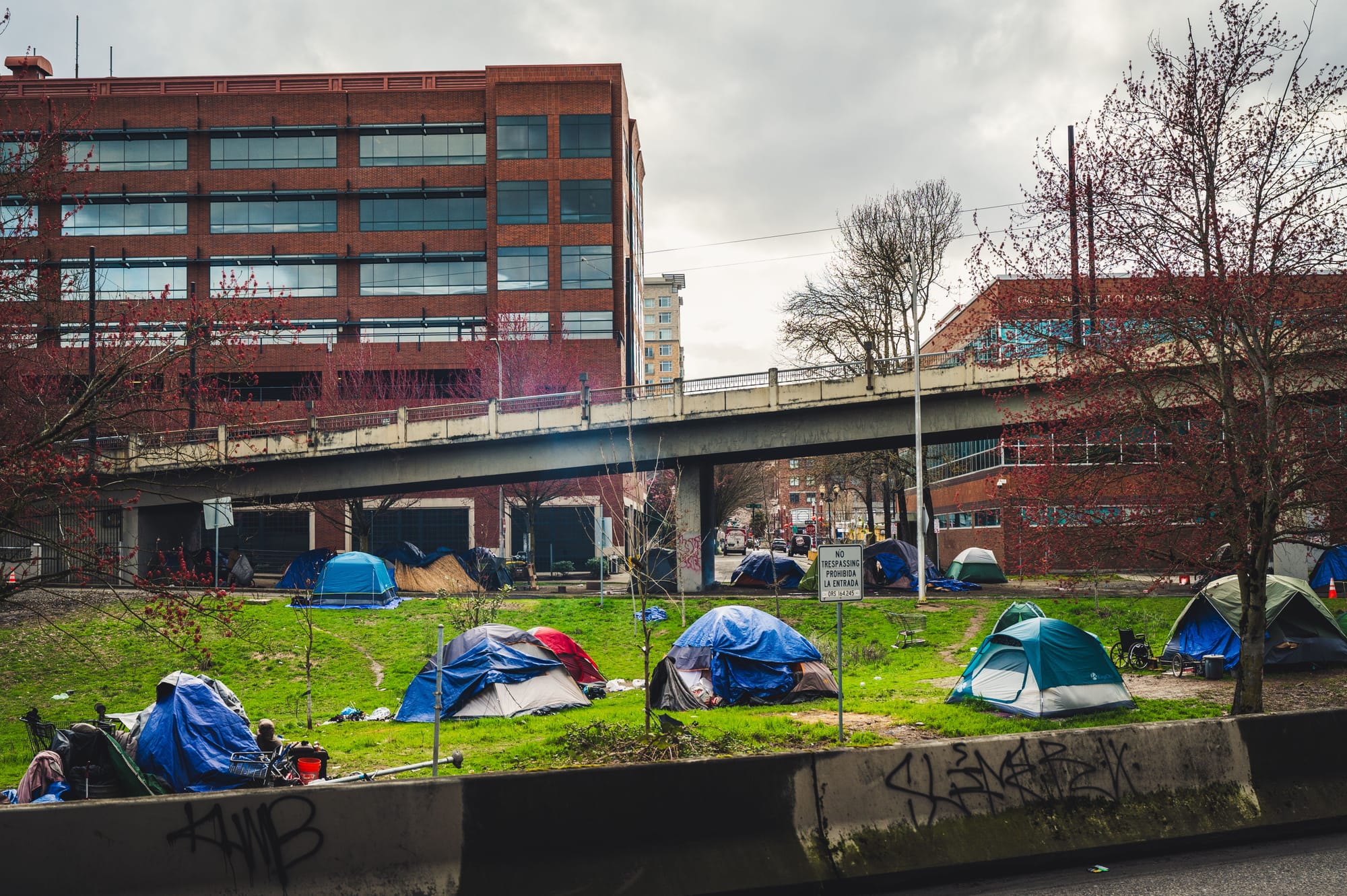
When a nation makes growth the primary mission of its economy, it doesn’t matter where that growth comes from. Increasing the Gross Domestic Product, or GDP—a numberfigure that distills the sum total of a nation’s economic output and activity—matters above all else. This makes things like artificial intelligence, Wall Street stock trading, and even private prisons valuable industries because they produce high profits, despite improving few lives and harming many.
Critiquing growth can sometimes seem to ignore the question of capitalism, but there are ultimately significant overlaps between the two: the central driver of capitalism is the accumulation of profit in the hands of those few who own corporations and control the levers of wealth. Capitalism cannot, as Japanese political philosopher Kohei Saito points out in Slow Down: The Degrowth Manifesto, exist without growth.
But even if the economy were controlled through traditional communist or socialist means, which is to say putting workers at the helm of the economy, it would not guarantee that growth be set aside. Even the Soviet Union wanted to grow as much as it could, which is why today’s most radical political economists talk in terms of degrowth, if not “degrowth communism”—Saito’s preferred term.

Degrowth as a guiding framework asks countries and communities to put people’s needs first and to prioritize the well-being of people and planet, regardless of what this entails for the GDP.
This could include disbanding the speculative real estate markets that have contributed to the housing crisis, and instead prioritize social housing programs that can build affordable, environmentally sustainable homes and apartments.
It could entail eliminating private financial markets that make money buying and selling stocks, regardless of the ramifications of the businesses they’ve invested in, and instead promoting public banking and community loan funds that are accountable to people and must invest in good faith. It could mean outlawing private health insurance and adopting universal free healthcare so that treating people’s ailments is no longer about maximizing profits but about promoting genuine care.
The scope of what could be seen as degrowth policy is vast and centrally concerned with promoting the good of the public, even though the word itself seems to be agnostic toward public interests—which may be part of why it resonates less in the US than other, related frameworks.
How Degrowth Emerged
As a body of thought, degrowth emerged in Europe in the 1970s, primarily in France. Up until the first use of that specific term, critiques of growth (and outright objections to it) had become increasingly common, particularly with the release of The Club of Rome’s Limits to Growth. That report used computer modeling to show how an economy predisposed to endless growth would exhaust the resources of the Earth, pollute the biosphere, and create the conditions for its own demise. France was particularly ripe for these critiques.
Following the end of World War II, France underwent a period of rapid economic growth as it repaired the damages the war wrought. But, as Timothee Parrique describes in Slow Down or Die, the gains of this growth weren’t evenly shared, and when student protests erupted in May 1968, it eventually spread throughout France’s broader civil society, including labor unions who demanded that they share in the nation’s newfound wealth. But many French folk still felt that there were more important goals than growth, and that it largely missed the point of what purpose the economy was meant to serve.
With these feelings swirling around France and critiques of growth emerging across Europe, French academics like André Gorz began to use the term décroissance, French for degrowth.
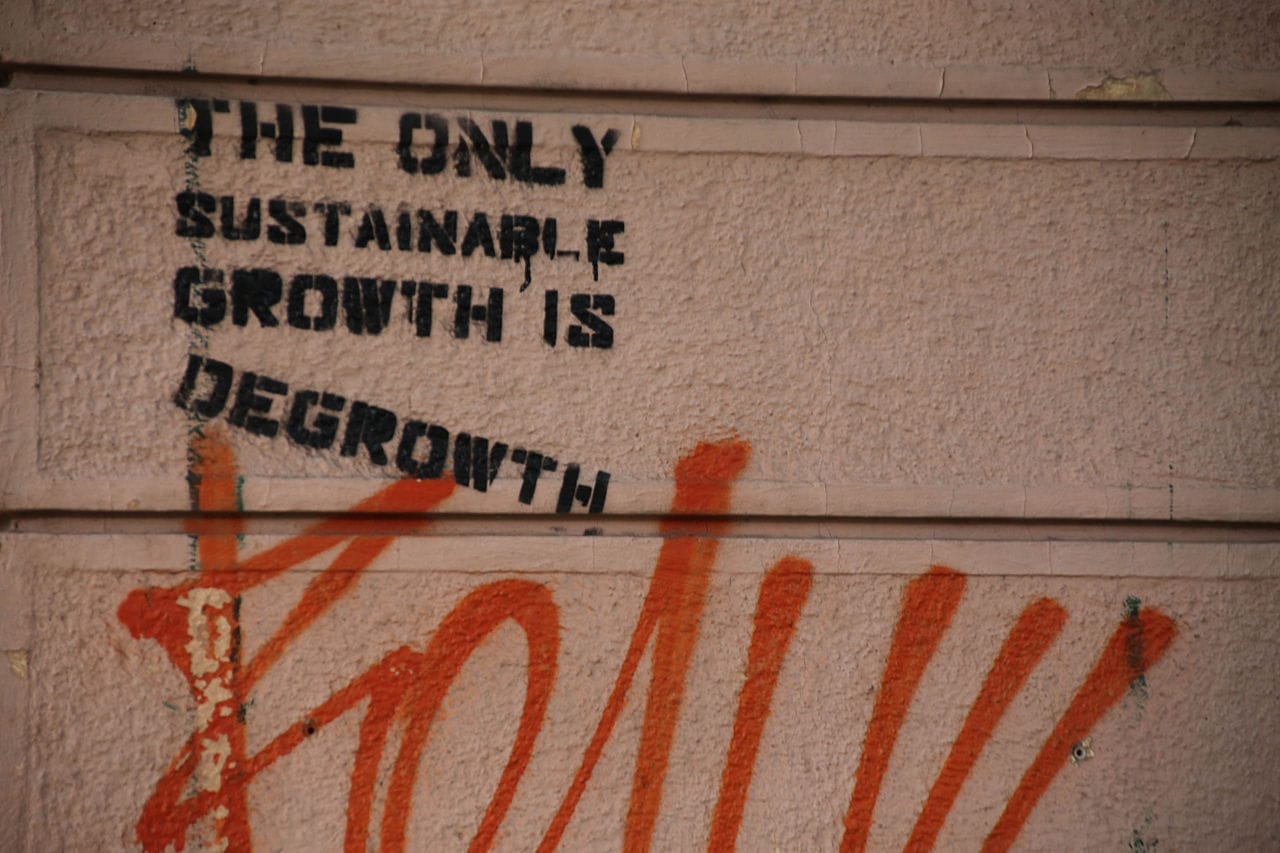
It wasn’t until 2008, however, that the term finally arrived in the lexicon of English-language economists and academics, with scholars in the U.S. beginning to publish papers on it in the early 2010s. But the language of degrowth hardly penetrated the American psyche during that first decade of scholarship. Only in recent years has it begun to enter the discussion circles of leftists and environmentalists—though it primarily seems to be young, white, middle-class, college-educated people who engage directly with degrowth.
Organizers like Baron have found that degrowth doesn’t tend to resonate with older audiences. But when he’s brought the idea into the high school classes he teaches, his students seem to intuitively grasp the issue. Still, he recognizes it’s an uphill battle to make the idea a popular organizing tool in the States. “Because of the history of U.S. capitalism versus socialism,” Baron said, “degrowth had a harder time entering American discourse.”
Many in Europe, however, where socialist ideas are far less charged, still remain skeptical of degrowth, even as the European Union has funded researchers to investigate it. This has led many people to tread carefully with the language they use.
“I tend not to use degrowth, actually, particularly in an American context, because it’s not helpful,” said JP Arellano, a communications strategist with the EU-funded, post-growth research group REAL, based in Barcelona.
“You automatically get people turned off from the idea, and so they don’t listen to anything that you have to say, regardless of if it has merit.”
Instead he prefers meeting people where they’re at and speaking to them directly about the issues they are most concerned about, whether that be the cost of health care, the quality of education their children receive, or the long hours they work that keep them from their family.
Speaking the People’s Language
All that is why Deric Gruen, a member of the Seattle-based leadership collective People’s Economy Lab, tends not to use the language of degrowth at all and instead prefers to use the language of the Just Transition framework developed by Movement Generation and the Climate Justice Alliance in 2017.
That framework captured in a simple and easy-to-understand infographic many of the same ideas that crop up in degrowth discourse: deep, local democracy; cooperatively owned and operated work places; well-being over wealth; regeneration over the extractive, fossil fuel-based economy that has driven climate crisis and other environmental and human rights abuses. But “just transition” speaks using language that most people can understand and connect to: a positive framing of what we want versus a negative one of what we don’t (ie. degrowth).
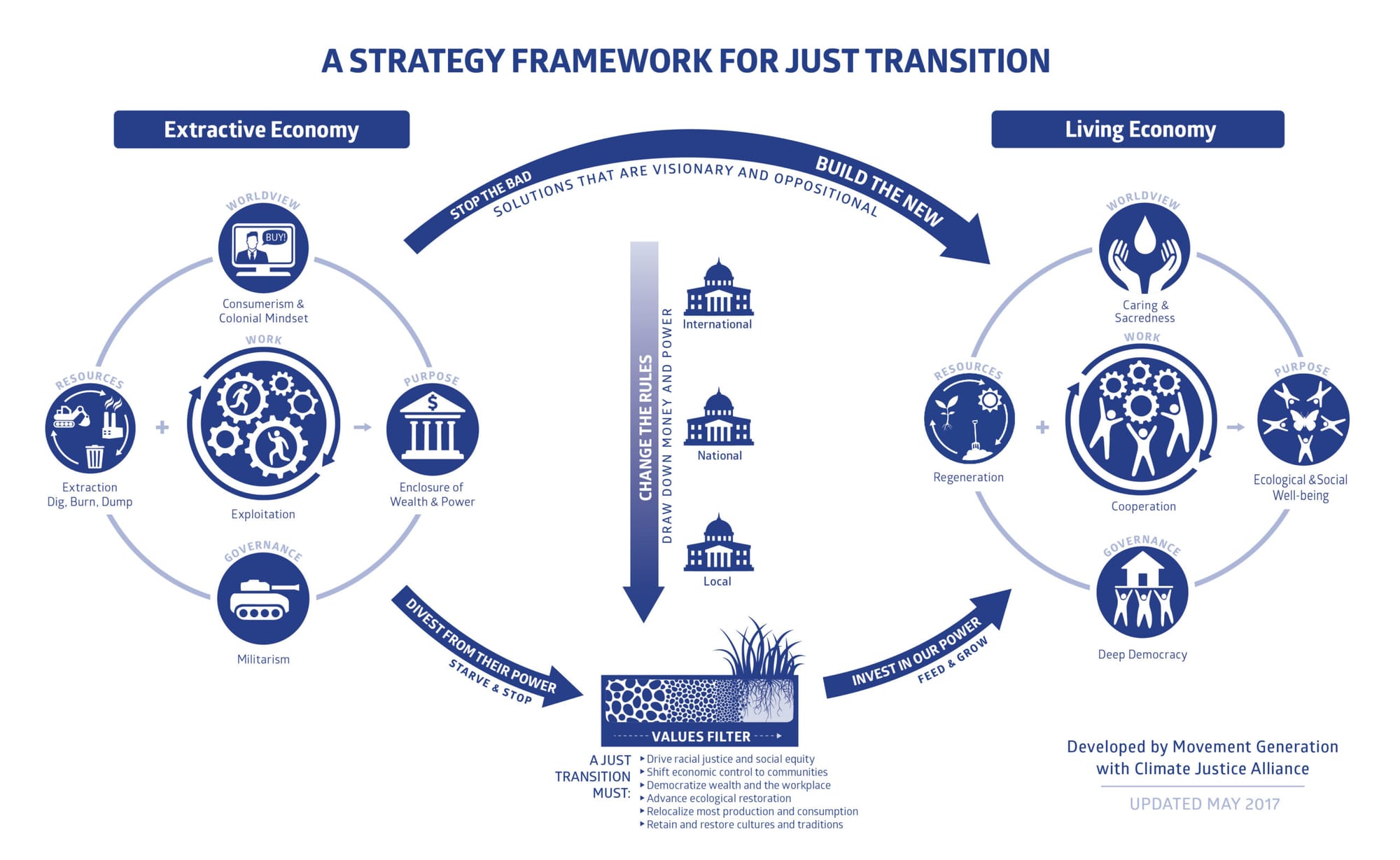
As with degrowth, just transition unpacks how the extractive growth economy drives ecological destruction and the climate crisis. In order for the economy to grow, more resources—more nature—must be captured and consumed by society. That means that more forests must be torn down, more pits must be opened to pull ores from the Earth, more wells must be drilled, more rivers must be dammed. The laws of physics dictate that all of these activities must submit themselves to the inevitability of entropy. Waste is unavoidable. Decay is unavoidable. Right now, the bulk of that waste and decay presents itself as carbon emissions.
But even the low-carbon components of the economy are subject to these same entropic forces. This is why the people of the Congo are being poisoned as the nation’s forests are felled, as its precious stores of cobalt are retrieved from the country’s undersoil, and as the pollution from that mining flows into its rivers. This is why Indigenous peoples within the Lithium Triangle of Bolivia, Argentina, and Chile are having the water they depend on stolen to flood the vast basins within which lithium deposits form as that water slowly evaporates.
These are the damages of an extractive economy—whether fueled by coal or wind—that a just transition seeks to replace.
“The just transition framework is really about a living economy, an economy that’s meeting the needs of people and planet,” Gruen said. “The conversation then that we’re having is really about, how do you create an economy that’s actually producing for [people’s] needs and not creating all this waste?”
Though the language is different, and though Gruen and his colleagues avoid saying “degrowth” and “post-growth,” he sees the work of the People’s Economy Lab as overlapping with the broader post-growth movement. Other frameworks do this as well, like the solidarity economy, donut economics, and buen vivir.
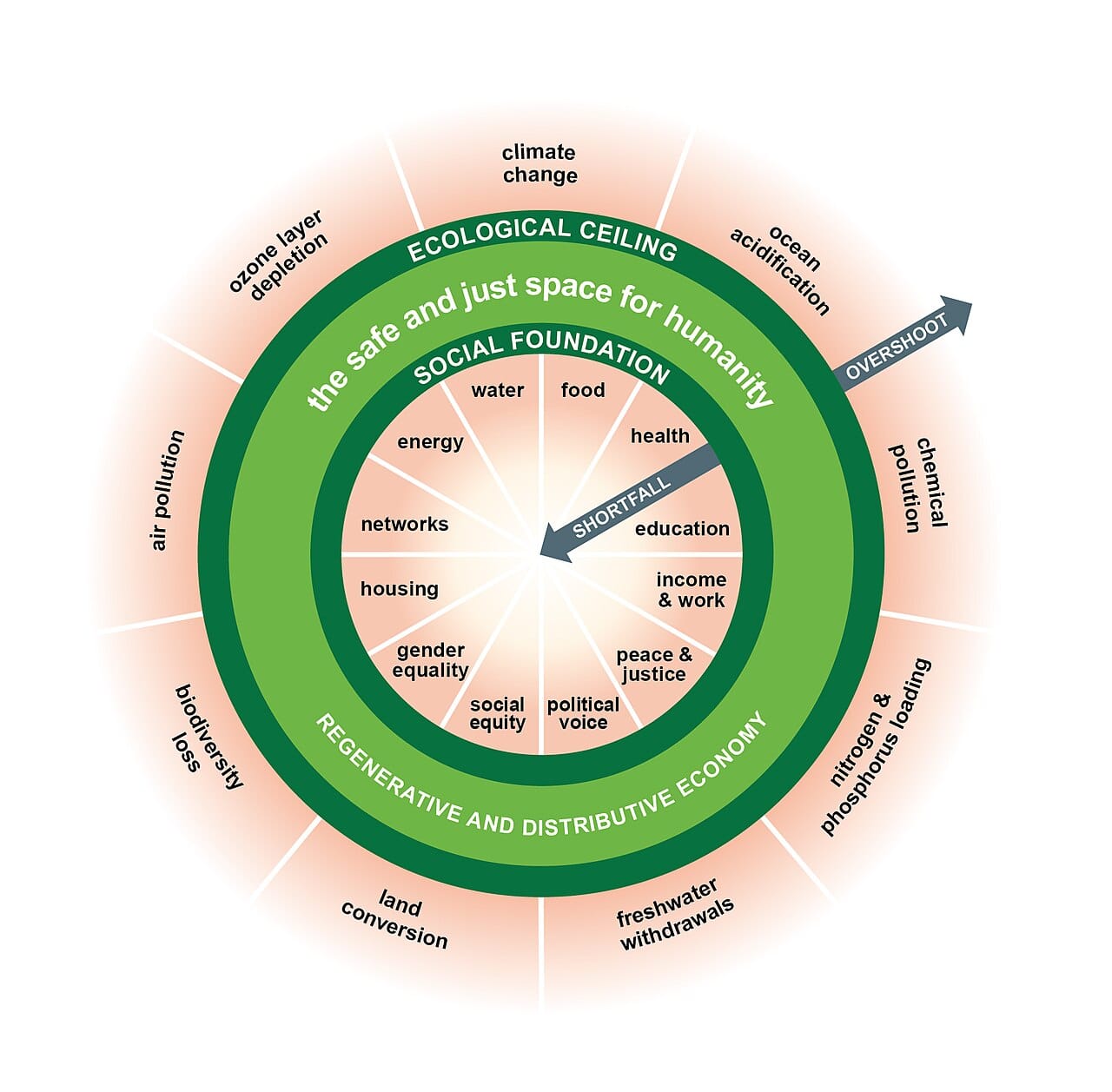
“It’s really just a signaling thing, “ Gruen said. “I care less about the particular words than the understanding of them.”
Because Movement Generation and the CJA have done a great job publicizing and spreading their framework over the last decade, the just transition framework has become a much more sophisticated tool for organizing communities, he feels. Whereas “[degrowth] is not actionable in the Seattle context,” he added, “because the narrative’s not there.”
Ending Extractivism and Empire
Another reason “degrowth” may resonate less with U.S. movements for climate justice is because most of the conversations around it overlook how colonialism and racism have compounded environmental issues for communities of color.
Given that Movement Generation, People’s Economy Lab, and CJA are often working in and with Black, Indigenous, and other communities of color, and with disenfranchised peoples more broadly, they’ve made a coordinated effort to speak to their experiences—something degrowth advocates seemingly have yet to do.
Early in the evolution of degrowth in the United States, scholars acknowledged that Black people were likely to be turned off by the idea because they have so often borne America’s burdens and, even in a growing economy, been left behind. Moreover, the extraction of lumber, metal, coal, oil, and other resources in the Americas is only possible because of the land theft and genocide of Indigenous peoples. So some scholars have argued that degrowth advocates must incorporate reparations, restorative justice, and Land Back into the aims of their overarching campaign, something that has become increasingly central to the climate justice movement.
“The problem is extractivism and empire,” Gopal Dayaneni, one of the co-founders of Movement Generation, said of the just transition framework. Dayaneni and Movement Generation at large urge us not to fixate on carbon emissions.
“It's not that I'm pretending that atmospheric loading of greenhouse gasses isn't a problem…it's just that the strategic points of intervention are not in the atmosphere; they're in the economy.”
Whatever terms someone chooses to use to describe their work: organizing the economy around something other than growth and profit will be critical to society’s ability to address the fundamental drivers of the climate crisis. Thankfully, despite the relative absence of explicit degrowth terminology in many community-led initiatives, many projects that can contribute to such an economic reorientation are already underway in Europe, in the United States, and around the world.
One of Degrowth California’s local hubs even went so far as to map out organizations and resources that are supporting the solidarity economy in the broader San Francisco Bay Area. On a national level, the New Economies Coalition and the U.S. Solidarity Economy Network have organized a larger-scale coordination of worker co-ops, mutual aid efforts, and other alternative economy projects, as has the Seed Commons. The U.S. Solidarity Economy Network has also begun to connect just transition movements in the Global North with Global South-rooted projects like the Global Tapestry of Alternatives, a “confluence” of countless movements for economic and social alternatives from around the world.
Deceleration Podcast
 Marisol Cortez
Overall, whether people realize it or not, most communities likely already have efforts underway that can contribute to the broader cause of degrowth, whether they call it that or not. Scholars like Arturo Escobar have argued that there has been a flowering of numerous “transition discourses” around the world, each specific to the histories and landscapes of their communities.
Often finding these alternatives is just a matter of knowing where to look in your own community.
“Degrowth can be so vague and so nebulous,” Arellano said, and so it provides room for a lot of different undertakings. “Your local bike repair shop, your electronic repair cafe, your tool library, or your worker co-op” can all be part of it. “And those exist everywhere, and are more and more, becoming more and more popular.”
-30-
ABOUT THIS SERIES: For decades, governments across the globe have assumed that constantly increasing their GDP promised to solve all the social and economic problems that confronted their citizens, from poverty to education and beyond. But as economic growth has become an the all-consuming obsession of nations, it has instead spurred overlapping and interconnected crises to deepen year after year. Poverty has worsened. Wealth inequality has grown. Climate change has accelerated. Homelessness has increased. All while the economies of the richest countries in the world continued to grow without any of that accumulated wealth reaching those who need it the most. In response to this, activists, academics, and everyday people have begun to call for new ways of assessing how we measure well being in our societies. One of these emerging models is known as degrowth. This series examines what degrowth is, how is has evolved, and where its principles are being put into practice.


.jpg?ref=deceleration.news)