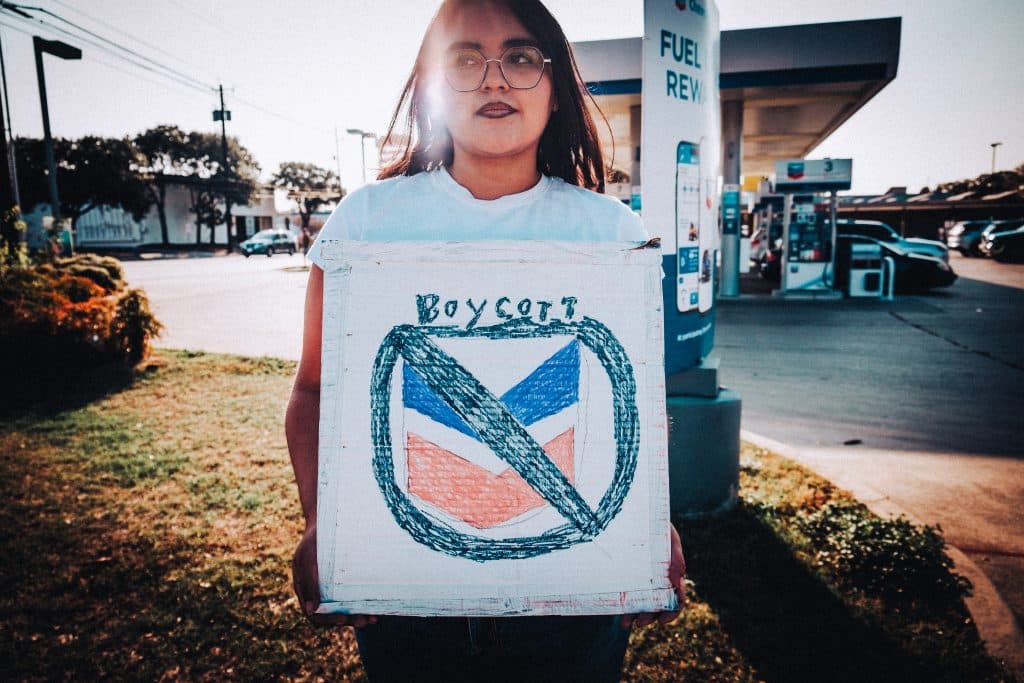
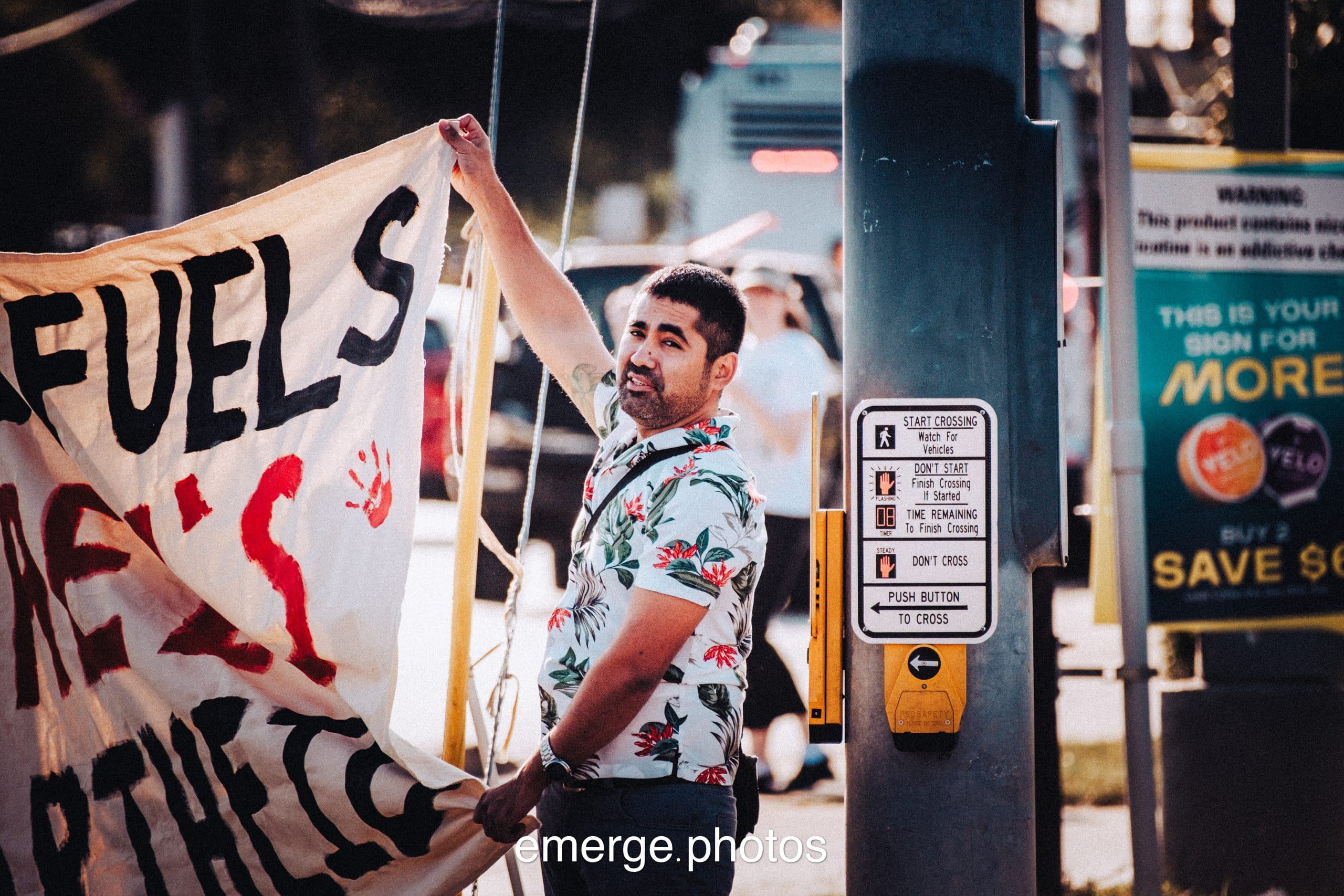
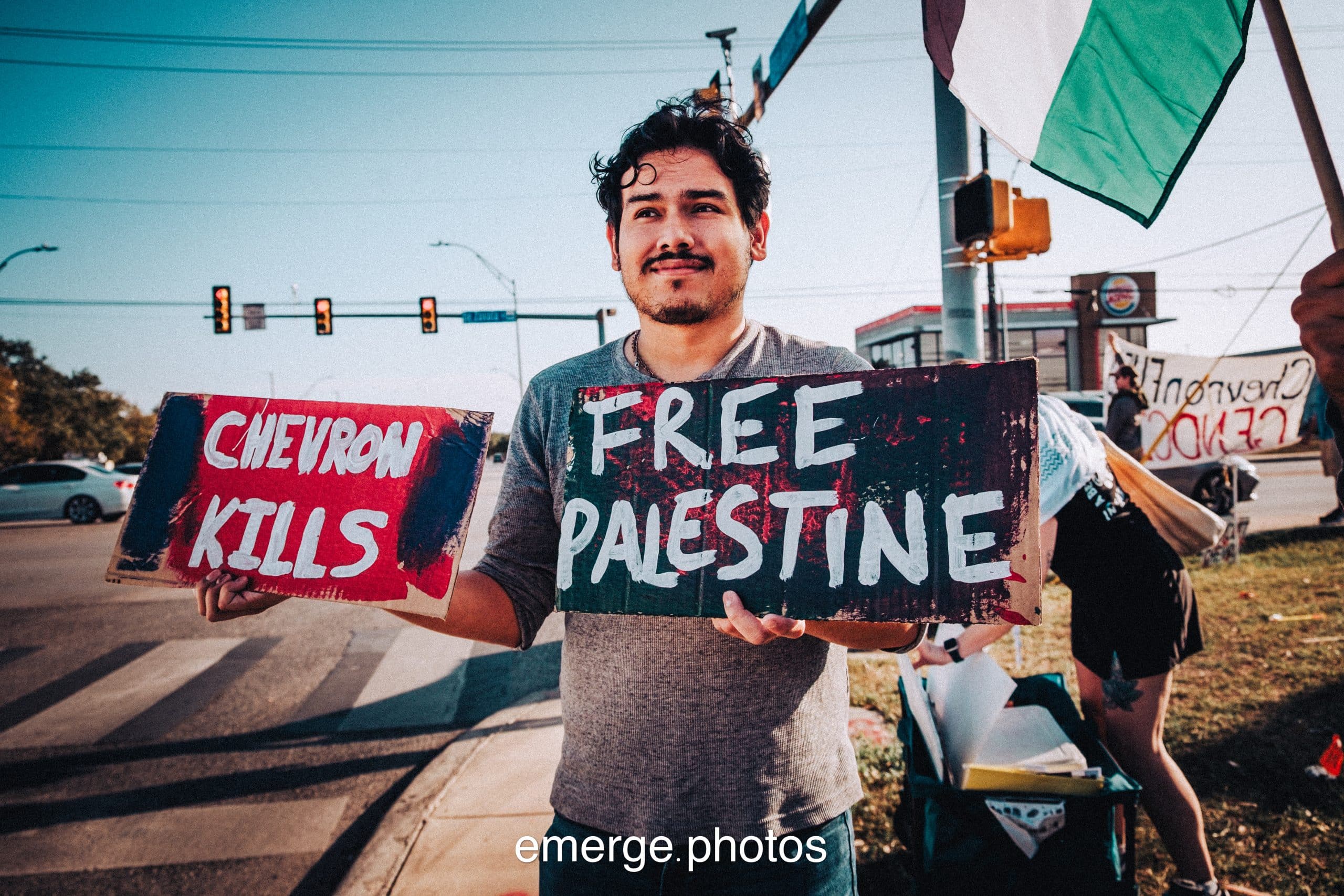
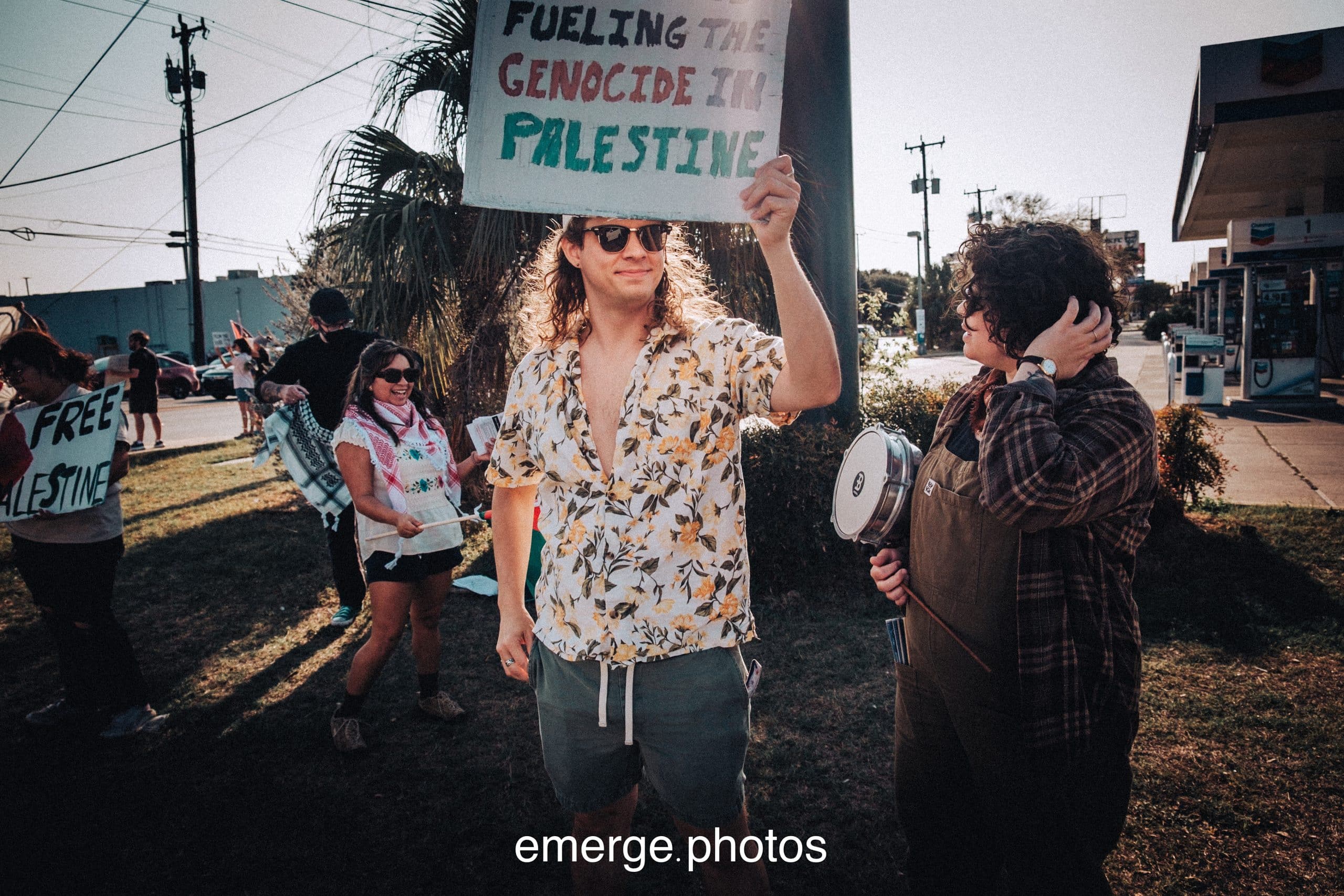
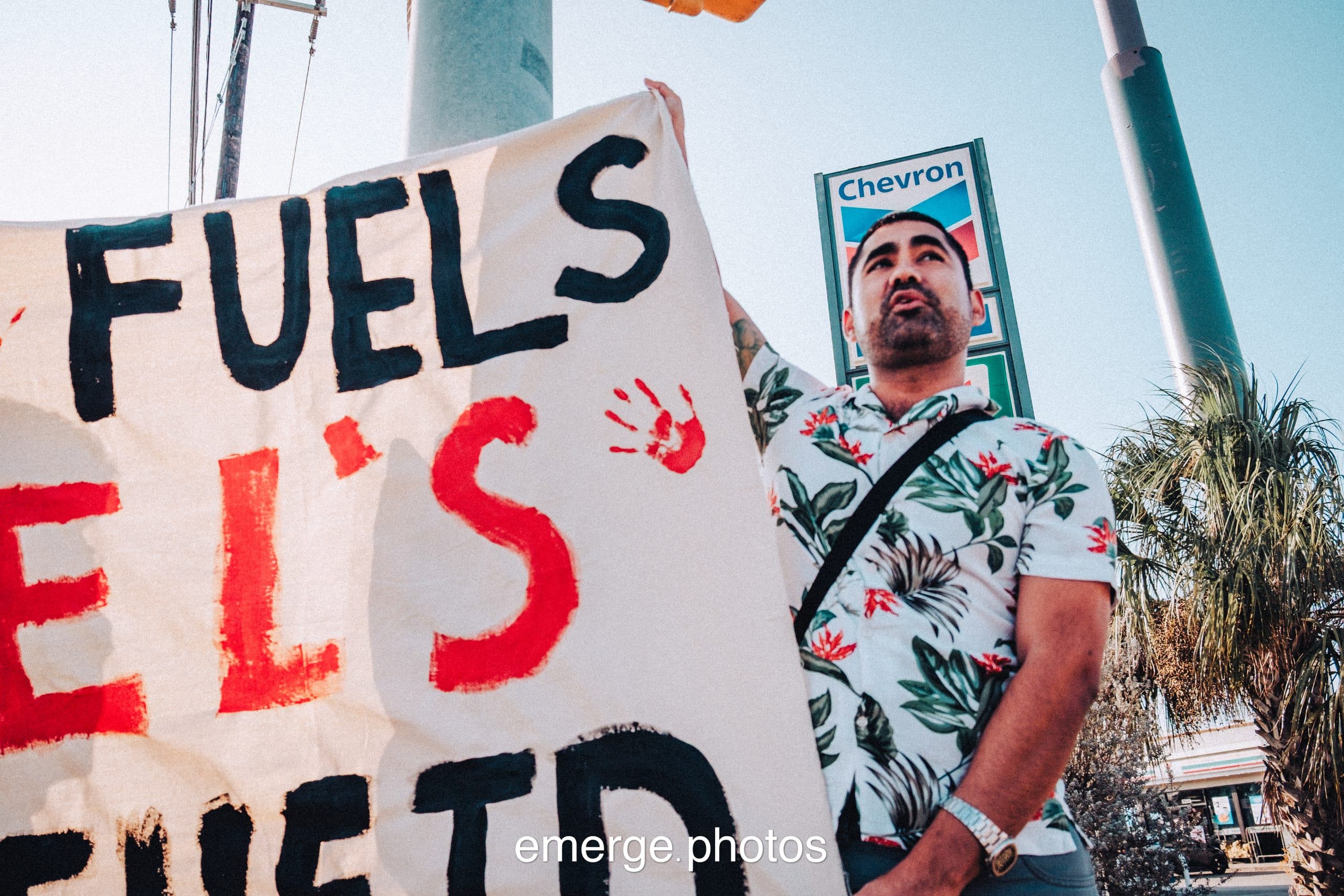
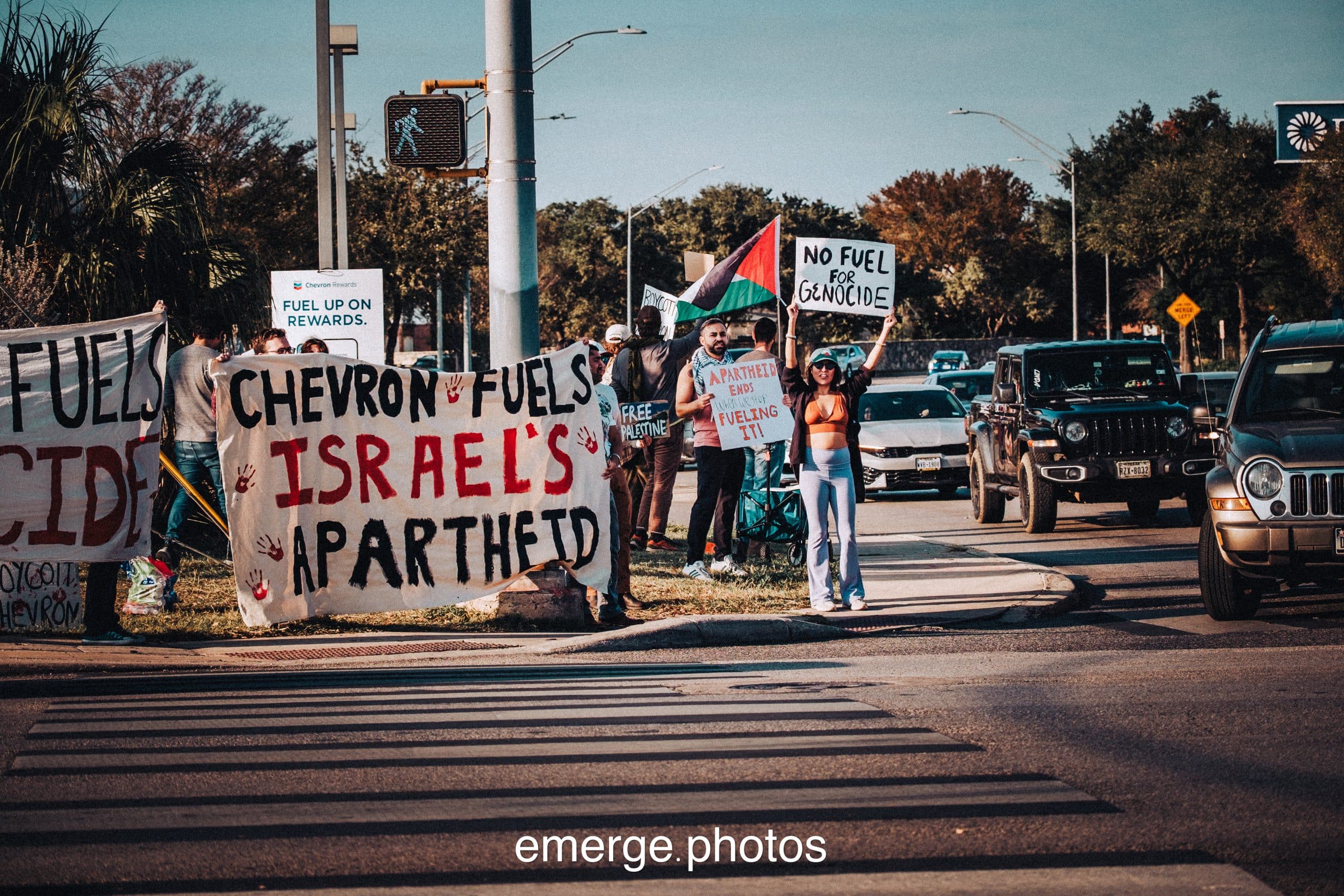
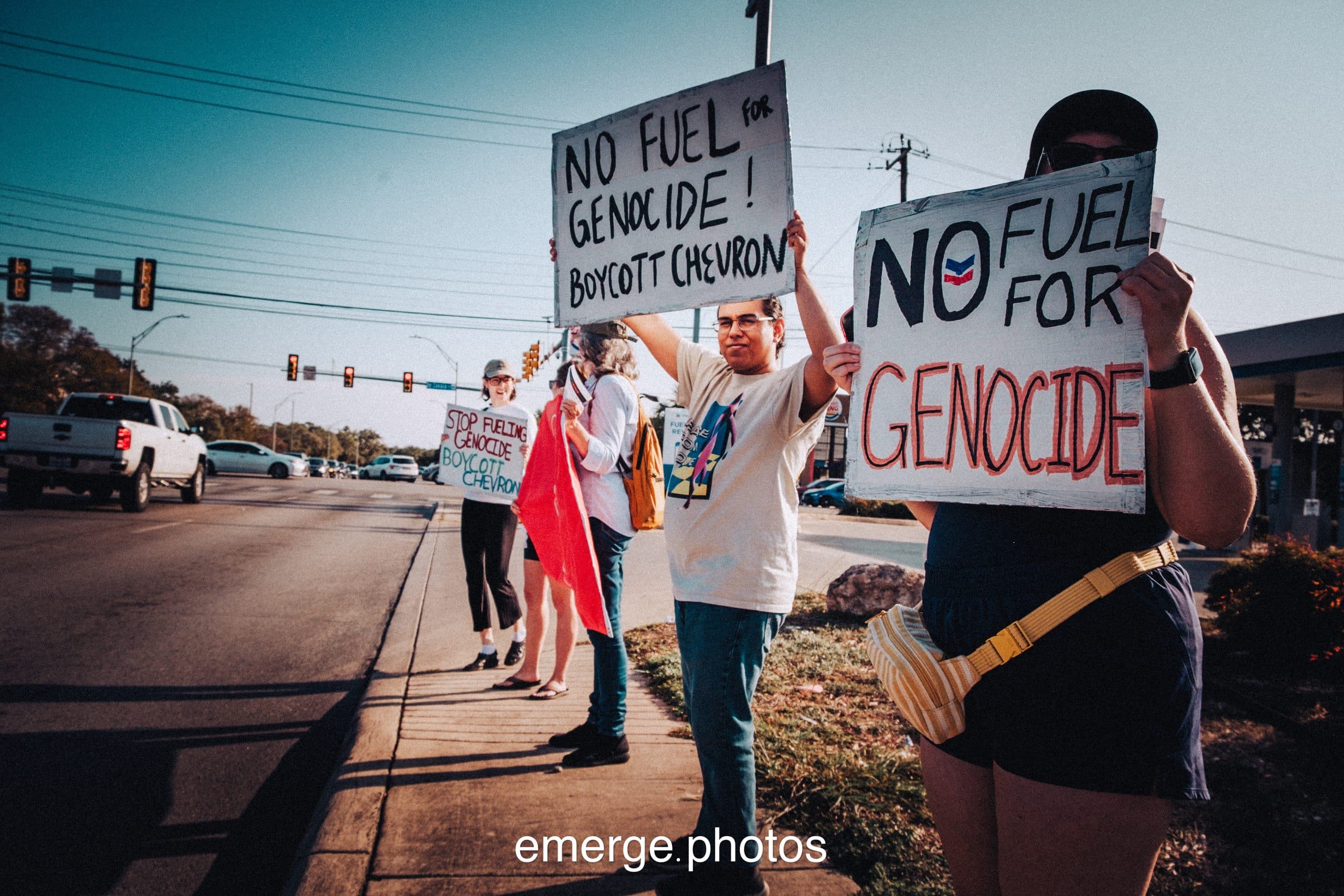
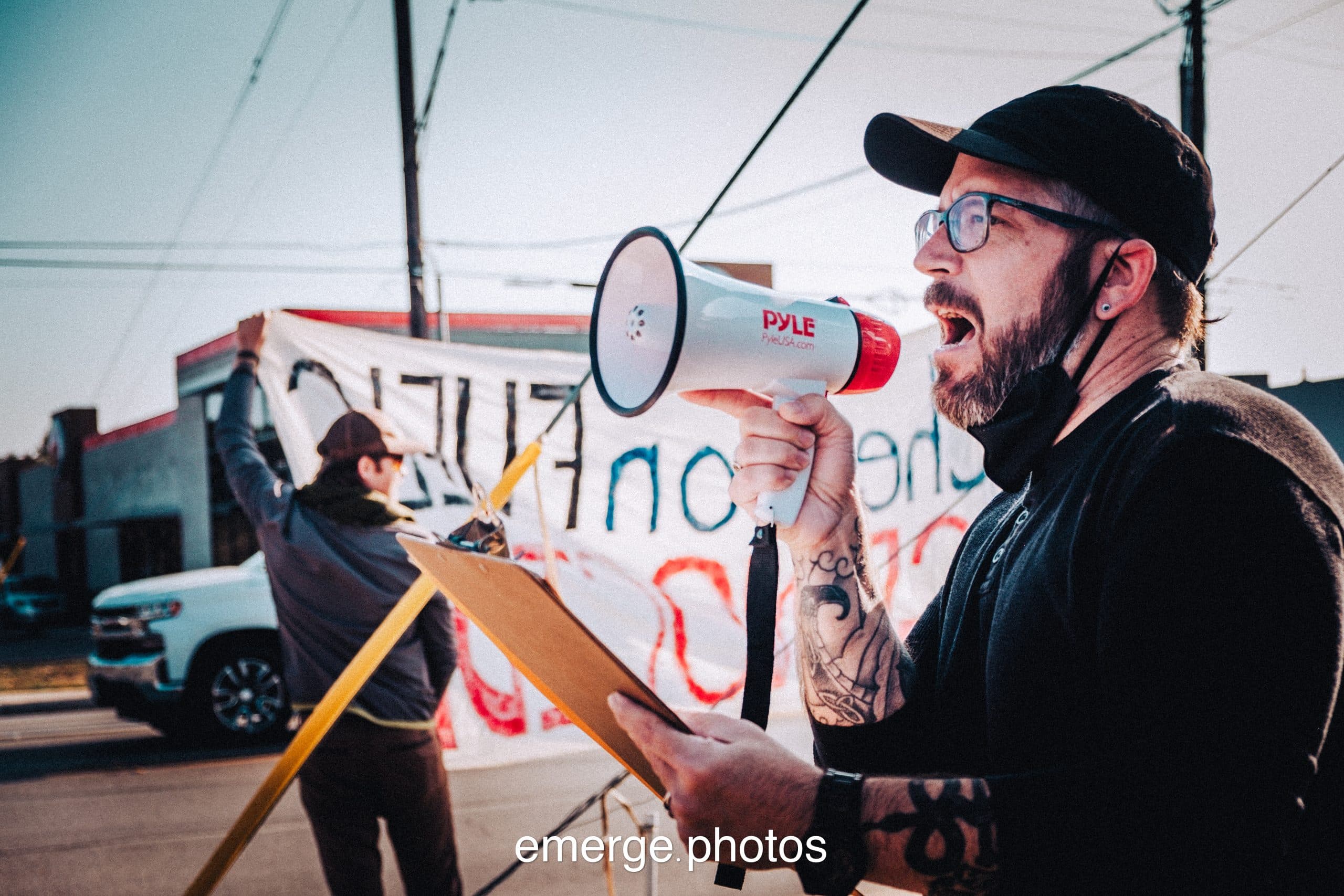
As negotiators at COP30 in Belém, Brazil went into overtime over the weekend—trying and failing to reach official commitments to phase out (or even mention) fossil fuels and end deforestation worldwide—a line of picketers surrounded the perimeter of a Chevron station on San Antonio’s northwest side, urging drivers to fill up elsewhere.
Chevron is “the largest natural gas supplier in occupied Palestine,” explained Lexy Garcia, a member of the San Antonio chapter of the Democratic Socialists of America (DSA). “Israel’s machine of genocide couldn’t run without the fuel from Chevron. And we are here picketing to discourage all drivers from fueling up with Chevron, today and everyday.”
Saturday, November 22 was a national day of action called by the Boycott Divest Sanctions (BDS) movement, which organizes global boycotts of companies that have played an outsized role in Israeli occupation, apartheid and genocide in Palestine. Locally, DSA’s “Stop Fueling Genocide” campaign is one of two BDS campaigns that seek to make local investments in Palestinian genocide both visible and politically toxic for the companies that profit from it. For the past year, the “Cut Out Caterpillar” campaign has also set sights on Caterpillar, which manufactures the heavy machinery long used under Israeli occupation to destroy Palestinian buildings and homes.
Significantly, both companies have played equally outsized roles in producing the climate emergency under global discussion in Brazil—specifically for Indigenous and Afro-descendent communities of the Amazon, whose voices a People’s Summit running parallel to COP30 sought to center and assert. Before its more recent role in the destruction of Palestinian life and land, Chevron for decades has been the face of fossil fuel extraction in and pollution of the Amazon, while Caterpillar’s machines have helped power the deforestation that has brought the lungs of the world to a “tipping point,” according to one of Brazil’s leading scientists.
Likewise, global climate movements have recognized Palestine’s centrality to struggles for “a world organized for life,” in the words of San Antonio for Justice in Palestine organizer Sara Masoud. A September 2025 report released by Tipping Point North South and Palestinian Institute for Climate Strategy has called on the International Criminal Court to “recognise ecocide as the fifth international crime” and factor climate harms into Palestinian reparations, estimating the total cost of all military-related carbon emissions since the 1947 Nakba at $148 billion.
Israel has thus not only committed genocide but also ecocide, “as an act of destruction of people and the environment upon which survival depends.” As such, “climate justice requires that reparations account for both the measurable carbon costs and the deeper ecological, cultural, and social destruction that no metric can fully capture.”
Similarly, the “Final Declaration of the Peoples’ Summit Toward COP30” explicitly acknowledges the importance of the BDS movement to accountability on climate:
“The advance of the extreme right, fascism and wars around the world exacerbates the climate crisis and the exploitation of nature and of peoples. … We offer our support and solidarity to the people who bravely resist, and to the Boycott, Divestment and Sanctions (BDS) movement.”
Or as Garcia said, “every single drop of fuel that doesn’t go into [someone’s] car today is a single grain of sand in the gears of Israel’s genocide of Palestinians.”
Ride Against Genocide
Talking with Deceleration at the start of DSA’s Chevron campaign, James Finley, who co-chairs a BDS working group within DSA, initially shared our surprise that Valero was not the target of local campaigns, given previous actions held at its corporate headquarters in San Antonio.
According to the American Friends Service Committee (AFSC), a Quaker organization that has long supported people’s campaigns against militarism and occupation globally, Valero is a long-time supplier of jet fuel to the Israeli military. In March 2024, a supply chain analysis for Oil Change International alleged that Valero had shipped two tankers of fuel to Israel after October 2023, both from the Bill Greehey refinery in Corpus Christi, as part of military aid provided by the United States. Asked to comment on these allegations in September 2024, after the UN’s International Court of Justice declared Israel’s occupation of Palestine to be unlawful, Valero stated:
“We do not sell fuel to Israel or the Israel Defense Forces. We are, however, a contractually bound supplier of various fuels to the United States military in several locations, including their use at U.S. military bases.”
In other words, Valero sells fuel to the US government, which in turn supplies that fuel to Israel as part of its military aid. A February 2025 announcement suggests that this relationship is ongoing, with Valero securing “a $200 million contract from the U.S. Defense Logistics Agency to deliver EN590 diesel and J8 jet fuel to Israel.”
Asked to offer clarifications or comments, a Valero spokewoman reiterated the company’s previous statement:
“We do not sell fuel to Israel or the Israel Defense Forces. We are, however, a contractually bound supplier of various fuels to the United States military in several locations, including their use at U.S. military bases. Valero operates in compliance with all applicable laws.”
Slideshow One
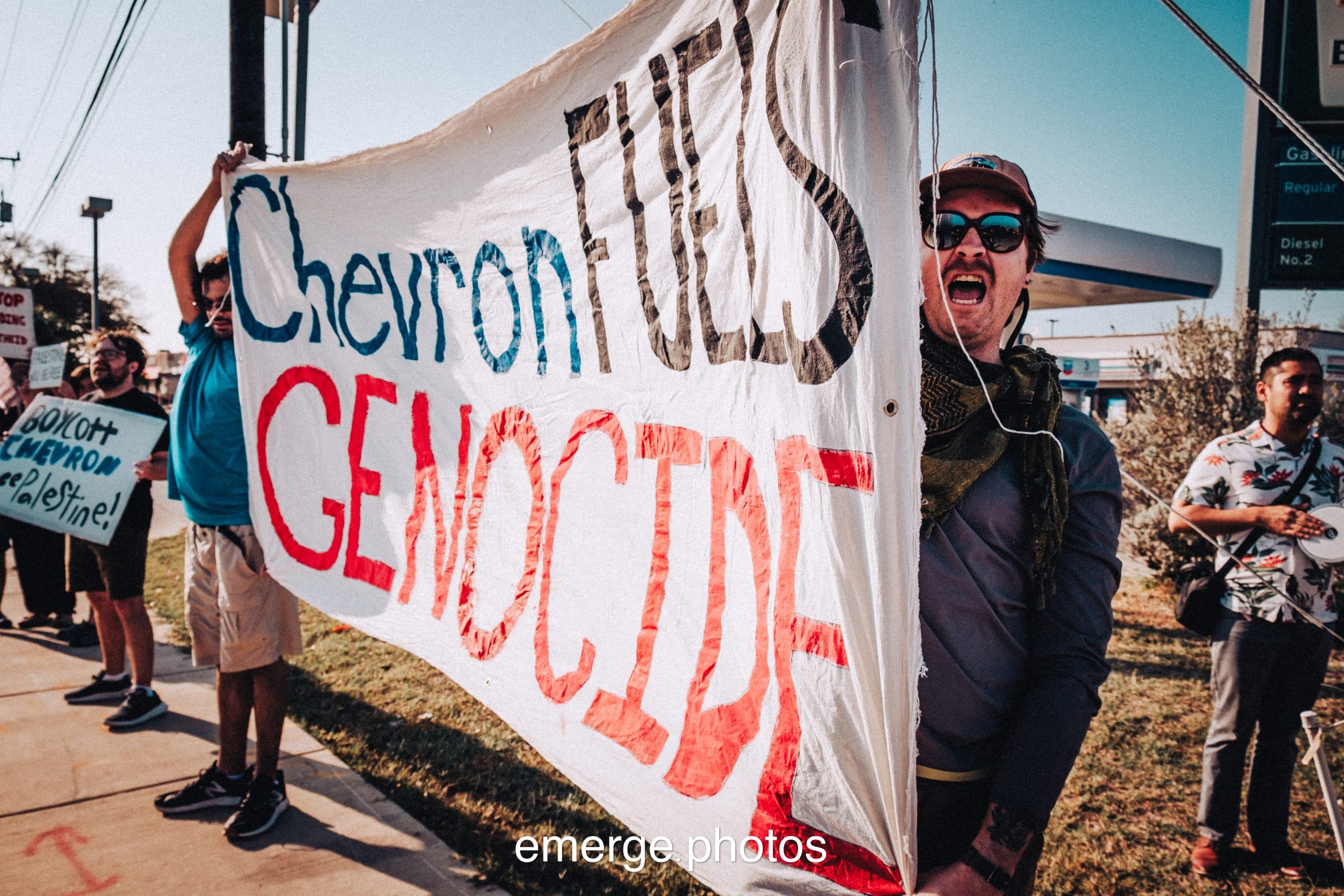
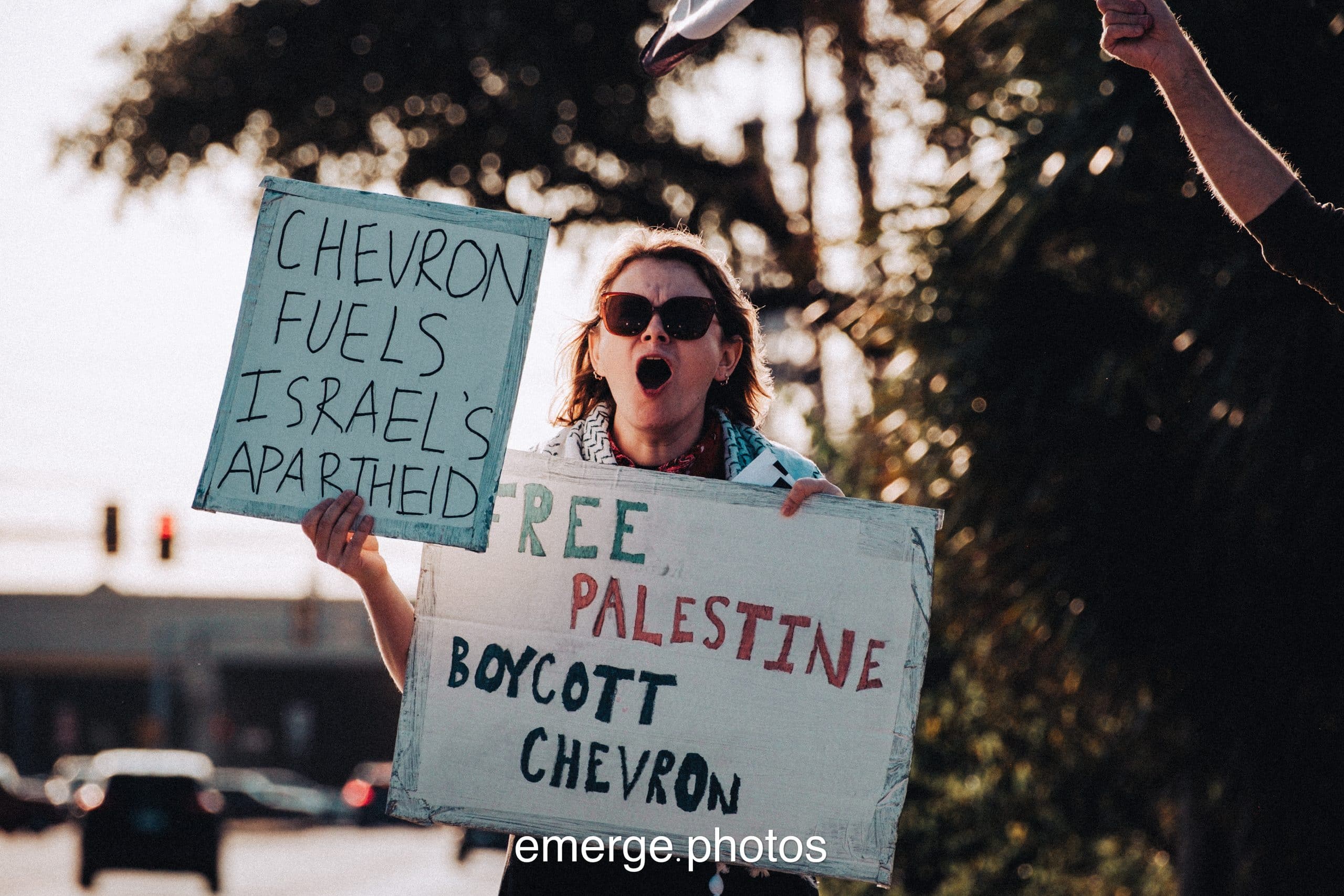
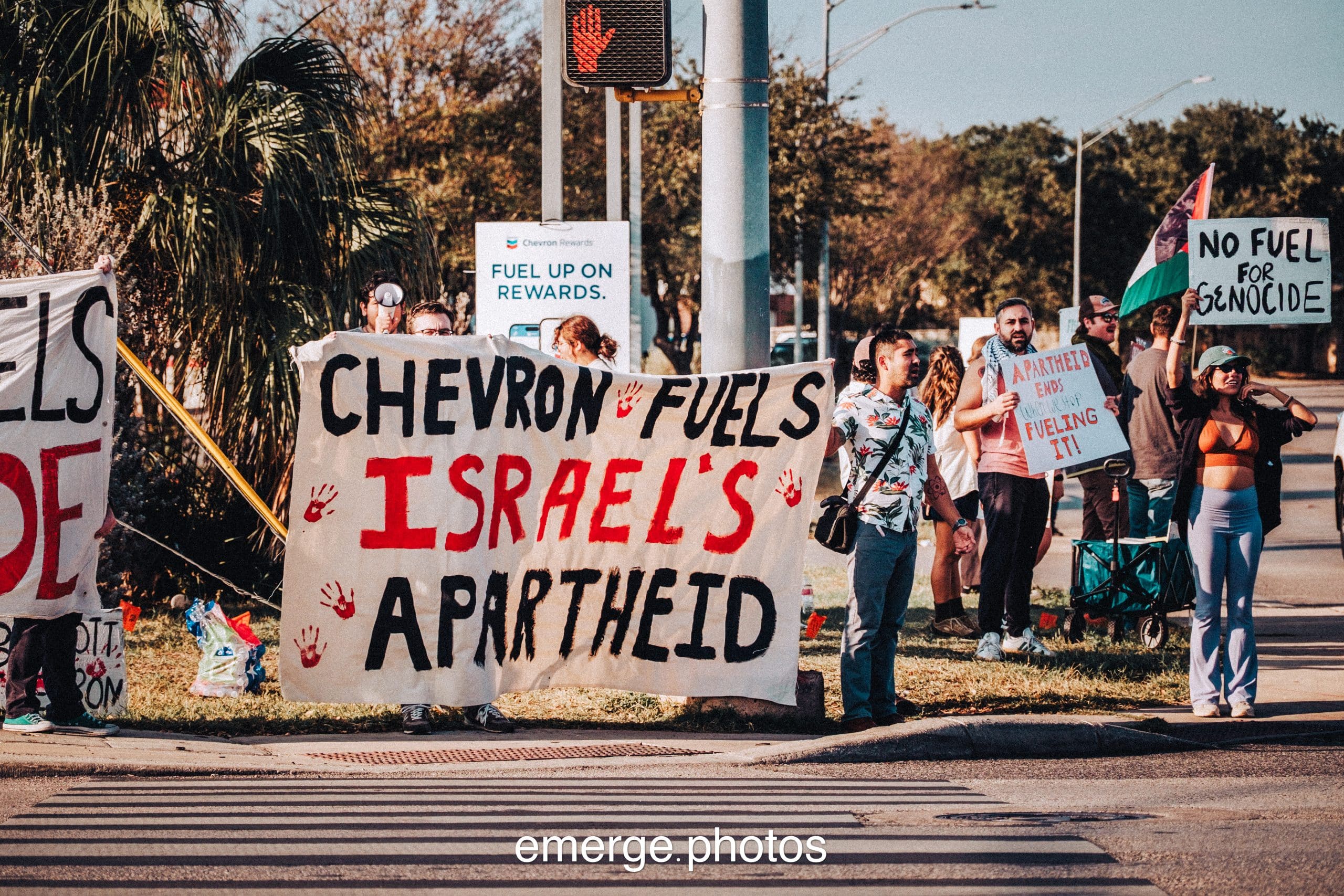
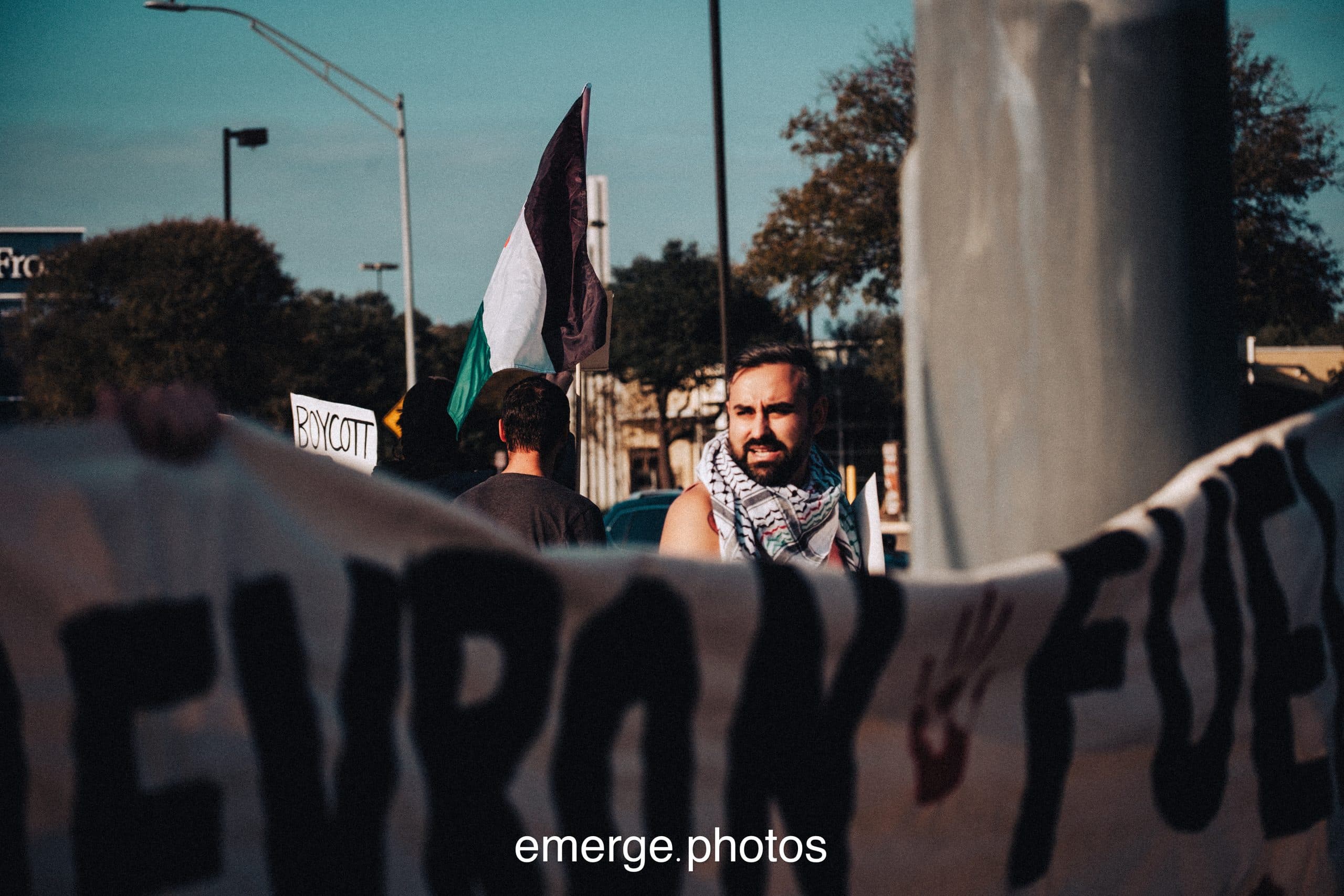
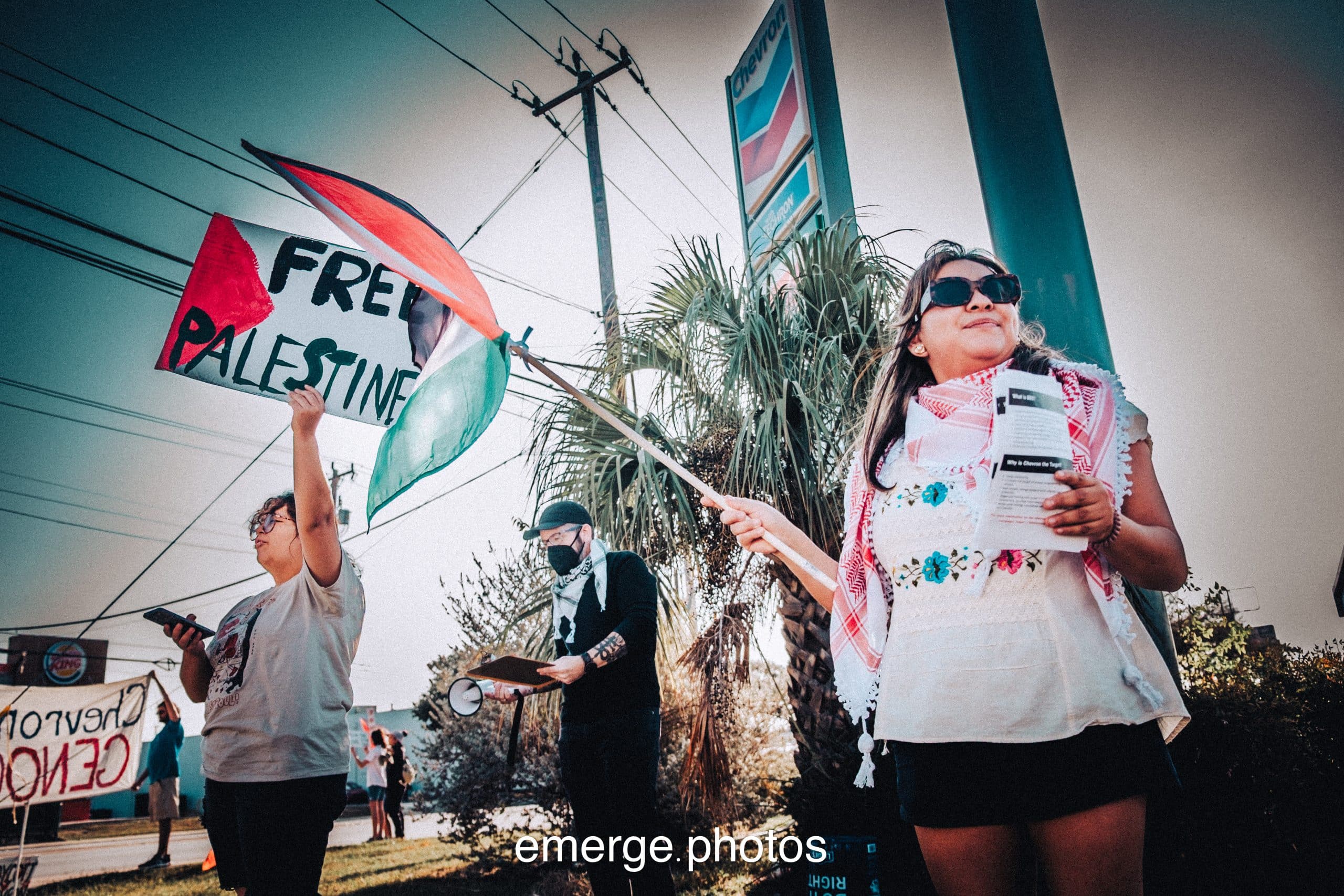
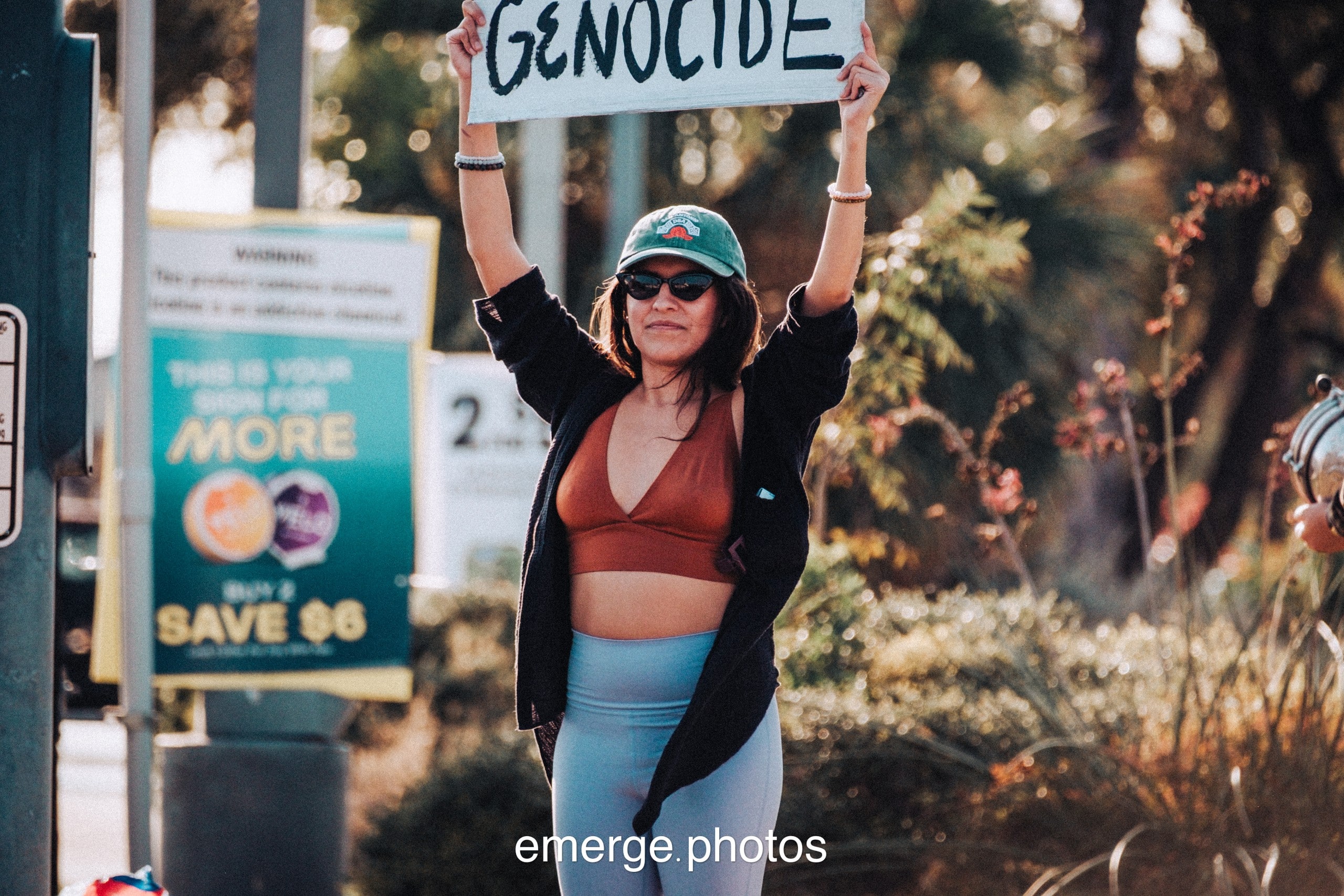
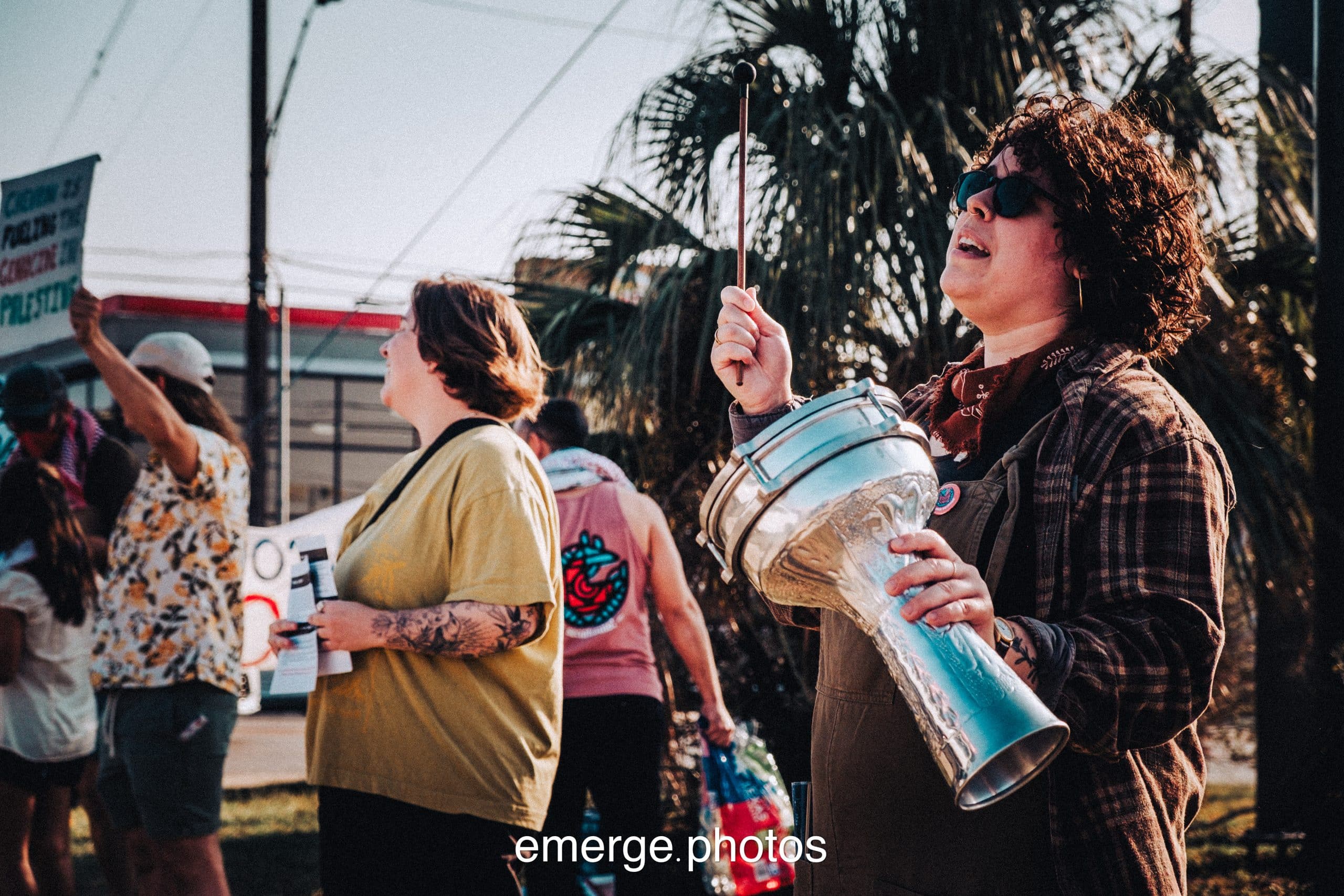
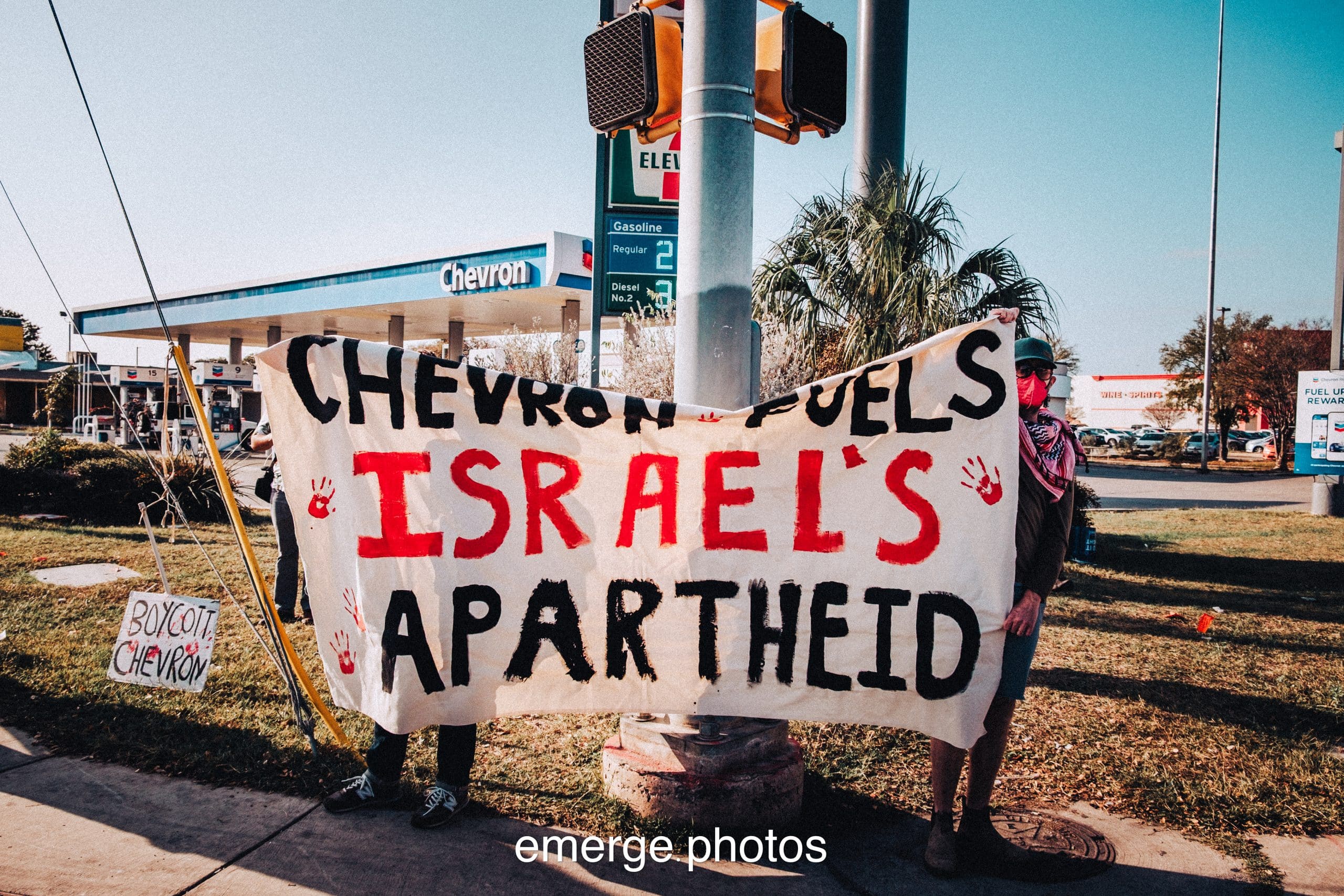

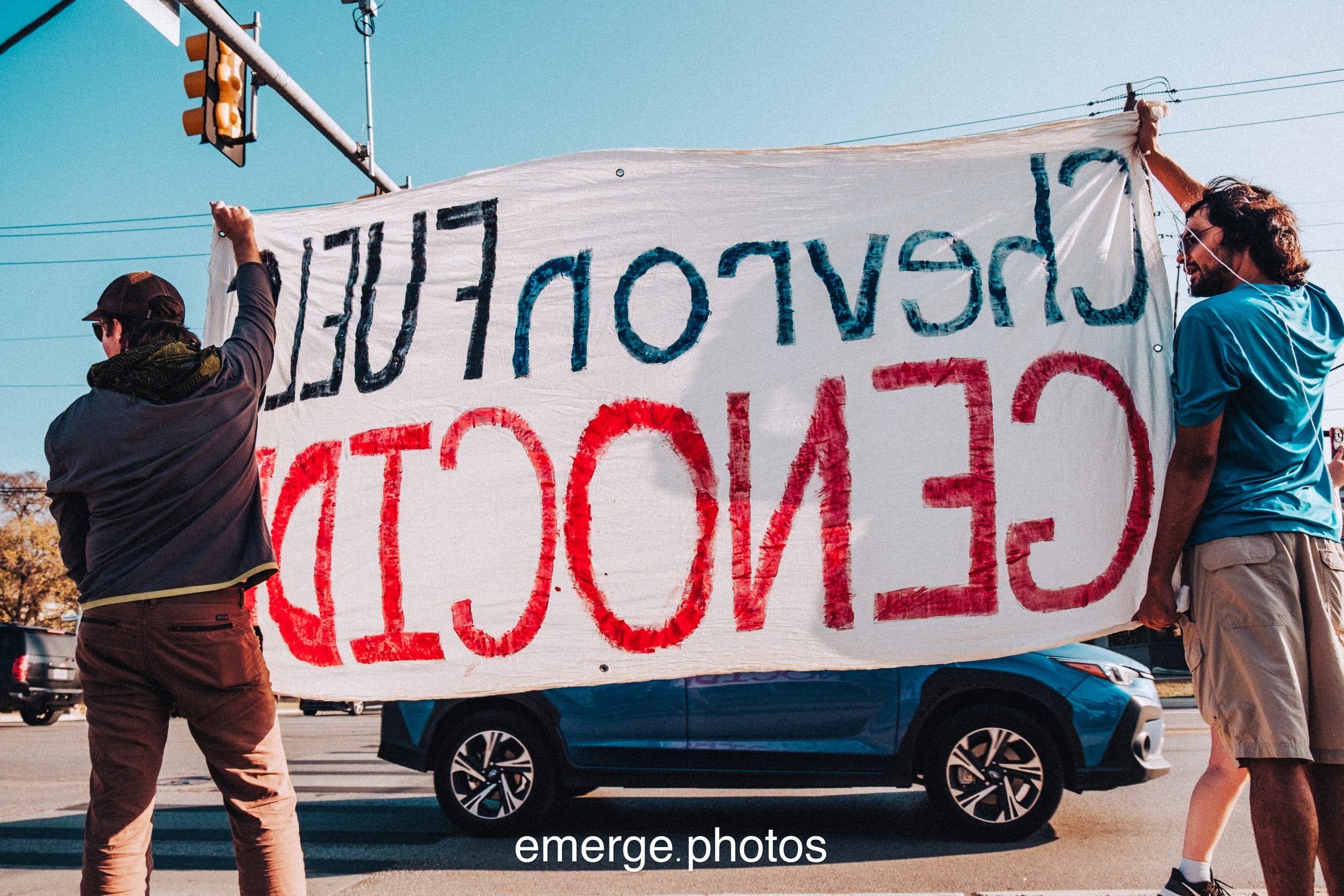
While this history puts Valero on the BDS divestment shortlist compiled by the AFSC, both Garcia and Finley said that the BDS movement has chosen to focus its energies on Chevron, part of its longtime strategy of selecting corporate targets that play a central role worldwide in supporting or normalizing occupation, apartheid and genocide. According to Finley, Chevron is the only oil and gas company currently on the boycott list, and a “Stop Fueling Genocide” bike ride and walk that kicked off the local campaign this past September alluded to the company’s wider histories of ecocide and human rights violations.
“Chevron has been a target [of justice movements] for decades,” Finley said, “especially in the Amazon. They’re the most polluting oil company, with the highest rates of land theft, disappearing of activists, and violations of treaties and legal settlements.”
Whereas Valero supplies fuel to the Israeli military, Chevron’s role has been to extract the fossil fuels that power almost half of Israel’s electricity generation, including for its settlements, prisons, and military operations. The company is Israel’s largest producer of natural gas and oil, with some of its rigs and pumps off the shore of Gaza. “That itself is a violation of international law, because Palestinians haven’t agreed to that,” Finley said. As with Shell Oil in the Ogoniland region of the Nigerian delta, Palestinians have received none of the royalties from Chevron’s extraction activities on their land.
Moreover, Finley said, Israel’s destruction of Palestine’s electrical infrastructure alongside water, sanitation, and health care systems has made Gaza in particular dependent on purchasing fuel and electricity from Israel, all to the benefit of Chevron.
“So Chevron is profiting from Israel’s destruction of Palestinian infrastructure,” said Finley, “much like Israel outlaws the drilling of water wells which then forces Palestine to buy water from Israel.”
At the same time, Chevron is a relatively new partner, beginning its relationship with the state of Israel only in 2020. “Because it doesn’t have a longstanding history, it’s more likely to cut ties,” said Finley.
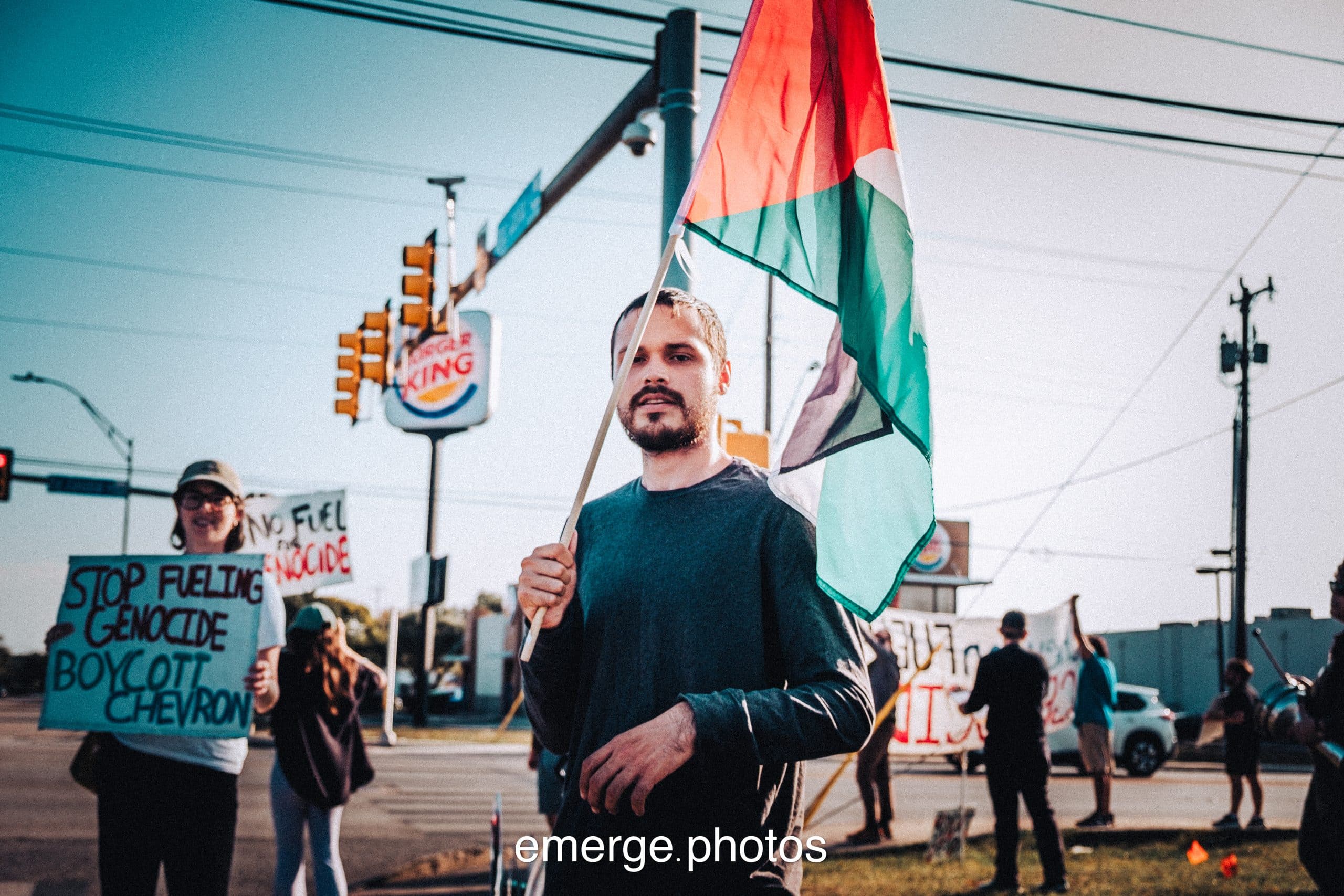
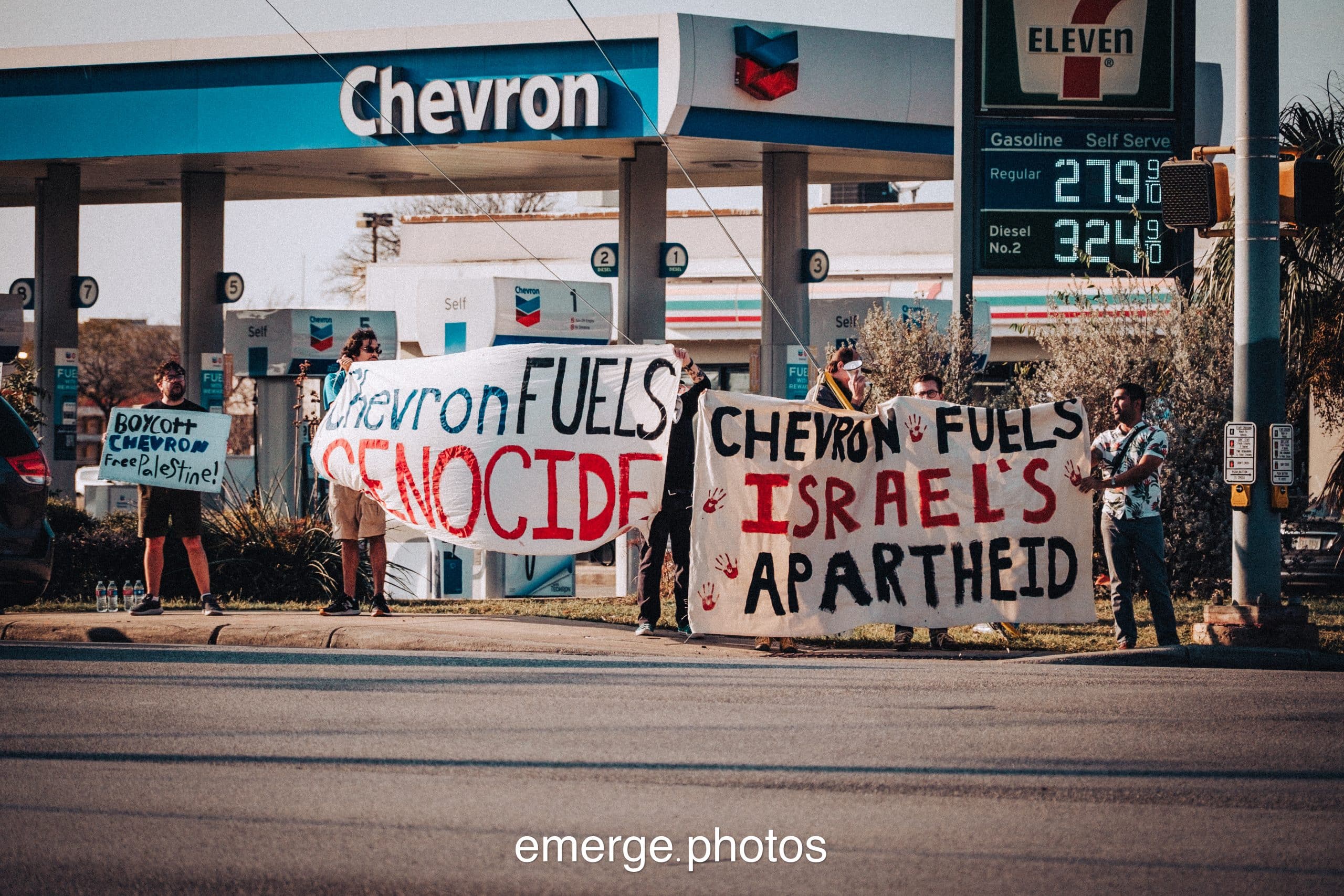
The Chevron station picket in San Antonio marks the beginning of a broader US campaign to step up pressure on the company, which recently moved operations from California to Houston (“the policies [in Texas] are welcoming of energy companies,” Chevron executive Mike Wirth said). In addition to asking drivers directly to boycott Chevron and to communicate this decision to CEO Wirth, Stop Fueling Genocide is also talking to the franchise owners of San Antonio’s 57 Chevron-branded filling stations, asking them to sign onto a national petition urging Chevron to divest from its business ties to Israel.
So far drivers have seemed supportive, according to Garcia.
After a day’s picketing, the gas station owners agreed to place a sign in the window of their store, which reads: As an independently owned and operated gas station with Chevron branding, we call on Chevron corporation to end its role in violations of human rights globally, including in Palestine.
“Then once we get Chevron,” Finley said at the start of the campaign, “we can go after Valero.”
Slideshow Two
Cut Out Caterpillar
Another local campaign that aims to connect the dots between local economies and Israeli occupation and genocide concentrates on the heavy equipment manufacturer Caterpillar. A multi-national corporation headquartered outside Dallas, Caterpillar’s local subsidiary HOLT CAT is owned by Peter J. Holt, heir to Caterpillar’s founder and current Chairman of Spurs Sports & Entertainment (soon to benefit doubly from the advancing multi billion-dollar stadium and entertainment district codenamed Project Marvel). While not currently a priority boycott target for the BDS movement, organizers with the “Cut Out Caterpillar” campaign told Deceleration that the company has been the subject of previous international campaigns for its longstanding and very material role in Israel’s occupation and apartheid rule in Palestine.
According to the American Friends Service Committee, Caterpillar is “the world’s largest manufacturer of construction and mining equipment,” weaponized since Israeli’s founding in 1948 to support ongoing occupation and apartheid on Palestinian lands.
“Its products … are used in home demolitions,” writes the AFSC, “in the construction of illegal settlement infrastructure, border walls, and military checkpoints; and in military assaults against Palestinians.”
Since October 2023, Caterpillar’s D9 armored bulldozer in particular has been central to the genocidal ground invasion in Gaza, “accompanying combat troops and paving their way by clearing roads and demolishing buildings.”
As with Chevron, Caterpillar’s track record of profiting off colonial violence abroad extends beyond Palestine. As Cut Out Cat members point out, Cat machinery has been implicated in environmental and labor abuses around the world, from strip mining in the Congo to deforestation in the Amazon, where Caterpillar backhoes are the second most-frequently seized equipment by the Brazilian government from illegal mining operations on Indigenous lands and in conservation areas. Closer to home, Cat equipment has cleared Indigenous land for construction of the Dakota Access and Line 3 pipelines and helped construct the Border Wall.
Since launching in the summer of 2024, Cut Out Cat has organized multiple art builds, banner drops, and guerilla projections as they educate community members on connections between San Antonio’s local elites and the bulldozing and destruction of Palestinian lives, livelihoods, and land. More recently, Cut Out Cat has spoken at the Bexar County Commissioner’s Court to urge the County to drop its contracts with the company and also widened their campaign strategy to include secondary targets like White-Conlee Builders—a local developer of luxury apartments that utilizes Cat machinery—and even tertiary targets, which provide resources and services to companies like White-Conlee.
For those who have organized more locally against the coloniality of displacement, White-Conlee’s name prompts an uncanny sense of déjà vu.

In 2014, White-Conlee Builders approached the City of San Antonio to request the rezoning of Mission Trails Mobile Home Community to allow construction of luxury apartments on that site, drawn by the rising land values triggered by redevelopment of the Mission Reach.
Residents of Mission Trails did not realize their homes had been bargained out from beneath them until they saw yellow rezoning signs pop up outside the park. And though they organized to fight for their homes, the City ultimately granted the rezoning, displacing approximately three hundred residents in the process, many who had lived there for years. Three residents died in the months after displacement, as I helped Vecinos de Mission Trails report in 2017, based on oral history interviews we completed with around half of the families displaced. One in five families interviewed experienced a period of homelessness after displacement. Two in five families moved multiple times.
Contacted for their response to White-Conlee’s material support for Caterpillar, organizers with Vecinos de Mission Trails sent this statement by text to Deceleration:
This is a significant detail in the urgency to reflect on how land deprivation and dispossession by the corporate entities that manufacture them have interests that intersect in many ways. We cannot be blind to the connections. These are the same entities that opportunistically profit from forceful displacement, legal disputes, and economic hardship and violence against the most vulnerable populations from the local to the global scale, creating confusion and severing relationship with land. We witnessed this right here in San Antonio along the “Mission Trail,” which has its own legacy of colonial devastation, and we documented this in the Mission Trails Community Study, bringing to light how gentrification as a colonial strategy negatively impacts individuals, families, community, and the surrounding ecology in [terms of] their safety, livelihood, and access to basic needs like shelter, food, and other aspects basic to a baseline quality of life and life expectancy. In reality it is the ties to the entities that support and enable genocide and ecocide anywhere in the world that must be severed.
In September, Cut Out Caterpillar members delivered a letter to White-Conlee Builders, detailing Caterpillar’s record of human rights and environmental violations around the world and calling on White-Conlee to cease rental or purchase of Cat equipment, citing White-Conlee’s own claims to being “extremely environmentally conscious.” Since then, COC has held phone zaps and letter writing sessions to White-Conlee executives, but to date has received no response, according to COC organizers.
Deceleration also reached out to White-Conlee to confirm whether the company still uses Caterpillar equipment and whether it has plans to cut ties with the company given its human rights record in Palestine, but we received no response by deadline.
As with the BDS movement globally, the central aim of local campaigns against Caterpillar and Chevron is to disrupt normalization, the ways companies and governments make violence against people and planet seem natural or unremarkable—unseeable. “Caterpillar seems to be building itself as a lifestyle brand,” one organizer told Deceleration, referring us to a picture they’d seen of Ryan Reynolds in a Caterpillar cap. Like a Dickie’s shirt or Harbor Freight hat, the intended vibe is down to earth, close to the land, of the people.
“Like they’re just any other company,” they said. “You know us, you have a shirt—when really they’re doing terrible, evil things all over the world.”
-30-
To connect with Cut Out Cat, fill out their interest form here.
To sign the pledge to boycott Chevron, see here.