

Welcome to Water and Power. A monthly newsletter about the elements of our survival and those who seek to profit from them. This month: Data Center fights across Central Texas, imploding federal climate regulation, SAWS proposed rate hike for greater San Antonio, and more. Water & Power highlights reporting found at Deceleration, but also offers links to critical stories from other publications, prepares you to engage on these issues with notices of events around the bend, and always offers unique content exclusively for newsletter subscribers.
If you know someone who would appreciate this research and analysis, pass it along. Subscribe to this and our growing roster of Deceleration newsletters. — Greg Harman
Organizing Lessons: Data Center Fights in Round Rock & San Marcos Show Burdens of Proof Falling to Community
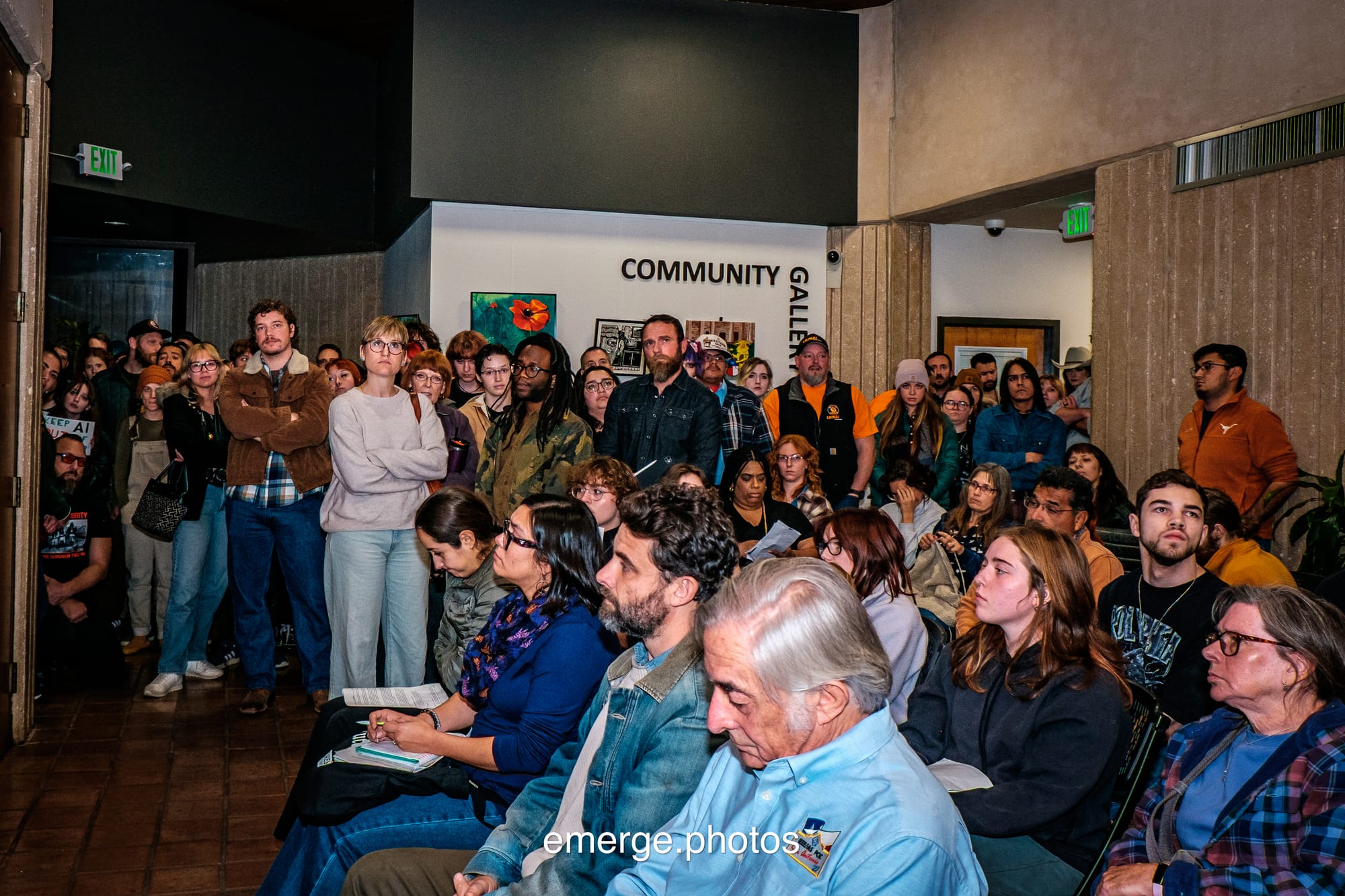
Last week, Round Rock City Council approved a rezoning request to allow Skybox Data Centers to become the ninth data center in this city just north of Austin. Speaking to failures in the duty-to-warn department, eight data centers were approved and moved toward construction before local residents noticed—though they quickly formed up into a potent force of opposition.
An hour south, in the college town of San Marcos, home of the headwaters of sacred springs feeding the region, another zoning change sought by another data center—Fort Worth-based Highlander SM One LLC, in this case—was beat back this week at Council. For a second time.
Community members in both cities told Deceleration just how difficult it is to fight these developments when local governments appear to be functioning not to empower and encourage residents in managing the affairs of their communities, but instead to facilitate the transfer of water and power to the data center owners at the expense of those they are sworn to serve.
'Not your normal cowgirl's agenda.'
“This has been a whole new world to be thrown into, to speak on. Not your normal cowgirl’s agenda.”
So says Torrie Blake Martin, whose ranch south of San Marcos proper backs up to what could one day be an industrial cement box full of whirring power- and water-hungry machinery. Her grandparents ranch next door. While Deceleration first met Martin in January after she spoke before San Marcos's planning and zoning commission, she insists that she has never been political. She enjoyed her agricultural life on the outskirts of town, taking a deep pride in her locally rooted multi-generational ranching heritage.
“My identity has been loving Texas and feeling like I'm a little bit better than people because I'm from San Marcos, Texas. Like yeah, it's a beautiful place, and you came to go to college here and you live here. I'm from here, you know? It's made me feel like really really proud of this place,” Martin told Deceleration.
What she witnessed after becoming aware of the threats to area water and land through the further industrialization of some of the last remaining rural pockets of the city, pierced that pride.
“I’ve been very disappointed in the town that I was very proud to be from.”
She spoke of being overwhelmed by the entire process. Of all she had to learn—and quickly—in order to influence the process. Of the fractures the proposal manifested in her own family. And of being crushed by the lack of protective spirit she witnessed from elected and appointed city leaders. (We spoke days initially before the ultimate 5-2 vote against the proposed rezoning being sought by Highlander; the company may resubmit its request in six month.)
“It just feels like my town that I've like supported and taken care of doesn't care about me and that's just absolutely soul-crushing feeling.”
And on this side of the vote?
"I need therapy. Because this was abuse."
What is local anymore?
Cloudburst, a 1.2GW “flagship data center campus,” has already broken ground in San Marcos. They'll be fed gas by Energy Transfer, the same company that brought us Standing Rock. Highlander is expected to be back. And other similar projects stalk the fringes of the communities here, challenging questions about what “local” fights mean anymore.
The nature of commons, shared resources that transcend geopolitical boundaries and are, hence, shared “in common,” challenges any data center resistance that is purely local in nature. Groundwater threats don't dissipate at the city or county line.
“Nothing is set up to actually resolve this," said Kay in San Marcos, who asked to used just their first name for our interview. "The fact that we were able to vote this away at the city level doesn't mean anything long term for the protection of the aquifers because the next logical step for them is to move next door into unincorporated Hays County, which they have explicitly threatened to do.”
Here a possible check was thrown down by Hays County Judge Ruben Becerra, who, calling for enacting Stage Four water restrictions, is seeking a moratorium on permits for all new industrial developments with high water demands.
But what happens when they bounce across a county line with designs on the same aquifer?
Kay organizes with the Data Center Action Coalition and reiterated Martin's concern about the pressure of having to learn so much, so quickly, to engage in the process.
On one level data centers are easy to ally against.
“A lot of the organizing has just been around sharing information. I mean these developments don't offer any local community benefit. And they're just wildly unpopular,” Kay said.
But in practice, the fight means contending with much more prepared adversaries—who seem to benefit from local bureaucracies more than they are challenged by them.
“None of us are professional activists,” said Kay. “We're just figuring out how to compete with the information machine of these industries. The talking points of the industry are even just like frequently parroted by the local government. ... We're contesting with highly paid marketing experts. There's a lot of lies and obfuscation.”
'Hot Girls' to the Rescue
While fairly new to local politics, Kay noticed quickly how even basic informational presentations seemed to skew in favor of data centers.
“In theory they're just like neutral presentations to city council highlighting the sort of details of the proposal. Like that's what a development presentation should be from city staff. But they're like oddly these sort of persuasive documents arguing for the development.”
As Martin laments:
“Sometimes people don’t need any truth to believe the lie, but they need all the truths to see what is really happening. It’s very frustrating.”
She observes these attitudes not just in Council chambers but among her neighbors day to day.
“We really don’t have water—and that’s just something people are fine with? We’ve been in a drought and people are still running their sprinklers. They don’t do anything.”
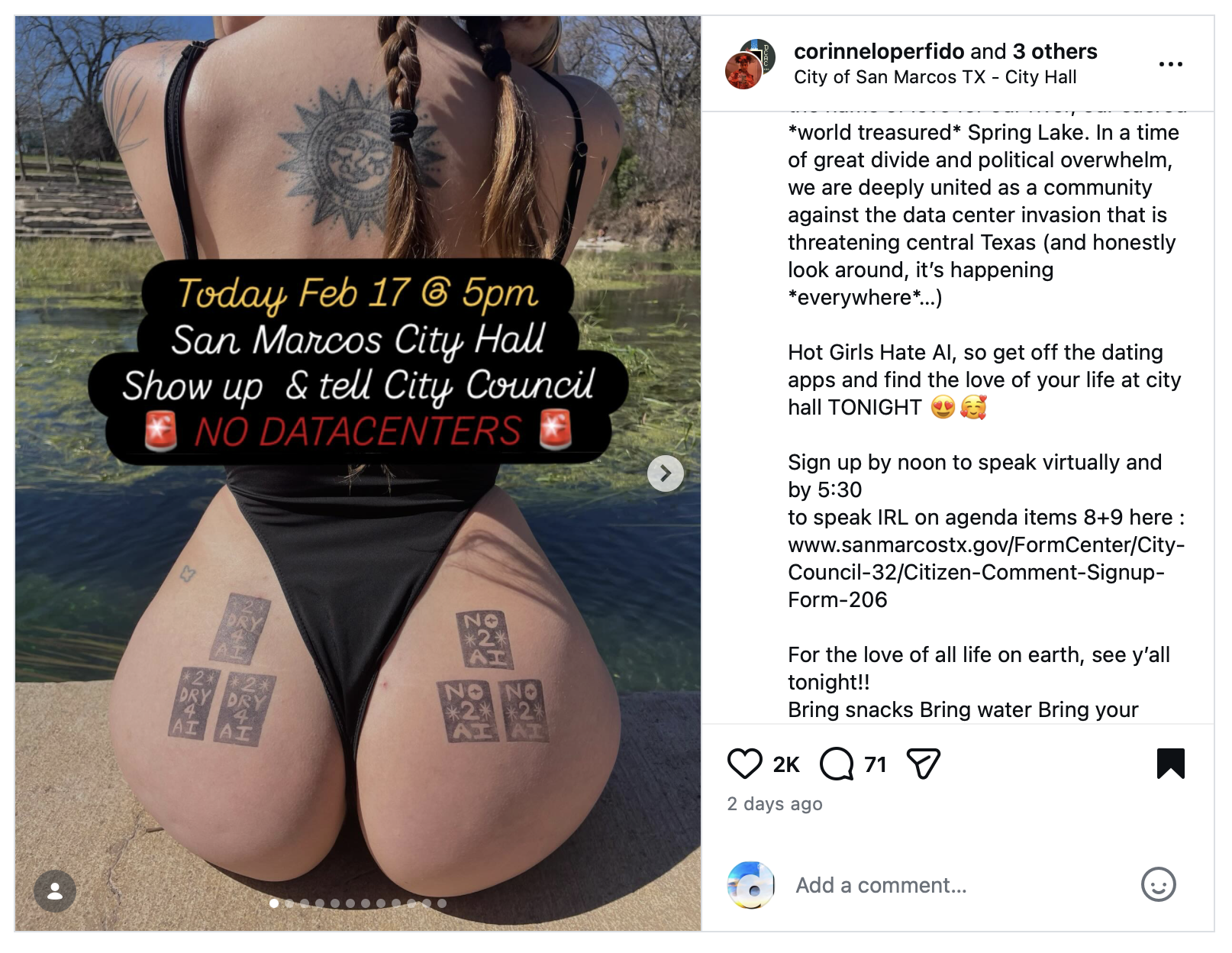
In the midst of crisis, however, the movements stirring in the grassroots have been remarkably effective, turning out hundreds at a go to many of these hearings. And, Water & Power would venture, surpassed the best pro-datacenter marketers in the business with humor and s/ass, as with a recent Hot Girls Hate AI campaign on Instagram.
These experiences—whether the result is holding the line or suffering defeat—contain lessons for those fighting across the state and nation. After all, these fights are coming—welcome or otherwise—to communities essentially everywhere, with speed.
In the spirit of fostering engagement across movements, we offer a couple blocks down our recent conversation with Gary Oldham of Protect Round Rock, just one of many emerging community leaders being born from necessity. The interview has been abbreviated slightly and edited for clarity.
Deceleration Opinion
Trump Assaults Climate 'Endangerment' Rule Instead of Actual Climate Danger
Laws to control air pollution and protect the public welfare—as with the Clean Air Act—have come grudgingly, but ultimately with bipartisan support. Then MAGA happened. And all that's left is an exercise of power designed to compound harms.
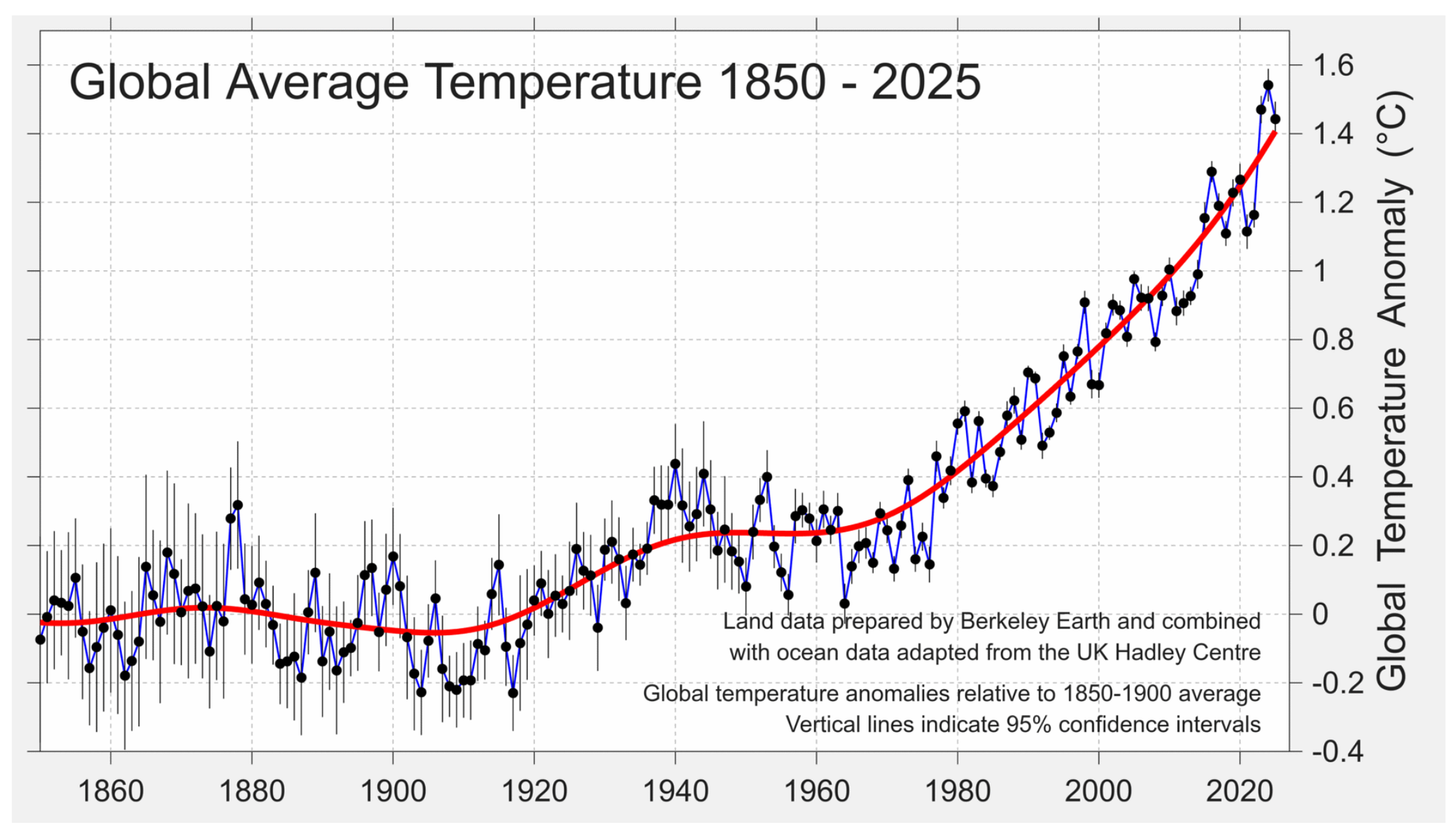
Shortly after Jessica Witzel collapsed and died on a Five Points area sidewalk of San Antonio her body temperature was logged at a dizzying 126 degrees Fahrenheit. The sidewalk on that 100-plus-degree day was almost certainly even hotter than that. Though disputed by the local medical examiner—who steadfastly refuses to label essentially any deaths unattended by an ER doctor as heat-related—Witzel died in the heat and from the heat in the summer of 2024—the planet's hottest year in...a very, very long time. Shortly before her death, a nearby neighbor called the police when they found Witzel, who was living unhoused, trying to cool down with their garden hose.
As a paper published just this month by a leading Texas-based climate scientist makes clear: the body count of heat-related deaths are rising. Increasing, even across Texas, more public health officials are watching and marking heat-related deaths.
Such concerns are rising with global air and oceans temps which have been pushing upward for decades as the world bakes under heat the planet hasn’t seen since humankind first began to emerge in numbers from the African continent over 100,000 years ago.
We were supposed to be moving toward another ice age, with glaciers again advancing across North America, instead of jettisoning into unprecedented life-smothering heat. But guess what? The Ice Age was cancelled.
At root of our rapid overheating is the pump jack, the fracking site, the data center, and all the fossil fuel pollution thickening the greenhouse layer, no longer swaddling the planet like a baby in the crib, but choking it like a python.
More than 100 years after the discovery of the greenhouse effect and the relationship of gases like carbon dioxide and that warming, they were finally added to the Clean Air Act in 1990.
The Clean Air Act is celebrated as an Earth Day feat. A big national pachanga in denim and love beads. The largest day of mass activism in U.S. history (until Trump’s authoritarian lurch and mounting attacks on basic liberties shook millions to get out into the street with a belated “No Kings” fervor). But deeply bipartisan concerns over the poisoning of the nation's lands and waters and people had taken root earlier than that.
The post World War Two building boom and “white flight” from city centers into seas of unrolling suburbs contributed to deepening unease of the unintended (or willfully neglected) consequence of all this productivity—particularly when it came to fears over what exploding automobile transportation, energy generation, and deepening industrialization were all doing to the air.
In 1963, the Clean Air Act’s original legislation passed as Public Law 88-206 with a charge to “improve, strengthen, and accelerate programs for the prevention and abatement of air pollution.” Air pollution was of special concern because what comes out of those tailpipes and smokestacks doesn’t travel obediently by road or cross checkpoints at county lines to display ID. Poisons were hitching a ride on the wind and dropping like the rain where they damn well liked.
This anarchy of the commons presented challenges.
“The growth in the amount and complexity of air pollution brought about by urbanization, industrial development, and the increasing use of motor vehicles, has resulted in mounting dangers to the public health and welfare, including injury to agricultural crops and livestock, damage to and the deterioration of property, and hazards to air,” the legislation stated.
Which is what makes President Trump’s argument this week in favor of abolishing of the “endangerment finding” that added greenhouse gases to the roster of pollutants in 2009 so pathetic. He and EPA Administrator Lee Zeldin stepped forward with straight faces to say only local poisons matter. That pollution that does its dirty work after traveling a few hours from home can’t be regulated in the same way as pollution that poisons asphyxiate a neighbor's cow or melt the paint off their car or give them cancer.
They overlook that this problem of proximity was the very point of the Clean Air Act fas far back as the 1960s.
PL88-206 sought to protect the public health, speed research into new air pollution technologies (particularly in motor vehicles), and clean up fuels, while helping state and local governments collectively organize to solve the problem of pollution that by its aerial nature transcends political borders.
The cognitive dissonance underlying Trump’s attack on this root of climate regulation is one reason some environmental attorneys are like…yup…this blatant chicanery is toast. The precedent is baked in the original batch. We'll see you in court. (In fact, the first of likely a round of lawsuits have already been filed.)
Others holding less regard for the current Supreme Court worry that cognitive dissonance is just the air that we are all forced to breathe now. The rule of law has been effectively overthrown. That power is what decides now, not logic or reason or justice.
These are likely are seeing matters more clearly.
This is a column in development. Look for its final form and related video at Deceleration in coming days.
'Business friendly, resident hostile'
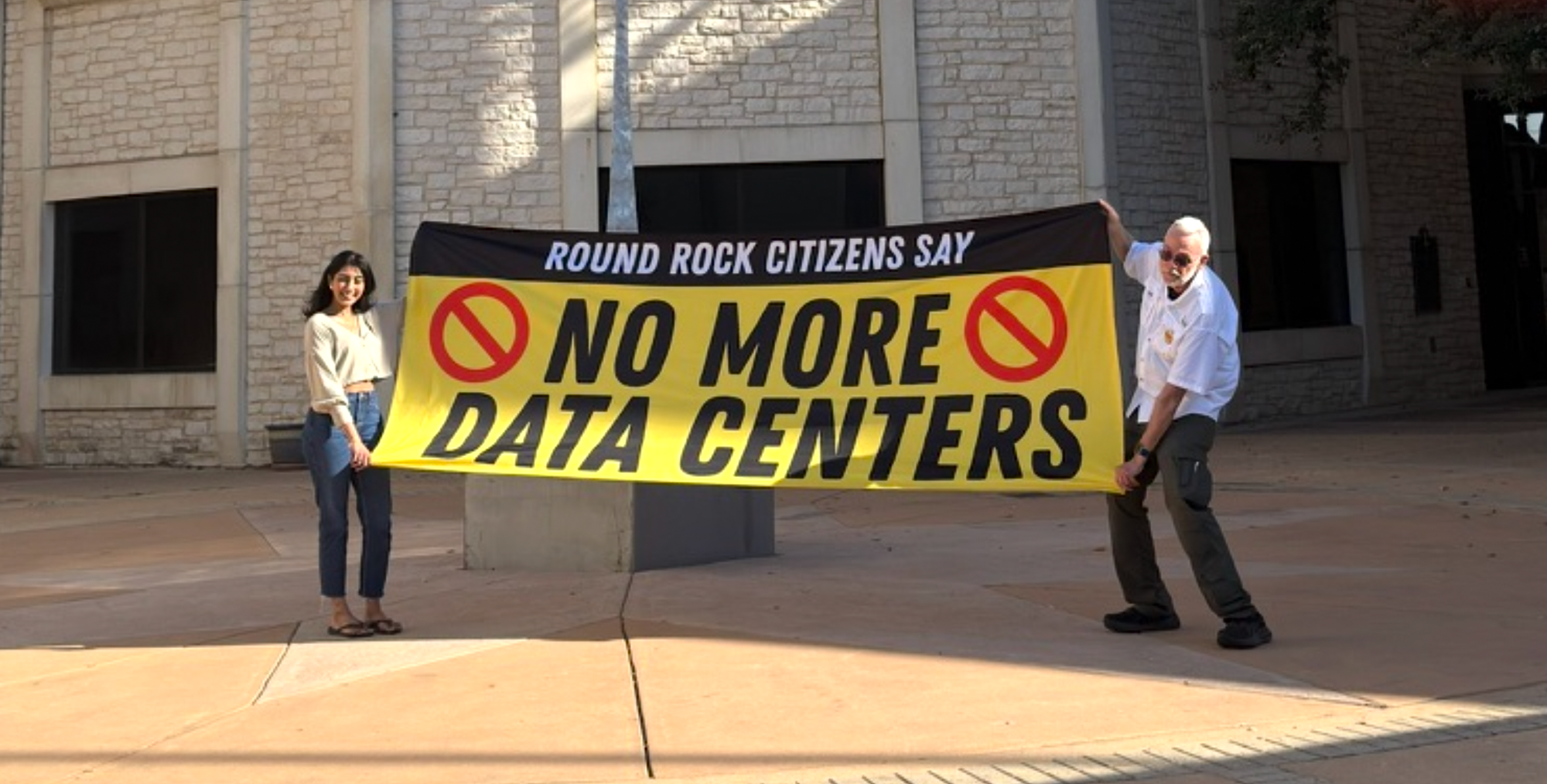
A Q&A with Gary Oldham of Protect Round Rock
Greg Harman/Deceleration: I've been trying to catch up with communities around the state who are facing off with data centers. It seems like y'all got a lot of traction on social media quickly. How did you know what to do next?
Gary Oldham/Protect Round Rock: In some ways we didn't. We've done some community organizing here, mostly around political campaigns. My wife's got a lifelong history of activism. So we decided to throw up a website. The city council meeting was December 4th. They're going to do the first reading on this. So we bought a domain name and put a website up on December 2nd.
Oh my gosh.
To our pleasure and satisfaction we had 25 people come out and speak at the first reading and the first hearing of this, which was awesome at basically 48 hours notice. Usually nobody comes and does public testimony. So we then started having people reach out to us, saying they want to get involved.
We formed a core team of six or seven people and kind of worked on strategizing. We got social media presence out there on Instagram, on Facebook, Nextdoor, on Reddit, Twitter, and BlueSky, and just kept building it. We had a really talented graphic artist on the team, some social media people, so we got signs and buttons and stickers.
We were doing guerrilla marketing, wearing a button in the grocery store and having impromptu conversations when people would comment on it. We weren't accosting people, but people were asking, and it was a great opportunity to have human-to-human contact.
And through this process fairly early on, we were stunned to learn that eight data centers were already either operational, under active construction, or approved in Round Rock. This would be the ninth.
That's incredible.
So we started doing tons of research. We put up a ton of links on our website and started realizing there's concerns over water. Closed loop [systems] are better than non-closed loop, blah, blah, blah, but it's still a concern. In order to meet the huge demand of the influx, there has to be increased generation and delivery of electricity. And all of us, all ratepayers, are involuntarily subsidizing the data center industry through increased utility rates. And through the increased generation [of electricity] there's an increased usage of water by the generators of electricity.The process of generating more electricity draws a lot of water.
The biggest concern for a lot of folks, including me, is the low frequency sounds generated by all data centers. They can't be mitigated by construction or trees or any other things that have impact on cognition, on sleep, on concentration, have a much higher impact on the neurodivergent population, folks with autism, dementia, Alzheimer's.
And I went out and measured low-frequency noise at data centers in Round Rock and Skybox in Pflugerville. And, as a baseline, the proposed Skybox site. And the numbers are off the charts.
We started an online petition that was done outside of our loose organization Protect Round Rock but still in conjunction. And ultimately presented the city council with more than 3,000 signatures on that online petition.
Every year Deceleration surveys readers: 'What do you want to know about? What do you want to hear about?' And this last year, water and data centers just came up. Like water had been going, right? Concerns about water in the midst of this drought? Of course, we're in a 1950's drought of record if we're not busting that. But coinciding with this is this data center thing, which just seems to be like a deluge across Texas, across the country. And maybe other countries in a similar way. I'm just looking at the headlines here.
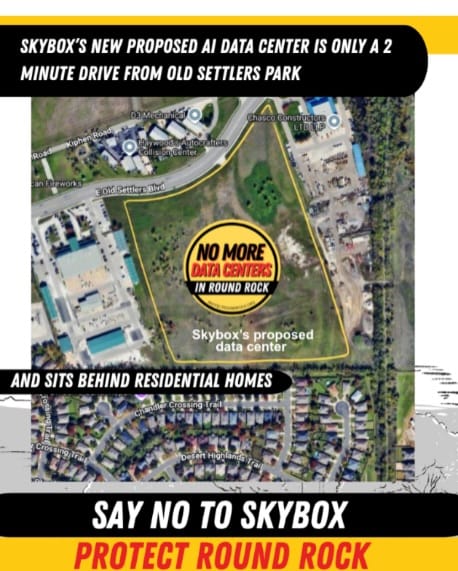
So I looked at the Round Rock planning and council presentations. And [Skybox] was presented by maybe somebody in planning or someone at the city manager's office. They were saying, 'Oh, yeah, well, we don't really have zoning for a data center, right? It doesn't fit any of these industrial categorizations. But that actually makes it easier or better for the public because every time we have one, we need to have a public hearing. And that gives people the opportunity.' It seemed like they were doing a good job of assuaging, trying to assuage concerns.
How do you see that? You're on number nine in Round Rock. Is that area targeted because of its proximity to other populations? How do you feel like these targets happen to begin with? And are political networks up to the task of involving the public, informing the public?
Oh, they're up to it. They just choose not to. It's a very deliberate choice.
I think areas are targeted for a number of reasons. One is having available power, you know, transmission lines. The data center developers have to pay to connect to the grid. So not having to have Oncor build infrastructure to get that connectivity to them is a plus. The Skybox facility has a 345 kVA line going directly overhead. So it's going to be cheaper for them to build it there than it would be, you know, five miles from an attachment point like that.
I think having a friendly city council is also high on their list of targeting. And those are probably the two biggest. They've managed to slip eight of them in with nobody noticing. In the dark of night. With any kind of rezoning or public hearing, you see there's signs posted on the property saying public hearing is going to be on this date. About this thing: those signs for Skybox were placed on a dead-end street in a residential neighborhood that only two people live on that stub. It has no traffic going by.
The other is placed in Old Settlers Boulevard, which is speed limit 45. So people are going 60, and it's on an S-curve, and the sign was down a driveway stub. So unless you're looking 90 degrees to your right while negotiating an S-curve at 45-plus miles an hour, you'd never see it. But more importantly, those signs were both placed face down in the dirt.
They were placed in these locations and then ended up face down in the dirt? Or just the way they were placed on a fence or in the ground?
I wasn't watching them place the signs. My Spidey senses tell me they were placed face down, but I obviously do not have evidence of that and did not witness that.
And do they have to publish them in the local paper, like the back pages of the [Austin-American] Statesman or something?
Oh, the Statesman? No. People have heard of the Statesman. You wouldn't want to put it there. The Round Rock Leader, which was absorbed by the Statesman, has—I thought it went out of business 15 years ago when the Statesman bought it. I did manage to find a copy at the local library. But nobody subscribes to the Leader. It's a four-page rag.
Very low circulation, small readership.
Very low circulation. Nobody reads it. It's posted on the city website. I mean, even the signs that they use give you a link, roundrocktexas.gov slash notices, when you get to that site, when you get to that page, you have to scroll through all the pending public notices for all kinds of things and try and associate it with the property you're looking at, which is not always easy. And if you're doing it on mobile, you can't even scroll the page.
So it's not a flashing "data center! water use! power demand!" top of the website.
No. But if you follow the City of Round Rock on any social media outlet they're posting three, four, five times a day with stupid memes and cutesy memes and bragging about this, that, or the other thing.
So this comes up to your attention. You're organized. You're coming. You're showing up. And on the day of the vote there was a rally, like a march. And how did that turnout materialize for you?
This is an ongoing process. We had the 25 people testify on December 4th. Typically, [the city] will waive that second reading and go ahead and vote the first night it's before them. They didn't do that this time. They postponed and told us it would likely be in January. So we used that time. We had multiple people reaching out, requesting one-on-one meetings with the city council. None of those were returned.
Wow.
We had hundreds, hundreds of emails generated through our website, and probably outside our website, to council that were at best responded to by a form letter from an assistant city manager telling us how swell the data centers are.
Skybox ended up hiring a global PR slash damage control slash reputation management company to help them. Because it's, you know, it's an awesome thing. They needed help from experts to sell it to us.
They threw up a website about this project. The city threw up a website about data centers and Round Rock and why they're so spiffy.
So we kept organizing. An organization called Public Citizen, who has a Texas office, reached out to us and says, 'Hey, we'd like to help.' So we worked with them. They came up with some of these ideas about the pre-meeting events. And so we organized that. We had an art build at the library this prior Sunday and had the rally or march and rally from the library through downtown to City Hall. Trying to trying to raise awareness.
Everybody we spoke with when they learned we already had eight [data centers] approved were stunned and shocked, just like we were. Nobody we spoke to said, 'I'm cool with data centers.' Yeah. A few people on social media, but no humans we spoke to. And 99 percent of the feedback on social media was also what the hell's going on in our city? And then we had well over 100 people show up in council chambers overflowing into the lobby and outside. About 50 people spoke.
There were probably 10 or 12 that had to leave before their names got called because it dragged out, as you'd expect with that many people speaking. I've lived in California, Virginia and Texas. I've been to [public hearings] in all those places. Plus, in my work, I've been to council meetings in many other states.
Never before have I seen when public testimony is given that when a member of the public says their piece, the presiding officer, the mayor, was calling up Skybox to rebut the person's concerns or comments. I've never seen that.
And of course, the person speaking, who is supposedly getting rebutted, had no right of cross examination.
So anyone who showed up for a negative comment, they would invite Skybox each time?
They didn't do it each and every time. They were heavy on that at the very beginning. And after a few selected speakers. There were three people speaking in favor of the data center. One was a Skybox employee. Shocker. And two were people that lived on that dead end street that backs up to this. And they've been swayed and they stated their support. We had the Texas director of Public Citizen as the second speaker. They called people up to rebut him. It was appalling. The utter disregard for the people they're supposed to represent.
And what has been kind of like the postmortem for folks? I mean, we've been looking at San Marcos. They had a very different outcome at Council this week. One woman I spoke to said, 'I'm going to leave San Marcos if they build this.' How are people feeling in Round Rock about their representation, about their quality of life, and what kind of organizing do you think is required now? Are people just fried or is there kind of like another level of organizing that you feel like you're moving towards?
I mean, there's some of each. I'm sure some people got burned out by this and may choose to stay through it. But other people are still around. We're not going anywhere at this point. I don't think we will. One of the fascinating components of this is that originally we were told that the second reading would take place in January, first or second meeting in January. So we were planning around that. Well, ultimately, it didn't happen until February.
Interestingly, we had our hearing on February 12th and 5 p.m. and on February 13th was a filing deadline to declare candidacy for any of the three slots: the mayor and two council members are up for reelection this year. And we are convinced that that date was chosen knowing what their vote would be and knowing how unpopular it would be.
So we couldn't stand up candidates to run against them. Which is a damn shame. We will have a slate of highly qualified candidates next year and going forward.
The only way to effect change is to replace the council with people who will represent their constituents. Our council was representing Big Business and ignoring the will of the people. Very clearly. Round Rock promotes itself as business friendly. They are business friendly. The other part of that equation is they're resident hostile. That was made quite clear. Quite clear. So "business friendly, resident hostile" should be the motto of this city.
SAWS Rate Hike
Jim Spickard breaks down SAWS rate structure as San Antonio moves toward a rate-hike vote.
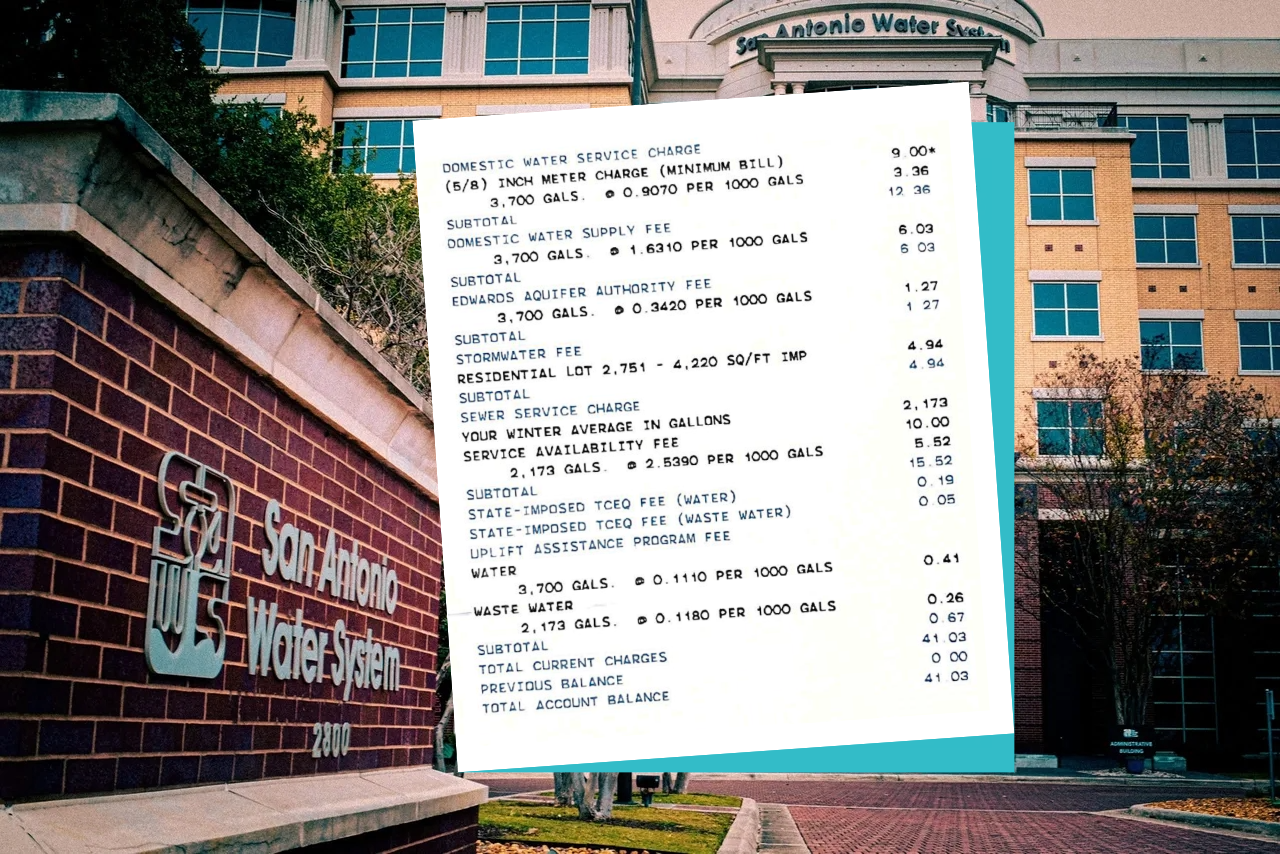
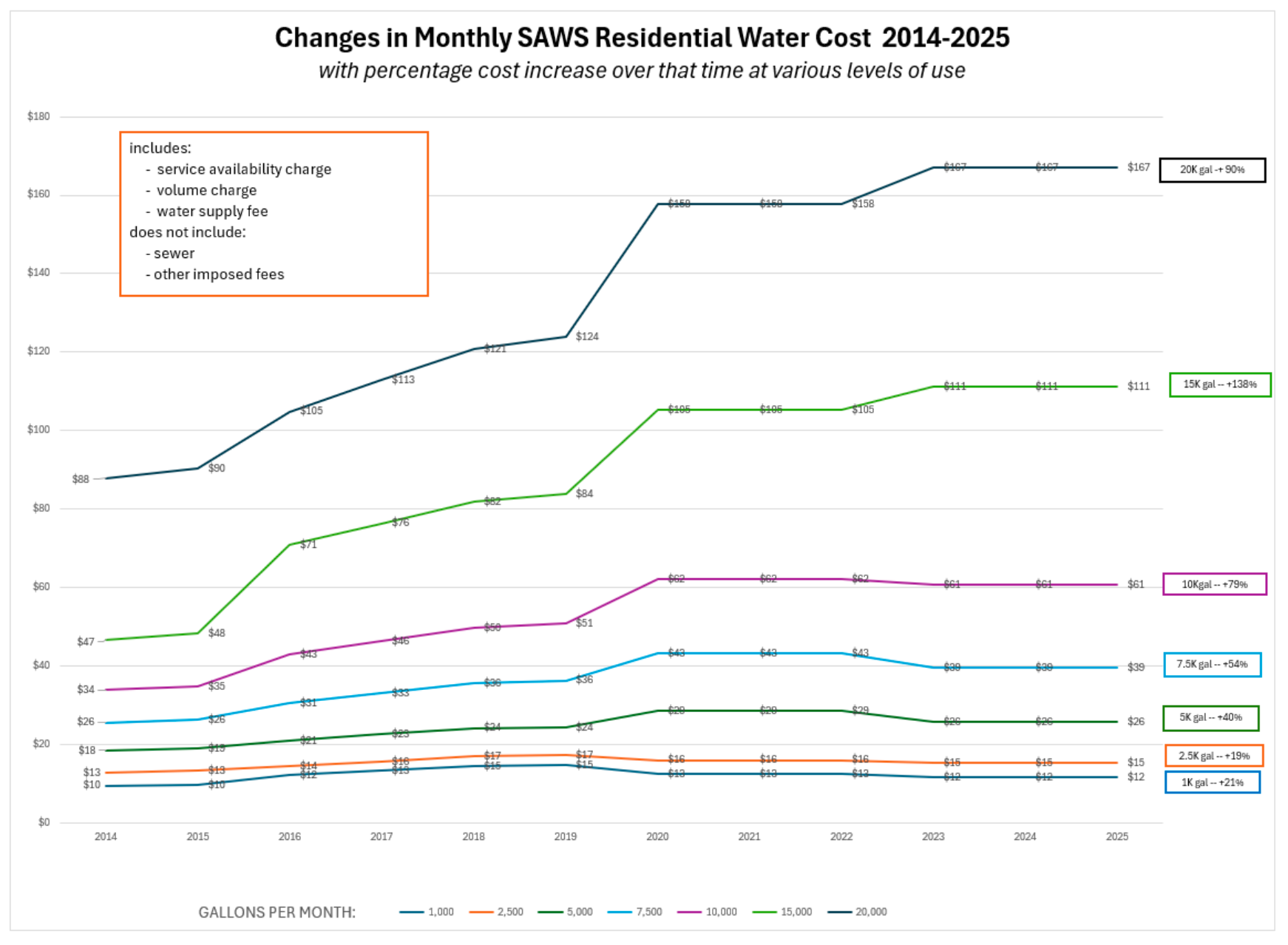
A serious rate hike may be coming down the pipe for San Antonio-area water users. Presented to members of City Council earlier this month, the proposed increases would raise customer rates year-over-year for three years. Ultimately, bills would balloon more than 30 percent, according to News4SA. This was not received well by Mayor Gina Ortiz Jones and Council. CPS Energy, meanwhile, is also expected to line up for an increase if not this year, then next. Increasing rates isn’t welcome news in a pinched economy. That pain is compounded when you know that the largest, wealthiest residential users have their own reduced-cost rate class at CPS Energy.
The flat-fee elements of SAWS’s rate structure raise similar concerns about unfairly punishing the most frugal water users. For many years, Trinity University’s Meredith McGuire parsed utility rates at CPS and SAWS. She regularly pointed out inequities and lobbied for reforms as a member of the local Sierra Club and various environmentally minded coalitions. Recently, her husband Jim Spickard, also an academic by background and (also) recently retired (he from University of Redlands), picked up on some of her work to carry it forward. His white paper titled “ANALYSIS OF SAN ANTONIO WATER SYSTEM’S RATE STRUCTURES: 2005-2025” found room to praise SAWS where appropriate while highlighting recommendations for further rate reform.
Spickard distinguishes between ‘rates’ and ‘rate structures’. The first sets how much people pay per gallon of water, which is often the lowest part of a residential SAWS bill. ‘Rate structures’ determine how much of a user’s bill goes to water and how much to other fees. These include a flat fee for being tied into the water system, a flat fee for sewer service, and various “pass-through” fees levied by other organizations. He points out that the most frugal water users pay more in such fees than they do for water itself. For example, those using less than 4,000 gallons of water per month pay the same “Service Availability Charge” as do those who use two or three times more water.
“That charge makes up 43% of the bill for 5,000-gallon users, 18% of the bill for 10,000-gallon users, and 7% of the bill for 20,000-gallon users. It is a regressive fee because it hits low-volume users harder,” he writes.
While SAWS bills have been rising for years, recent rate reforms actually lowered the percentage of SAWS’ budget that low- and moderate-income SAWS customers must carry. Rate tiers were modified in 2016, taking some of the weight off lower users and shifting it to higher users, in hopes of encouraging more water conservation. In 2020 and 2023, the Service Availability Charge was lessened for low water users. Water rates in 2023 also saw reductions for low users and increases for high users—“making the overall Residential Rate Structure more progressive in 2025 than it was in 2014.”
That said, there is room for improvement—especially, perhaps, when it comes to the largest users: business and multi-family (or “General Class”) customers. Their rate structure provides virtually no incentive to conserve water, Spickard’s analysis found. And their per-gallon rate was, for many, well below that of Residential users. Essentially, any company using more than 10,000 gallons (or more) per month is getting a discount over what Residential users pay. The 2023 rate reforms improved this situation, with the bottom half of Residential users paying less overall than they were a decade earlier. Still, the gaps between Residential and General Class rates weren’t erased.
“By lowering the Residential Class Service Availability Charge and making the tiered per-gallon rates more progressive, the 2023 rate restructuring lessened the burden on low-using ratepayers,” Spickard writes. “While apartment houses, businesses, schools, and so on may find it harder than households to limit consumption, SAWS should explore possible incentives.”
Perhaps a rate class could be created to inspire those heavy users to implement greater conservation efforts, he writes. “In my view, the 2023 rate structure is not perfect, but it better expresses San Antonio’s commitment to equity than did those when I first started observing the rate structuring process. I hope it can continue to improve.”
After all: “A gallon saved is a gallon added to SAWS water supply.”
More Water & Power News
News we are following that fills in the blanks on the quickly changing landscape.
- Public health and green groups sue EPA over repeal of rule supporting climate protections
- Elon Watch: Thermal drone footage shows Musk's AI power plant flouting clean air regulations
- Images confirm xAI is continuing to defy EPA regulations in Mississippi to power its flagship data centers.
- Texans are demanding their local governments push pause on data centers. Can they?
- Texans from Waco to Harlingen are raising concerns over how much energy and water data centers are poised to use. Local officials, some enticed by a tax boon, say they have little power to stop the rush.
- Fear of farmland loss slows solar and wind development
- Renewable energy projects can help small-scale farmers make ends meet, but some rural residents don’t like changes to the agricultural landscape.
- Related: Are faked public comments about to tank an Ohio solar farm?
- Texas Alleges ‘Habitual Non-Compliance’ of Wastewater Rules at Dow Chemical Complex
- But the lawsuit, filed Friday by Texas Attorney General Ken Paxton’s office, could shield the petrochemical giant from harsher litigation from a local citizen group.
- Black Residents Win Key Ruling in ‘Cancer Alley’ Environmental Racism Case
- Lawyers for residents say that zoning that concentrates pollution in Black districts is a violation of the 13th Amendment, which abolished slavery.
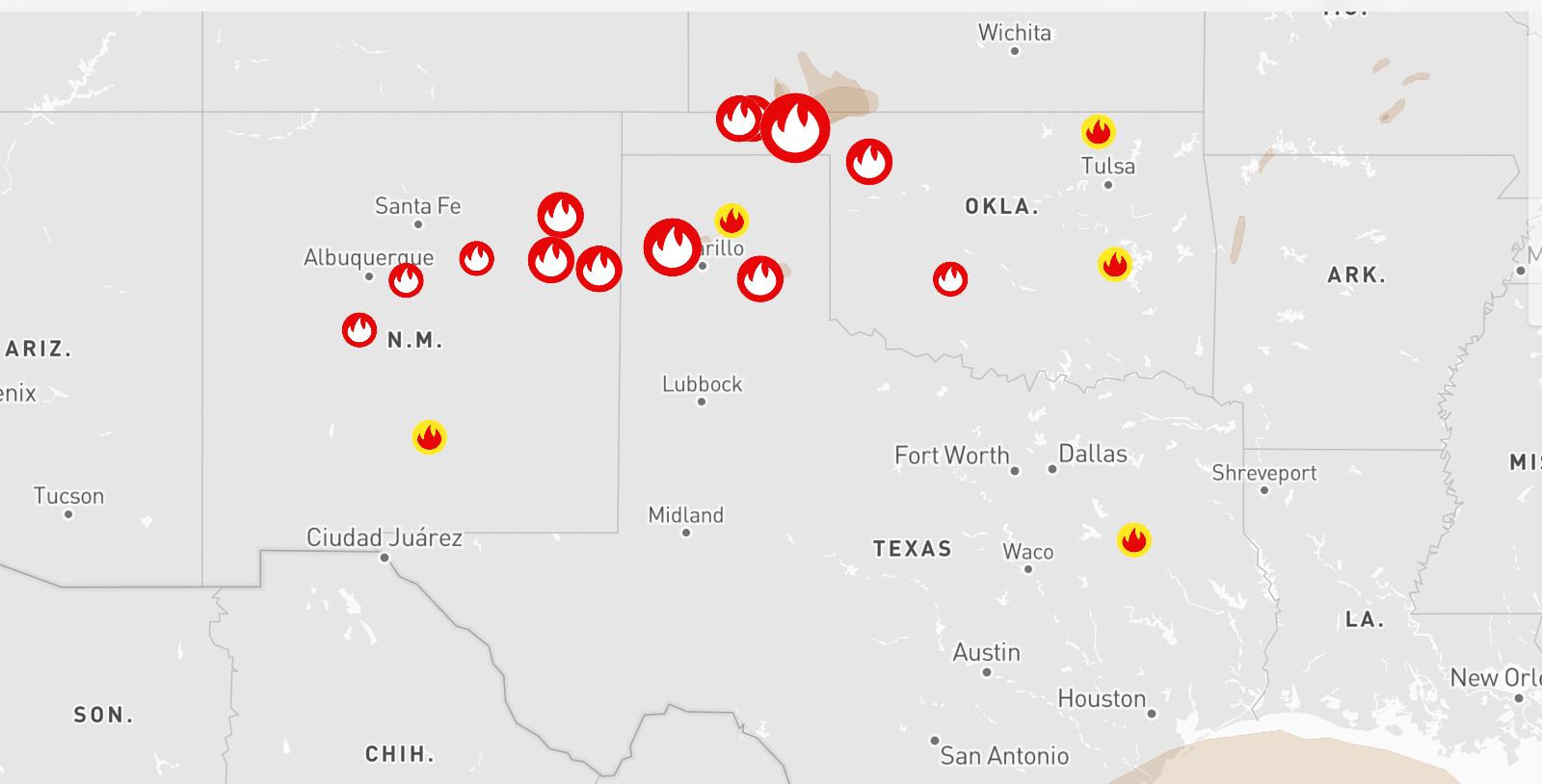
- Is Oklahoma OK? Wildfire explodes across Oklahoma, Kansas as extreme fire danger grips the Plains
- Explosive wildfire growth fueled by 60+ mph wind gusts, low humidity and drought conditions has scorched 155,000 acres across Oklahoma and Kansas, with forecasters warning of continued critical fire weather and new wildfire outbreaks across the southern Plains.
- Related: Salty, oily drinking water left sores in their mouths. Oklahoma refused to find out why.
- At Bezos's Washington Post, Democracy May Still Die in Darkness, But Journalism is Dying in Daylight
- And climate journalism even more so...
- Democratic senators launch inquiry into EPA’s repeal of key air pollution enforcement measure
- Senators said repeal was ‘particularly troubling’ and was counter to EPA’s mandate to protect human health
- Valentine’s Day Massacre—One Year Later
- 'Radical Transparency' & Your Health


