

Welcome to Water and Power, a newsletter about the elements of our survival—and those who seek to profit off them. Water & Power delivers unique reporting to prepare you to engage on the issues dear to your heart, including notices of upcoming events and highlights from across the media landscape.
If you know someone who would appreciate this research and analysis, pass it along. Subscribe to this and our growing roster of Deceleration newsletters. Paying supports from the $5/month level up may leave a comment below. Reader support makes this work possible.
— Greg Harman
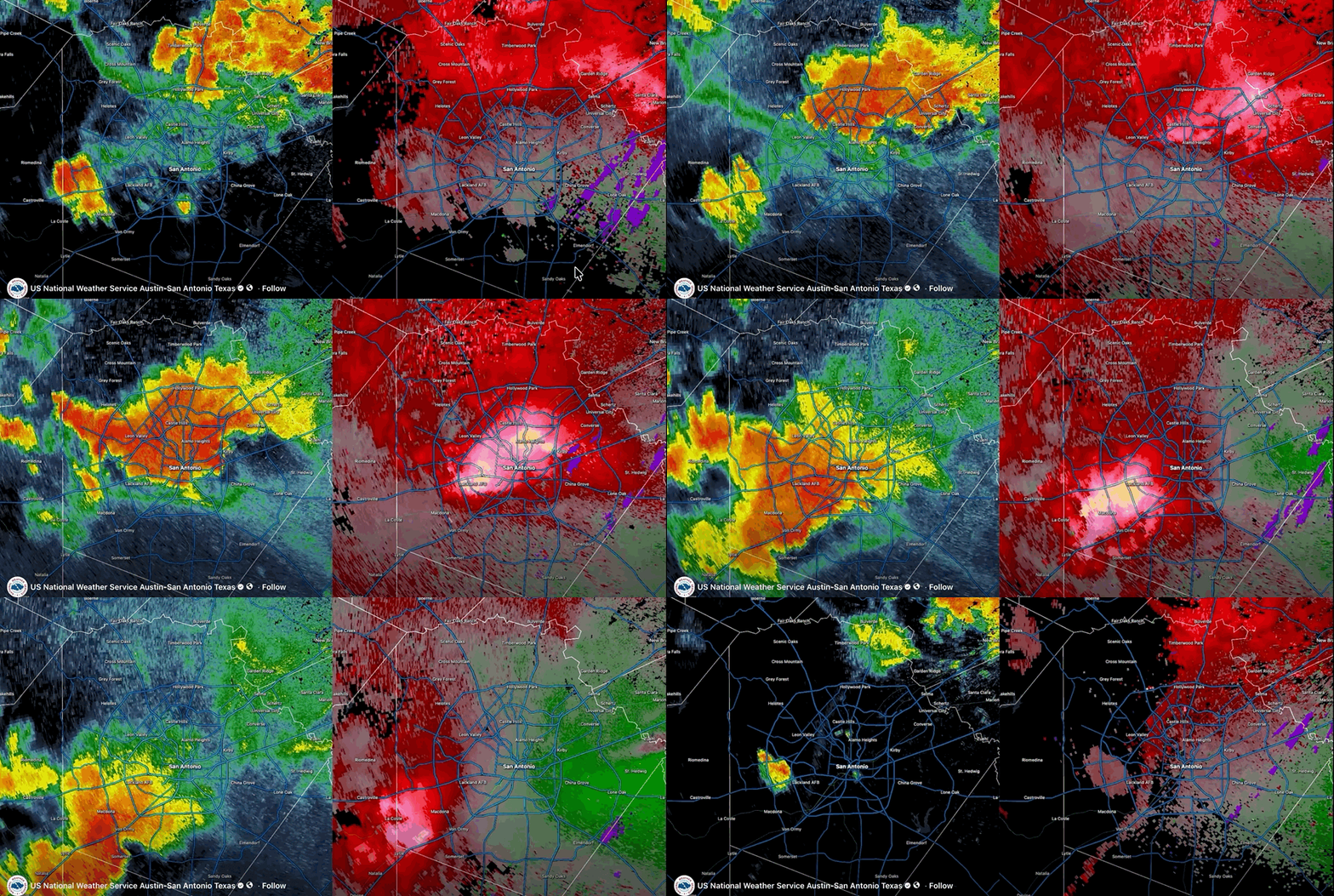
There was no warning that a series of “popcorn storms,” rainstorms popping up here and there across the region, could evolve so quickly into bursts of winds over 80 and 90 mph raging across San Antonio late last month. Official warnings about what one meteorologist later termed “one of San Antonio's more significant wind events of the summer” came only after the winds and rain were already driving.
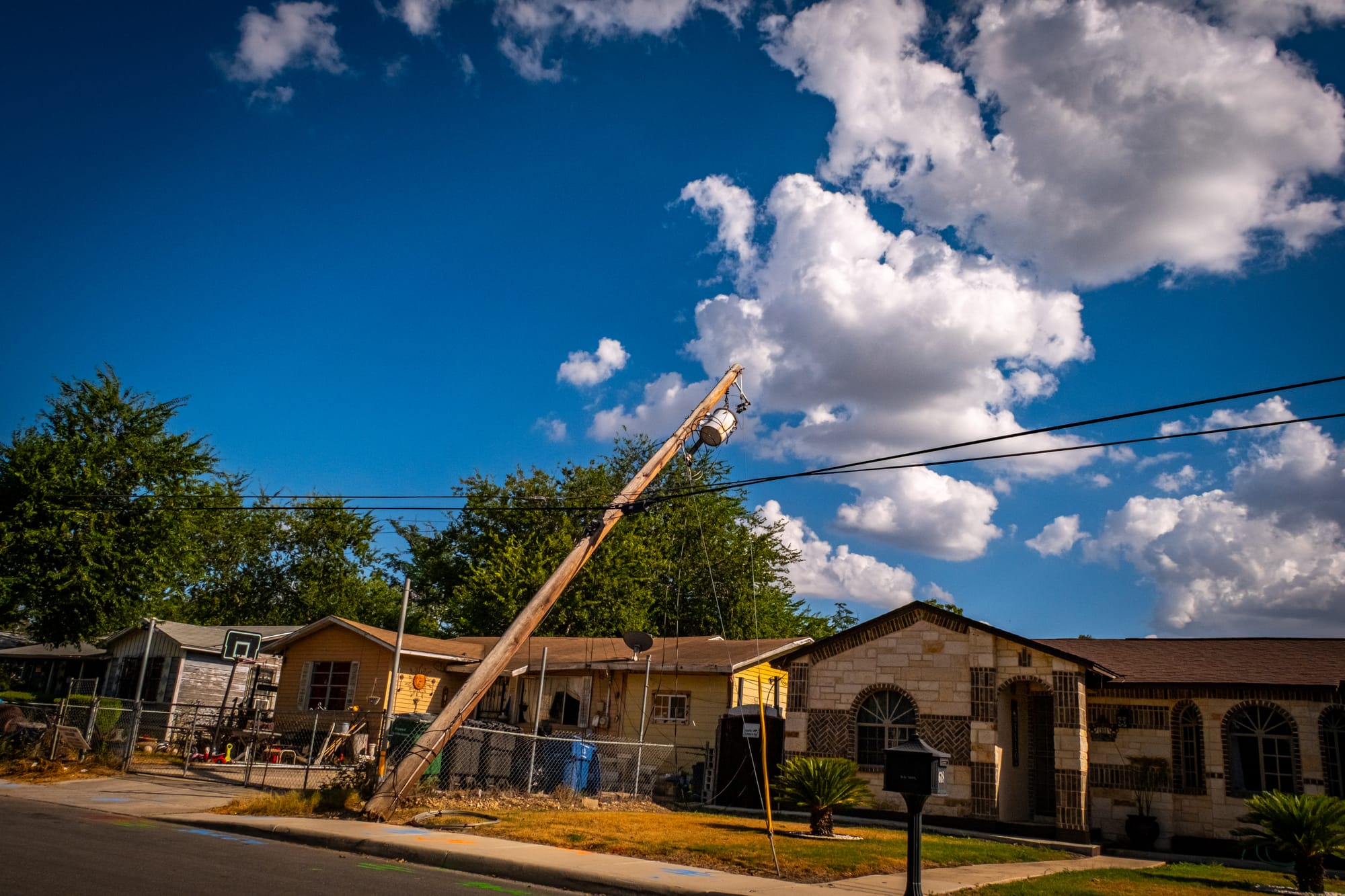
The straight-line winds of Friday, Aug. 28, 2026, roared from the northeast to the southwest, their most severe aspects just skirting downtown proper. Power lines were downed. A semi-tractor-trailer flipped. Transformers torched. Roofs pried apart. Street signs wrapped in debris and snapped to the ground. Traffic lights dimmed as large sections of the city went dark.
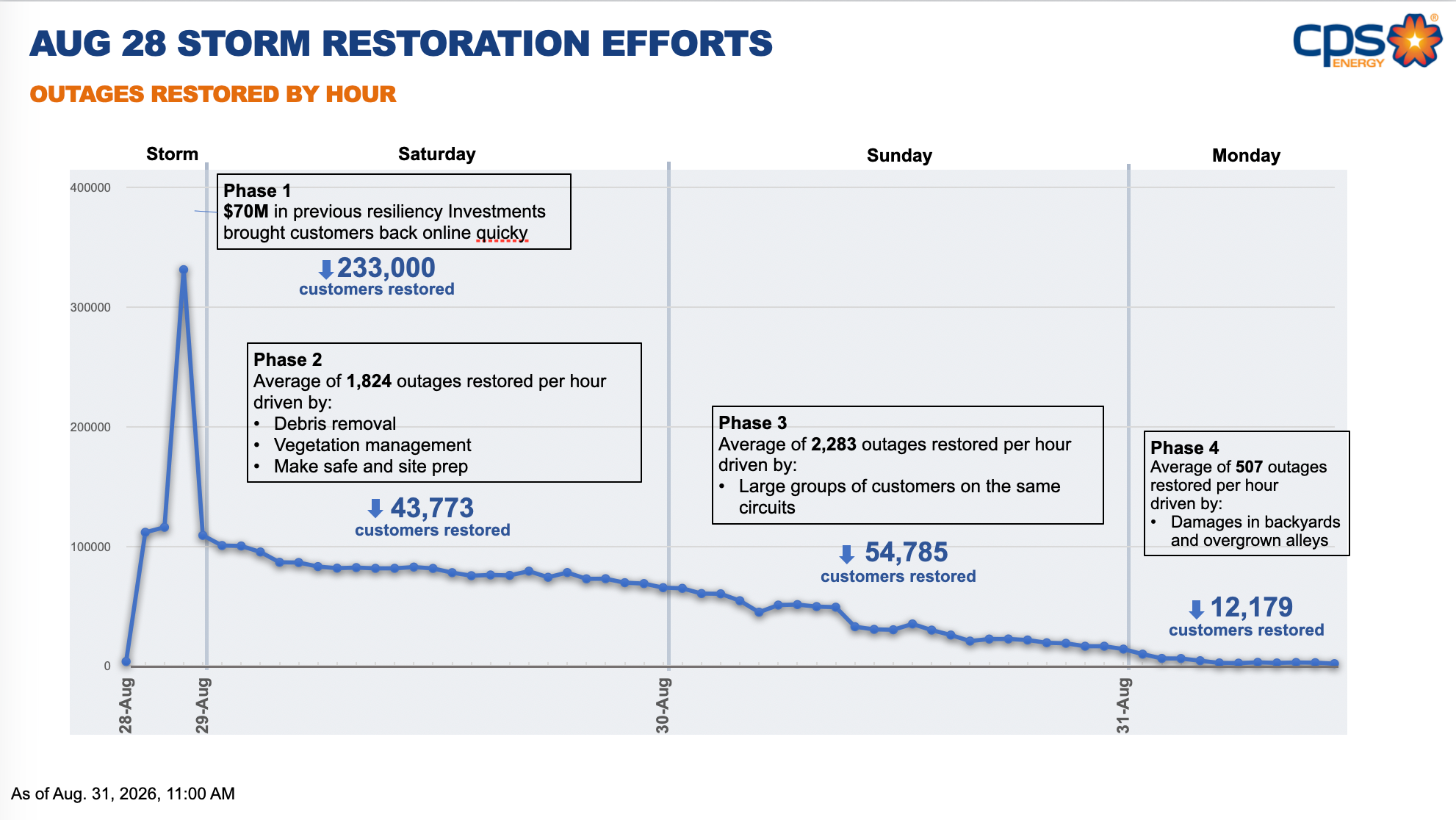
While the first communications from CPS Energy noted a little over 100,000 were without power, the full number actually exceeded 300,000 at first.
With little time to notify unhoused residents, two people are now known to have perished in the storm, swept along in sudden floodwaters. But recent investments in electrical infrastructure made after the devastating winter storm of 2021 contained what could have been a much bigger outage.
“Since Winter Storm Uri, we’ve invested $70 million in equipment called reclosers,” acting CPS Energy CEO Frank Almaraz told utility board members on Aug. 31, 2026, at their first meeting post-storm.
“Whereas otherwise a circuit would say open and a customer would be out, that equipment allows the circuit to close and bring those customers back.”
Instead of the city waking up on Saturday morning to 325,000 customers out of power, the number was roughly 112,000, he said.
It is unclear, however, where these reclosers were installed. Deceleration has requested this information but not received an answer by our publication deadline today. (UPDATE: CPS Energy statement received Sept. 14, 2026, is posted at close of story.)
Impacts on the West Side
What is known is that the bulk of the outages centered in some of the city’s most economically marginalized communities around Five Points and the near-West Side. For many families here, packing up for a hotel wasn’t an option. They faced days of subsequent 100-degree temps without cooling or refrigeration—many grilling whatever had been stocked in their freezers rather than face spoilage.
Surveying the community on Saturday with streets full of debris and an estimated 60,000 still without power, Deceleration found Susana Segura on the West Side off Castroville Road. The trunk on her small white economy car popped with more than 100 bagged meals inside. It was a donation from Al Carbon Pollos Asados off Culebra Road, which had itself moved operations from its darkened brick-and-mortar to a food truck on site.
“People need help. There’s a lot of elderly people with trees down,” Segura told Deceleration. “We need people to come together and bring their saws and bring their trucks and their trailers, and not try to gouge people that don’t have money. This is the poorest ZIP Code in the city.”
“Of course we don’t have any traffic lights,” she observed, a fact that would mark the West Side for days to come, contributing to start-and-stop congestion and at least one traffic accident we witnessed.
The otherwise empty lot beside us that day was filled with camping and household supplies—the razed home Segura described as a victim of overly aggressive code enforcement. Though the house has been leveled and removed, displaced local residents still come to this spot to collect their belongings.
As some of those previously displaced walked by quietly to pick up a bag, Segura added: “It’s the neighborhood they grew up in. It’s all they know.”
Staying cool for these unhoused residents is more challenging than navigating the multi-day shock that stranded tens of thousands across the city in a stroke. For them, summertime is a life-threatening reality potentially stretching from super-heated spring days to summer temps that often linger well into the fall.
Since 1970, the average temps in San Antonio have increased nearly 4 degrees, according to data maintained by Climate Central, while rising humidity levels have resulted in 22 more days each year with a heat index over 90 degrees.
Storm Damage
Three days without power during the hottest season of the year: this is killing combination. Legacies of structural racism and disinvestment have created and sustained a slow-rolling disaster in our communities for decades. Follow Deceleration on YouTube.
Volunteers Stepping Up
Savannah Hernandez recalled that Friday as a bright, sunny day. While there were thunderstorm warnings the previous day, those were now well past. She didn’t think much about the dark clouds as they started to stream into her Five Palms neighborhood on the city’s southwest side. But the sounds on her metal roof stirred her after sunset.
“I looked out the window and saw stuff flying. I ran to tell my boyfriend to check his car,” Hernandez wrote to Deceleration. Loud whistling from the wind sent her dogs scrambling for cover.
Her boyfriend put a cover over the doggie door to keep rain from pouring in.
Hernandez blamed a microburst for knocking out the power in her neighborhood. It was one of the areas of town hardest hit, an area that would endure days without power. Loud bangs signaled transformers exploding. As a lupus sufferer, Hernandez knew the power outage would test her heat intolerance.
After retreating to a hotel that night, Walmart provided a space for the family to cool down and assess on Saturday morning. Later her family went to Chick-fil-A to charge their cell phones. They scoured for food and food assistance—including one hosted by the San Antonio Food Bank and another organized by 210 La Chismosa—sharing what news and resources she could on Facebook and delivering supplies to family members who were waiting out the disaster at home.
“I used free food distributions to feed myself,” she wrote Deceleration.
And even as she watched her own health faltering, she used her next paycheck on Sept. 2 to help organize an event for her immediate community the next day with supplies gathered from HEB, Sam’s Club, and River City Produce.
While CPS Energy and the San Antonio Food Bank had pop-up events, the bulk of assistance appeared to flow through social networks of individuals like Segura and Hernandez.
In public comments on Monday, a CPS Energy board member also credited local orgs and companies like Thompson Neighborhood Association, Hash Vegan Eatery, and Mireles Party Ice. There were many others.
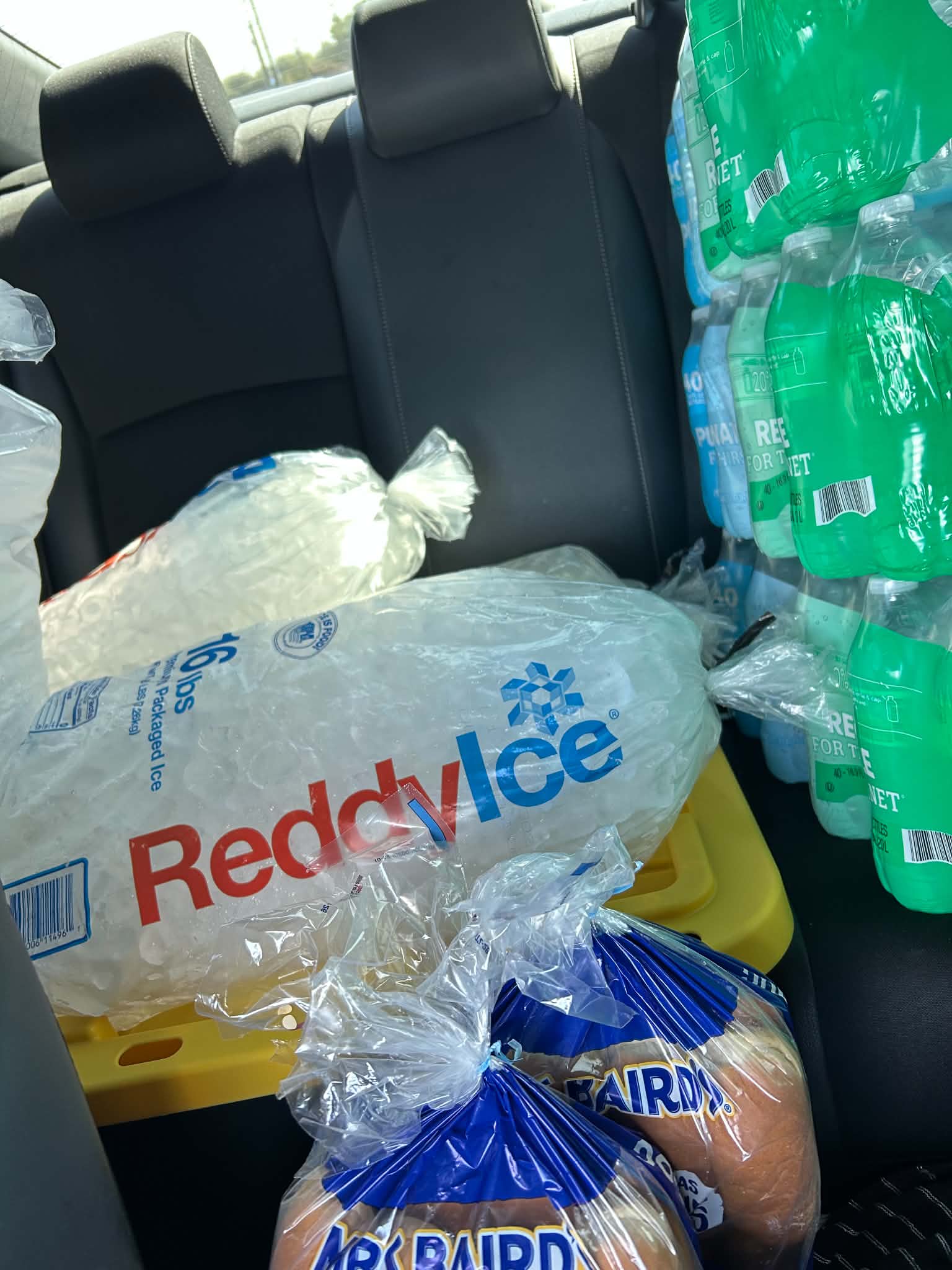



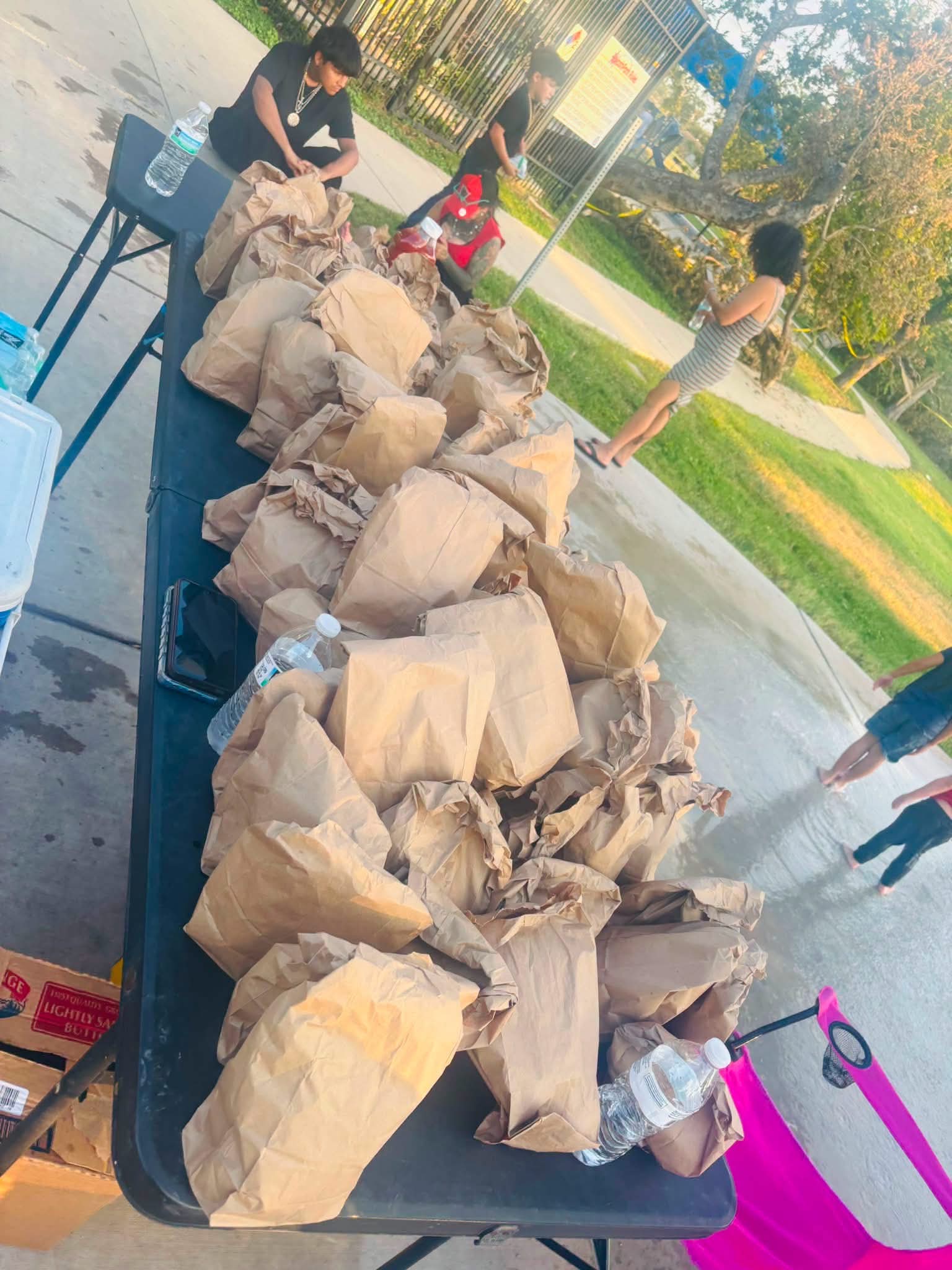
Images Courtesy: Savannah Hernandez
Extreme Weather: The Climate Connection
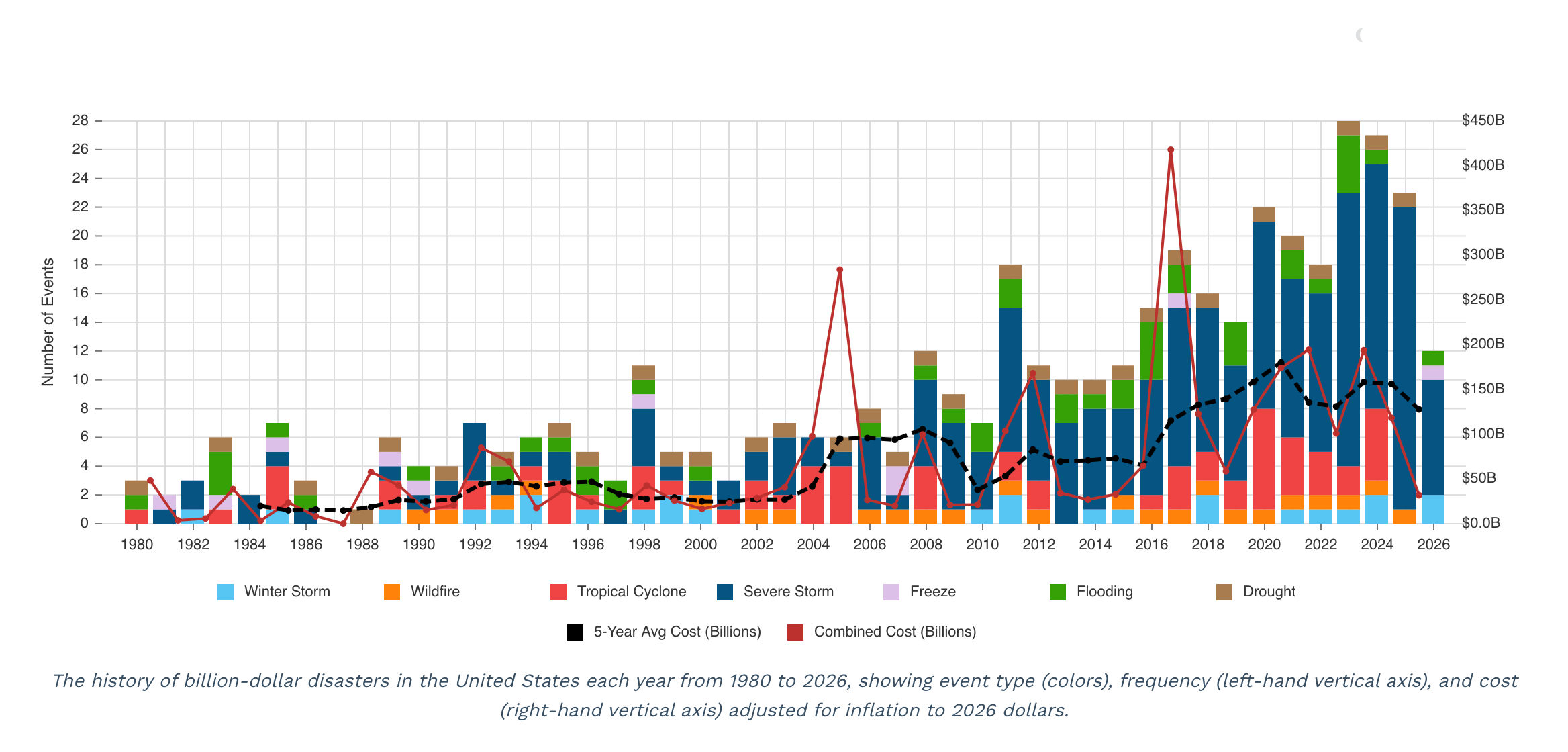
The damages wrought from August’s sudden storm, with two dead and thousands left stranded without power for days, occurred against a backdrop that most of the media coverage neglected: accelerating and increasingly violent storms and floods driven by climate change.
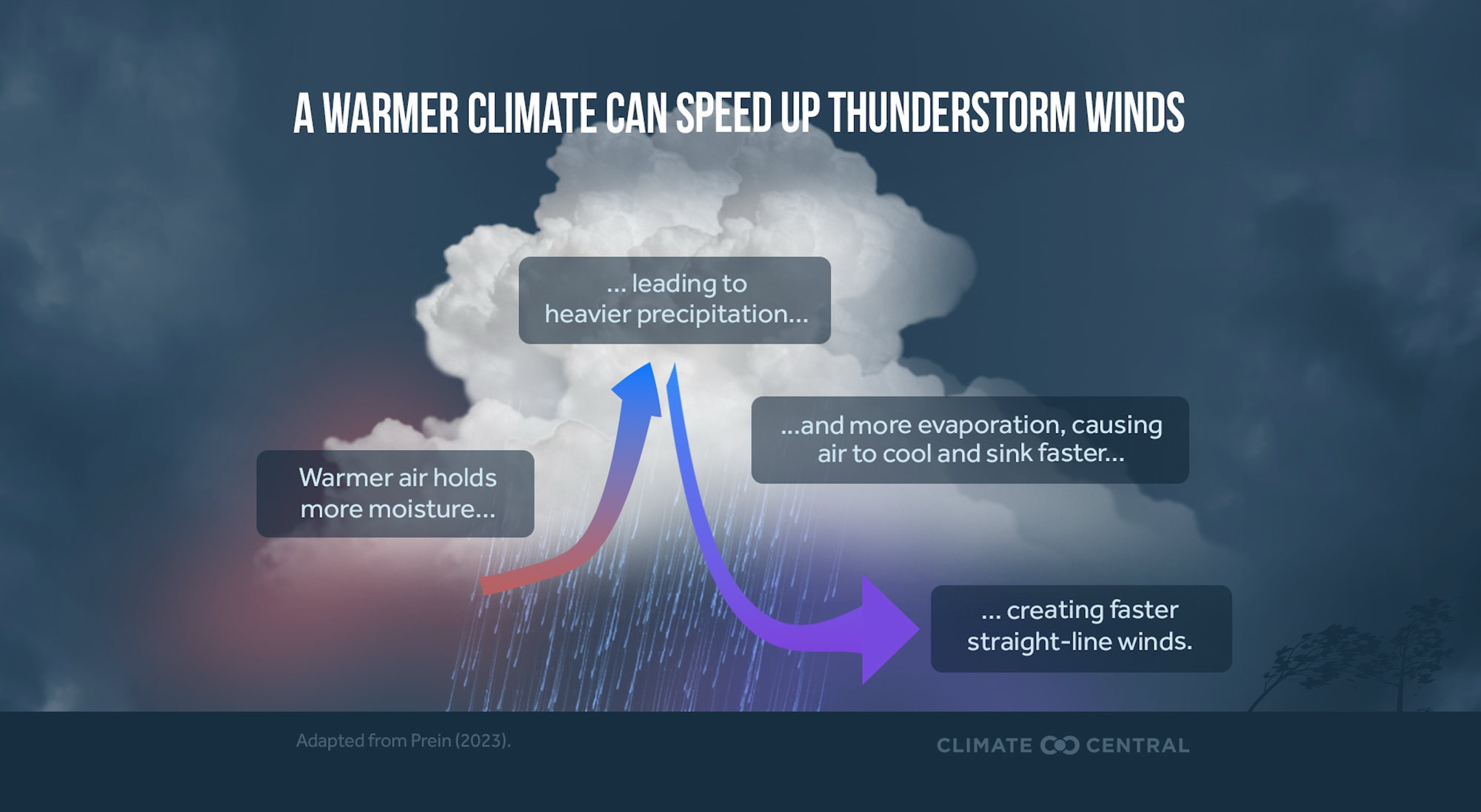
While this storm’s violence came more from its wind speeds than its water content, it fits within a pattern of destruction tied to rising heat levels in the atmosphere. Straight-line winds, something like an unfurled tornado, are increasing with rising temperatures.
“You can store more moisture in a warmer atmosphere, so you can evaporate more," said Andreas Prein, author of a 2023 paper on the subject. "This means that the temperature difference between the surrounding air and the air that falls out of the thunderstorm is getting bigger, which causes a stronger downdraft and a stronger wind at the surface."
There was certainly a surfeit of heat in the atmosphere that week. As Climate Central wrote days before the storm:
"Between Monday, August 24 and Friday, August 28, 103 MILLION people across the western and southern U.S. will experience at least one day of excessive heat made at least 5 times more likely by human-caused climate change. More simply put, this kind of intense, late summer heat would be almost impossible for 103 million people without the influence of human-caused climate change.”
The heat was inescapable for the storm-punished residents of the West Side, especially as all the closest cooling centers—Bazan Library, Las Palmas Library, and San Pedro Library—aren't outfitted with independent power generation and storage systems and so also lost power.
1-in-500 Year Storms on Repeat
After the massive wall of water swept down the Guadalupe River in July 2025 and similar flooding swept other area rivers, creeks, and channels, leaving a death toll of over 130 in its wake, some emergency responders cast the event as an Act of God no one could have foreseen or prevented.
“Everybody wants to blame this on somebody,” Kerr County Engineer Charlie Hastings said at the time. “[P]eople are going to want to talk to engineers like me and say, ‘Tell us what happened. Tell us what happened.’ Yeah, we could tell you what happened. But we couldn’t have predicted this.”
But not only is this Flash Flood Alley with an established history of destructive floods, the storm was tracked closely for days. Such storms, dropping massive amounts of water, are known as "rain bombs." And they are accelerating as the Earth warms.
This fact is made clear in the recent UN report about the failure of world governments to address climate change titled simply “Limiting Overshoot.” Most conspicuously since 1970, these extreme heat levels are being driven by the burning of fossil fuels, destruction of natural systems like old-growth forests, and industrialized agriculture.
2026 saw a near hydrological repeat of 2025’s flood event over much of the same geography. Its ferocity was not lost on those who once more found themselves in the path of extreme floodwaters.
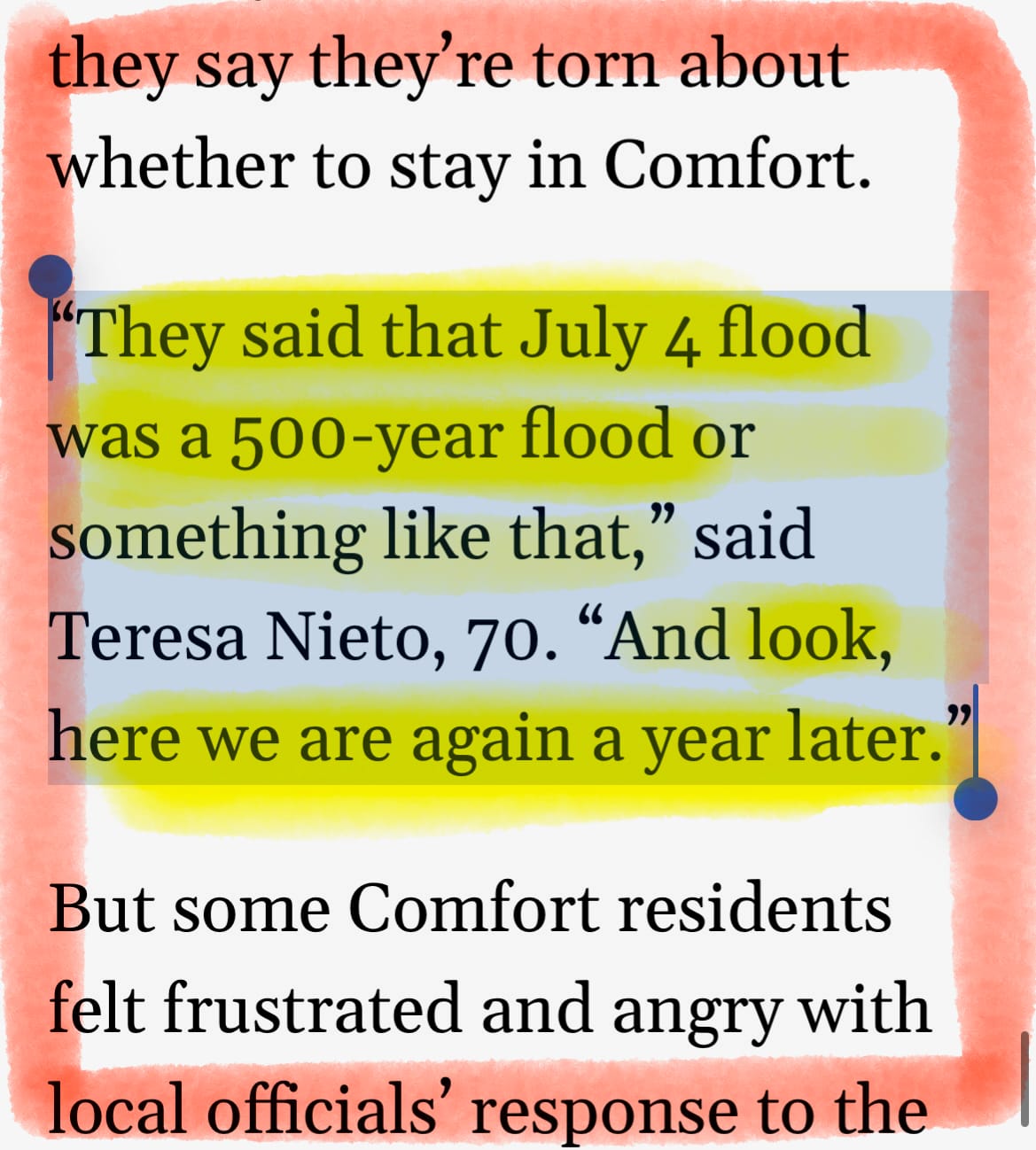
The answer to back-to-back 500-year storms isn’t difficult. This new realty of our sweltering planet has been studied and parsed for years. But readers of this multi-author storm survey were left hanging.
Most recently, Jeff Masters wrote for Yale Climate Connections about how quickening flood events are rewriting our relation with disaster within a generation.
CBS News wrote in 2017 that the U.S. had suffered 24 "500-year" rain events since 2010. That Hurricane Harvey was the third 500-year storm to hit Houston in three years.
Summarizing the state of climate science at the time, I wrote in 2007:
While it’s unlikely, rainfall levels may stay roughly the same as they have been, but they will probably be delivered in bursts of violence, followed by intense flooding, separated by periods of drought. What water does reach the region will be lost to evaporation thanks to an anticipated 7-degree spike in average temperatures [by 2100], researchers found.
It’s a drum our state’s climate scientists have been beating for years.
Roughly a month before 2026's Guadalupe flooding reprise, Deceleration quoted Texas State Climatologist John Nielsen-Gammon saying that growing extreme rainfall events are becoming more common—thanks to the massive amount of heat-trapping gases that fossil fuels are injecting into the atmosphere.
“Unfortunately the Hill Country flooding is the sort of event we’re going to have to continue to deal with in the future,” Nielsen-Gammon said.
When the paper's editorial board finally stepped up to address this question about quickening extreme storm events, its members neglected to unpack the lessons from decades of climate science and the combined threat of these growing storms to keep a tight focus on two floods alone:
“Flood-inducing storms in consecutive Julys is not enough to call a trend, but it would be careless to not consider the possibility that we’re at the dawn of a new normal and alter the way we think and live — and plan accordingly.”
CPS Energy: A Call for Reflection
With thousands of residents still without power three days later, on Monday, Aug. 31, CPS Energy board member Janie Gonzalez called for a review of the utility’s storm response.
“I want to see a comprehensive after action review,” Gonzalez said, “not to blame people, not to second-guess employees who are making difficult decisions in the middle of an extraordinary event, but because what good organizations do is [ask] what worked, what didn't, where's the bottleneck, what surprised us, what would we do differently?”
CPS Energy trustee calls for a post-storm performance review. Deceleration Video
This is, we should note, the same utility that recently modified its generation plan to allow for greater investment in fossil fuels certain to both break its own climate commitments and feed this climate destruction.
Describing the storm, its damages, and restoration efforts, CPS Energy’s Almaraz said the story of the storm wasn't infrastructure failure, per se, but high winds and lightning. He narrated a prepared chart that asserted the success of outage-limiting investments made since the winter storm of 2021 that left hundreds of thousands stranded for days to weeks while the state’s electric grid teetered on collapse. That event helped inform the new generation plan, which veers further to gas investment in part to limit market purchases and insulate the utility as much as possible reliance on the rest of the state.
The multi-million dollar recloser investment, for instance, made after Winter Storm Uri “created some resilience effect for the grid” and allowed CPS to “fairly quickly” restore 230,000 residents. Almaraz termed this "Phase One" of storm recovery.
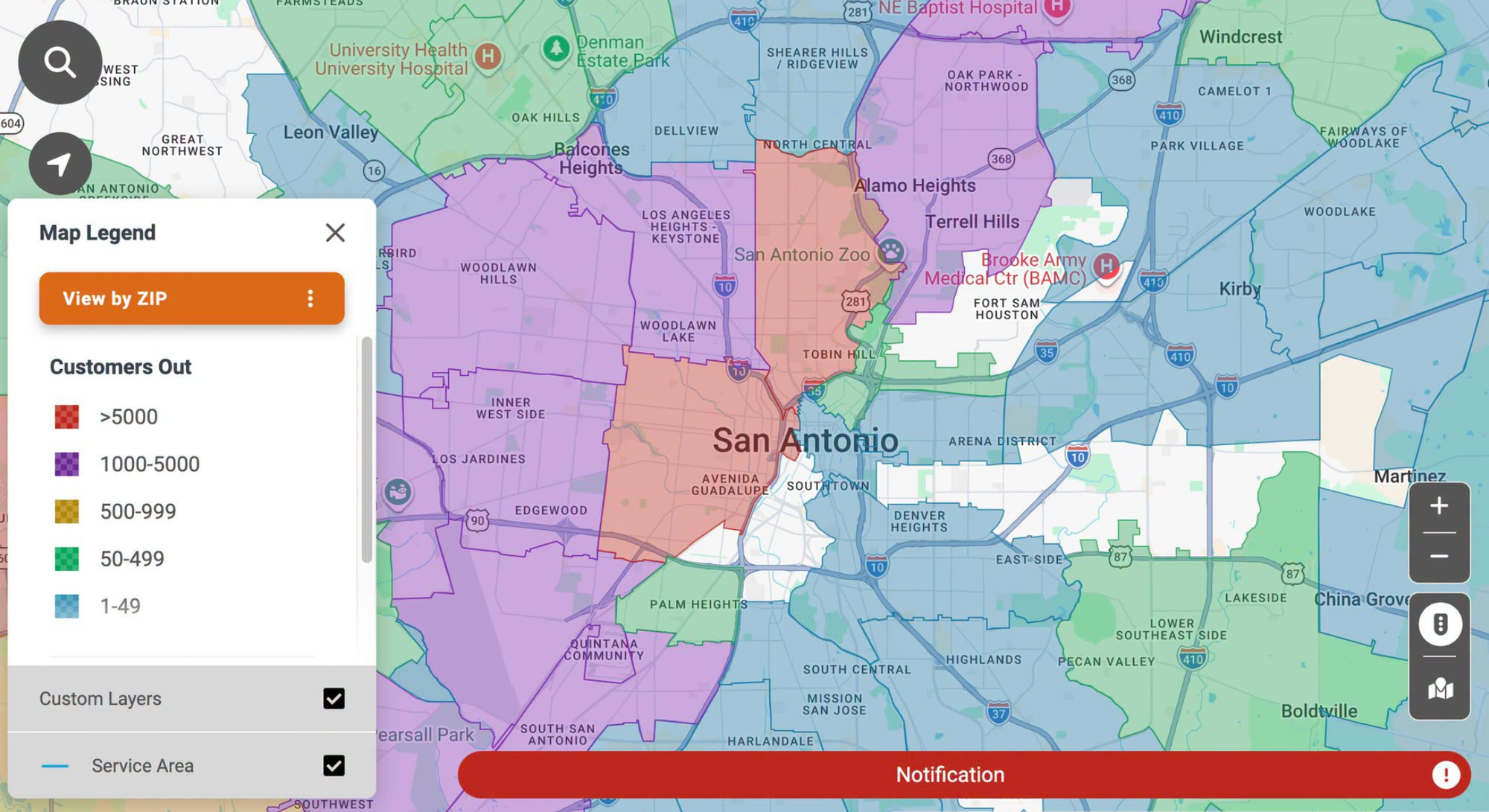
Phase Two began on Saturday, Aug. 29. It was a day of debris removal, prepping sites for repair, an “agonizing, slow progress” that began in the “hardest hit areas,” Almaraz said. This work centered in Five Points and nearby areas (where roughly 25,000 of the 65,000 still-impacted residents lived). For that reason, few saw their power restored on Saturday.
On Sunday, restorations picked up, with roughly 2,300 outages restored per hour, he said.
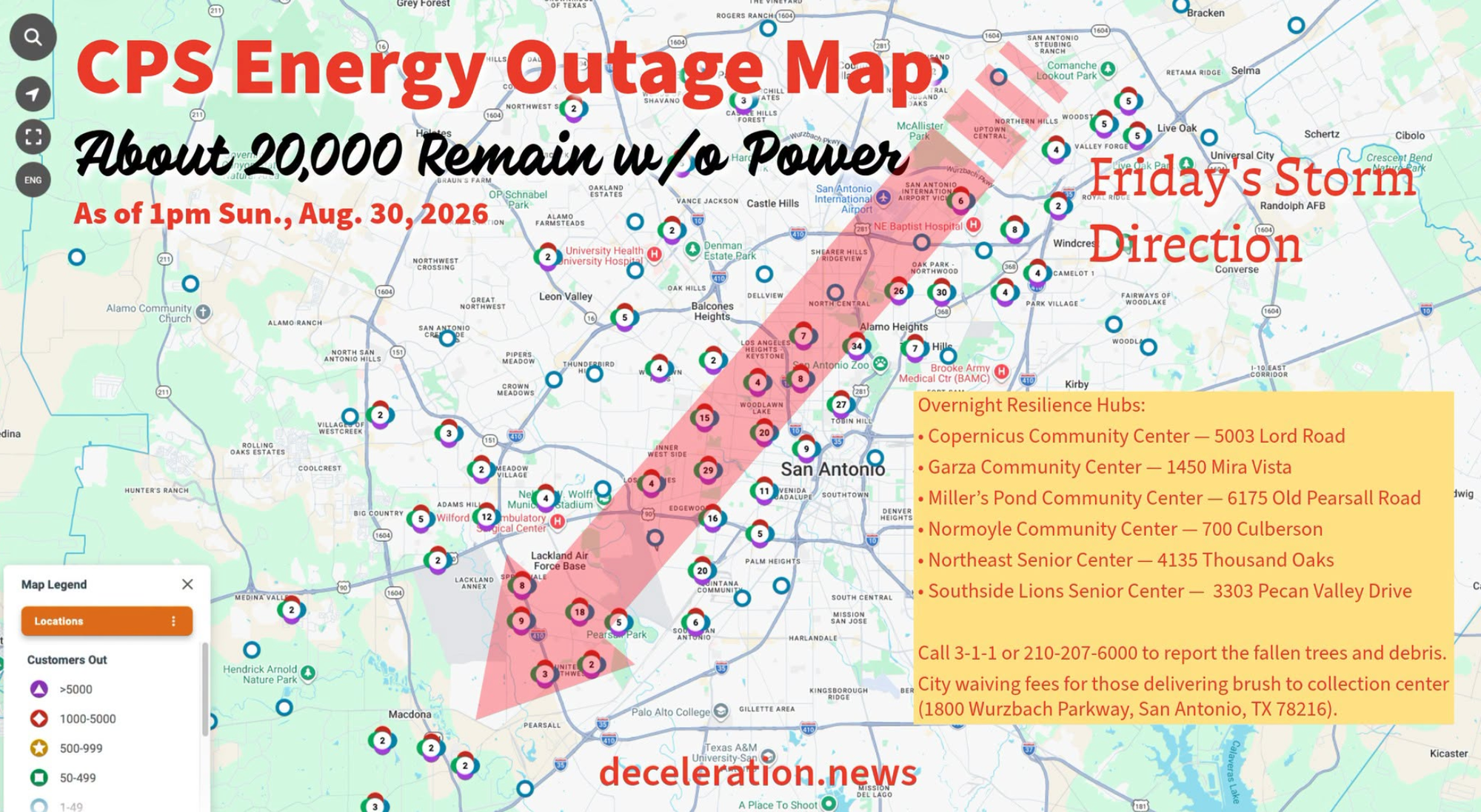
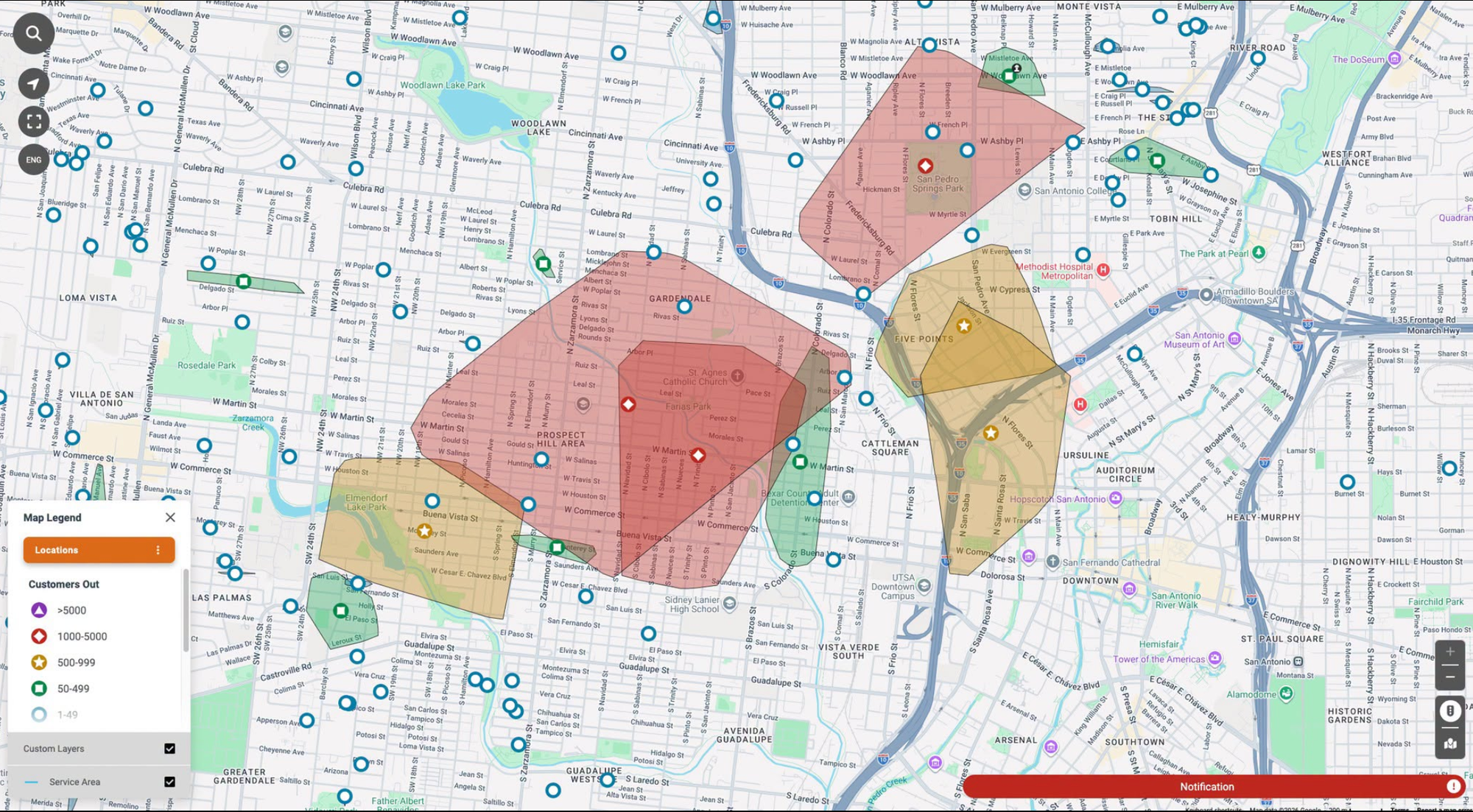
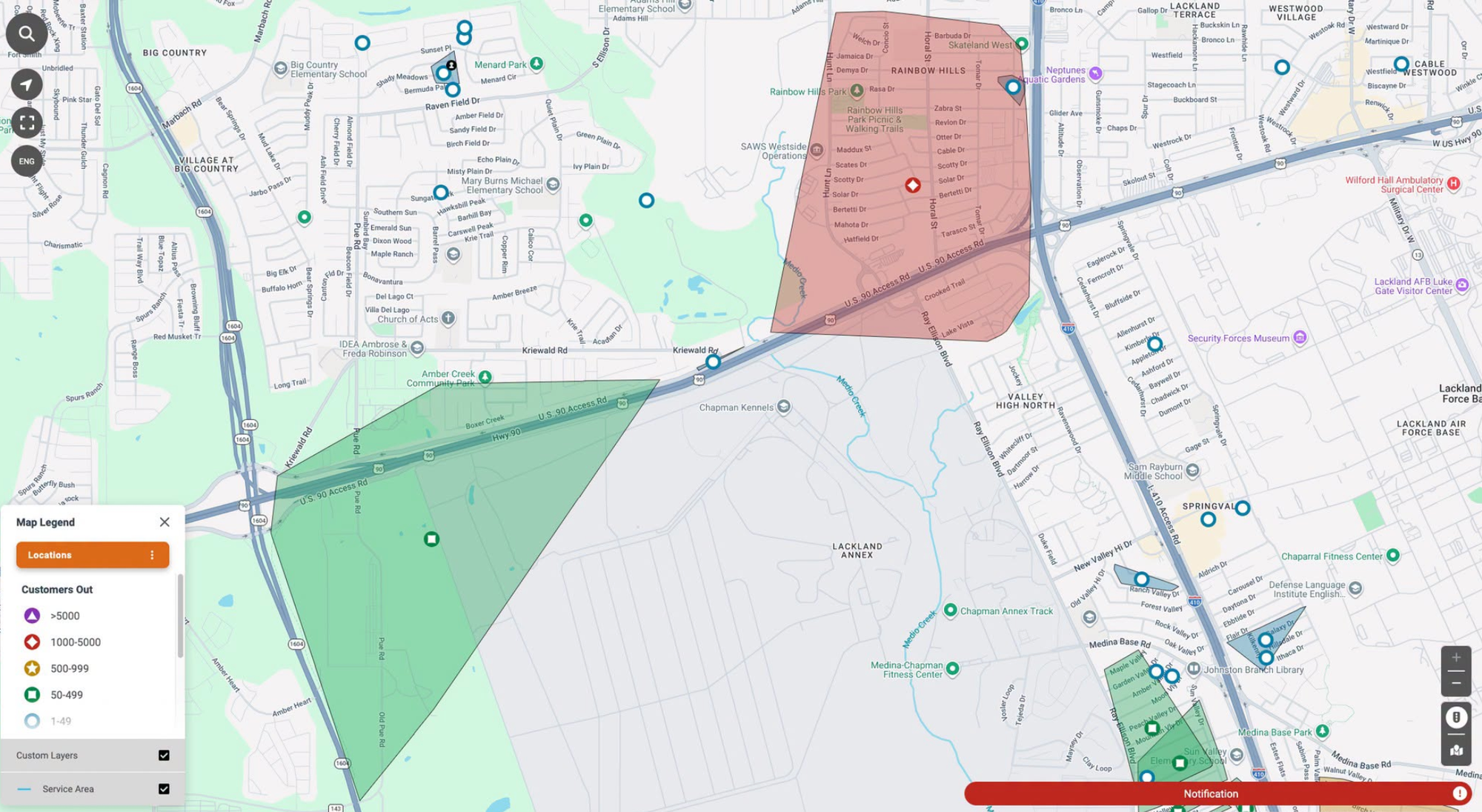
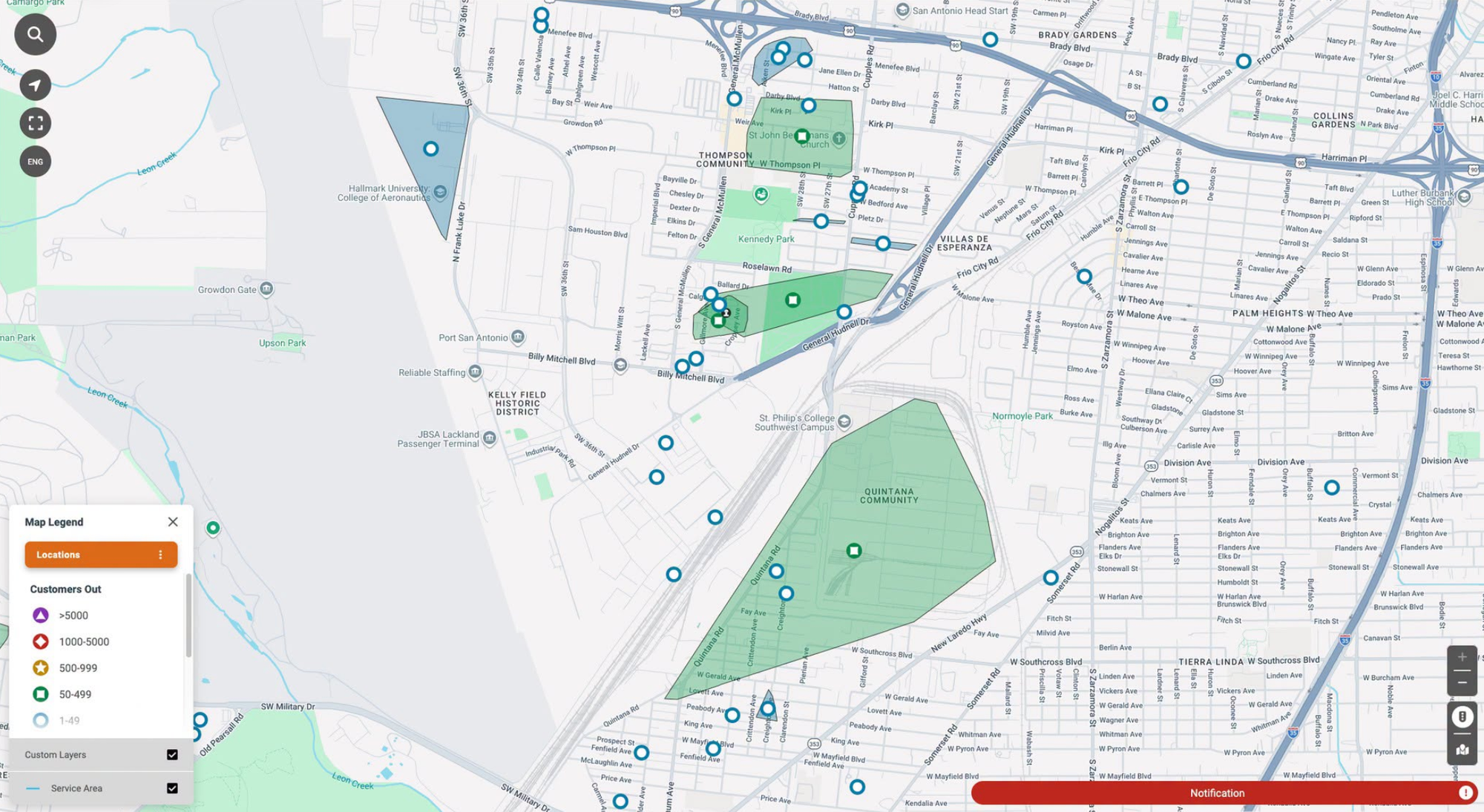
Outage maps for Sunday, Aug. 30, 2026. Deceleration/CPS Energy.
The sun rose on Monday with roughly 5,000 still in the dark.
As Almaraz said at the Monday afternoon meeting: “The size of the clusters are smaller now. Pretty soon we’ll be in people’s backyard, handling outages to 1 or 2 houses.”
It was this afternoon that Deceleration met Juan Flores in a small home a couple blocks west of Zarzamora Road on the West Side. Flores and his wife had slept for three nights with their front and back doors propped open, trying to catch a cooling draft. The official nighttime temps recorded miles away in the shade at San Antonio International Airport remained in the upper 70s and lower 80s. But on the Flores’s porch Monday afternoon, Deceleration measured temps of 102F in the shade (and 114F on the street). The official high that day was 98F.
Power was restored by a subcontractor, Mississippi-based Chain Electric Company.
Disasters and storm recovery are increasing costs for utilities across the country. Prior to the recent data center power demand surge, "the biggest costs that utilities have faced ... have been grid upgrades and hardening because of storms," according to Conor Harrison, a geography professor at the University of South Carolina.
Harrison is the author "Brokers of Power: The Financialization of the US Electricity System," a recent book about the financial forces driving utility behavior (and misbehavior) in the U.S.
"Generally utilities want to get things up and running quickly, but it is time and labor intensive."

City of San Antonio Defunding Climate Programs
This freak, if freakishly normal, storm hitting in climate-destabilized times exposed the endemic and unresolved economic truth of San Antonio: where stark economic segregation forces some to bear more than their share of suffering when disaster strikes.
Neighbors who lost refrigerators worth of food, unable to relocate to a hotel for safety, with local cooling centers out of commission, were standing in long lines in 100-degree heat on Monday for help from the Food Bank off of Guadalupe Street.
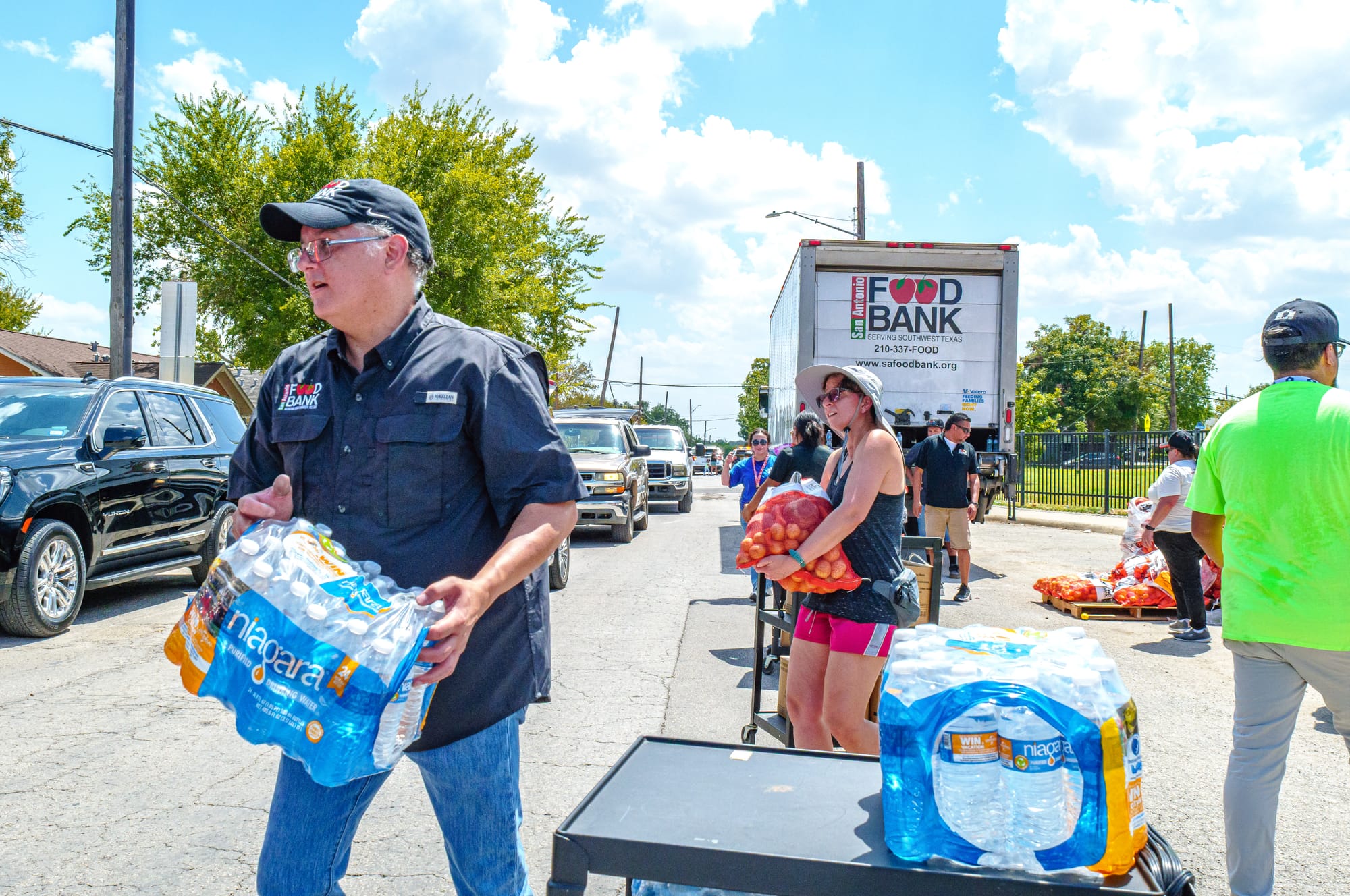


Food distribution for impacted families. SAISD/San Antonio Food Bank
Now a proposal to defund a program designed to help communities activate in times of climate crisis is winding its way to approval in a new City budget. For two years Climate Ready Neighborhoods has been a key response to the fact of rising temperatures in San Antonio partnering with established community organizations. Deceleration first warned about this defunding proposal a year ago.
The leading vision for downtown today is wrapped around a rising sports and entertainment complex crowned by the San Antonio Spurs, even as the city budget lurches into a season of deeper austerity. Climate programs slashed as extreme heat builds and climate disasters accelerate and the costs of necessities like housing, food, cooling, and water grow.
Climate Ready Neighborhoods, a partnership with the local nonprofit Impact Guild, activates “pods” across the city, neighborhood by neighborhood, to prepare themselves for increasingly extreme weather shocks driven by climate change. It is aimed at helping some of the most heat-impacted communities respond more effectively to climate shocks. This includes a partnership with local nonprofits, like Fuerza Unida on the South Side, to build up community resilience where families have a harder time retreating from the heat.
Three full-time positions are proposed to be eliminated at the department, including the manager of the Climate Ready Neighborhoods. Outreach is expected to be reduced overall from 100 events to 10 events per year. One of the sustainability office managers said he hopes the funds will be restored in “a matter of budget cycles” (ie. years).
SA Climate Ready committee members question the move to defund Climate Ready Neighborhoods. Deceleration Video.
Elizabeth Eichhorn helped in that early development in the Beacon Hill area on the near-north side of the city.
“Defunding a program like Climate Ready Neighborhoods goes against any future hope for resilience to climate change,” Eichhorn wrote Deceleration. “The city is looking at immediate change and quick funds versus spending money that will help to ensure that neighborhoods are ready and prepared for the inevitable.”
While delivering meals across the West Side, Segura spoke about what she saw as the City’s warped priorities.
“Here our electeds are giving $1.3B to Project Marvel, Spurs billionaires,” she said, “yet we continue to struggle with poverty.”
After the immediate needs from this most recent storm are met, Segura predicted “a lot of accountability sessions” for local leaders.
What About Deregulation?
Climate shocks are quickening, and will continue to quicken and deepen until the world transitions away from fossil fuels and begins restoring the lands and oceans responsible for regulating global temperatures.
The track of August's storm exposed long-simmering wealth disparities that are responsible for decades of difference in life expectancy between the North and South sides of town. In spite of that daily lived reality, it is frequently (but not always) representatives of the more conservative, wealthier (and generally whiter) North Side districts resisting investments in social services like climate programming.
That legacy of disinvestment should likely be the target of those who seeks to prevent a repeat of this outage when the next climate-strengthened disaster strikes.
While Texas Governor Greg Abbott has promised to break up municipal utilities in the state, including CPS Energy and Austin Energy, such a move is unlikely to improve service or affordability or storm response.
"I don’t know of any evidence that deregulation has improved storm recovery," said Harrison. "I don’t think deregulating/introducing competition is going to really change any of the issues they are facing, or provide any real benefits.
"One thing that will change, though, is that responsibility for these things becomes quite dispersed when deregulation happens. At least with [CPS] you have an entity connected to a democratically elected city government."
-30-
UPDATE: CPS Energy response to Deceleration's question about the location of the reclosers that restored power to more than 100,000 homes. Received Sept. 14, 2026:
"Reclosers have been part of CPS Energy’s Board-approved capital plan for several years and have been supported through rate adjustments aimed at continuing to invest in infrastructure that supports reliability. CPS Energy’s capital expenditures are funded through a mix of debt and cash, with the capital plan funded on average approximately 60–70% by debt and 30–40% by cash. By maintaining low borrowing costs, we keep our rates competitive, which in turn ensures that our customers benefit from some of the lowest combined bills in the state of Texas.
"CPS Energy does not disclose the specific locations of reclosers for security purposes.
Deceleration Archive
We know our unhoused neighbors, residents without sufficient cooling, or those with medical conditions are highly vulnerable to heat stress and wildly undercounted heat-related death. But imagine trying to survive this monster heat in a 6x9 concrete box—without air conditioning. Follow Deceleration on YouTube.
Events

Buy Greg a Coffee
Already a subscriber? Show your appreciation for Water & Power's investigations and analysis by leaving a tip here.


