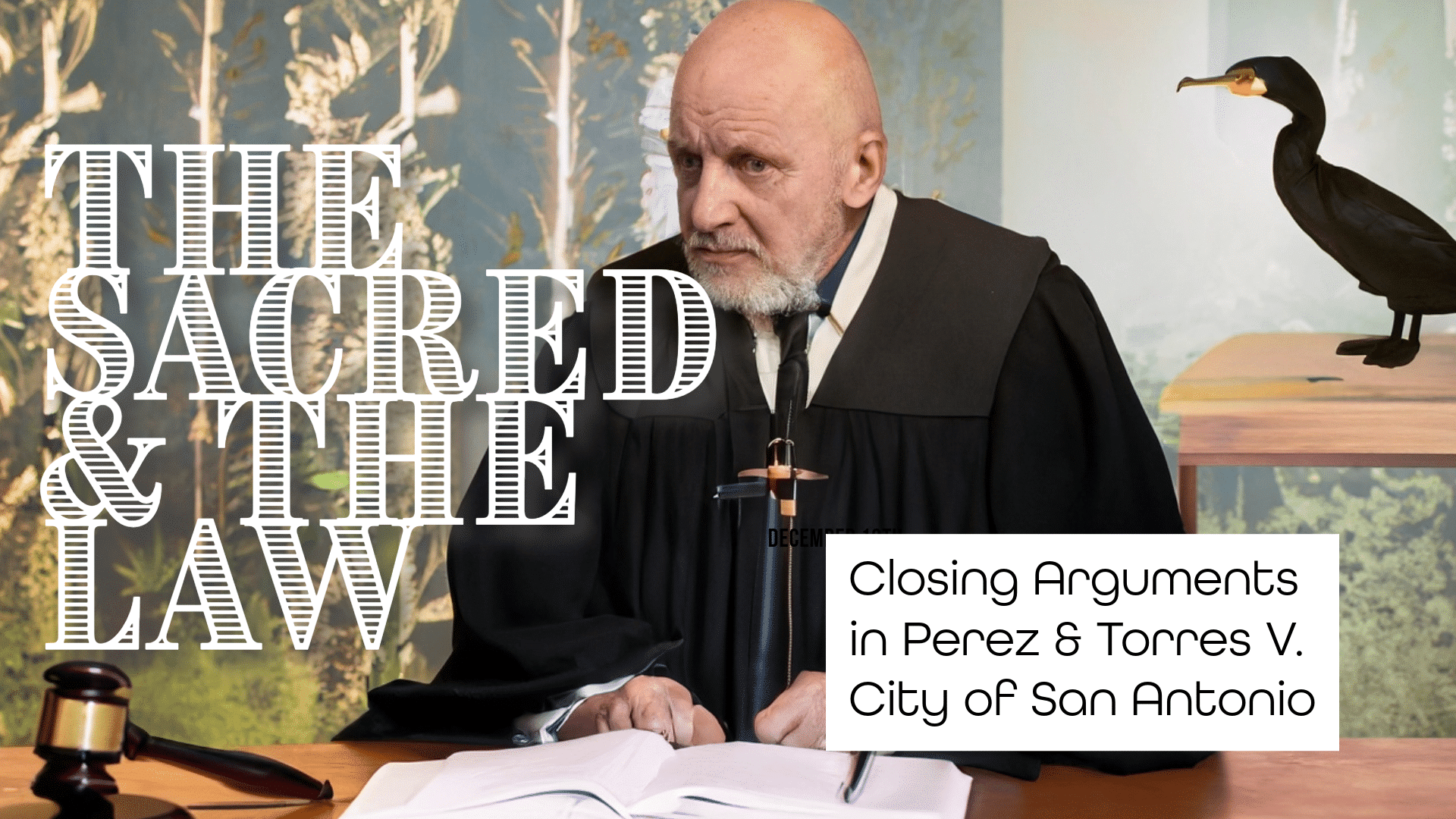
Has the City of San Antonio made sufficient efforts to provide members of the Lipan-Apache Native American Church “Hoosh Chetzel” access to one of its most sacred sites?
Lawyers for the city argued in federal court last week that they don’t even need to try.
Greg Harman
For most of last week, attorneys met in a federal courtroom in downtown San Antonio and debated the engineering merits of different forms of wall construction.
They endeavored to disentangle the migratory pulse of the Great-crested Cormorant from that of egrets and herons. And they compared various counts of trees proposed for destruction or relocation for a redevelopment project at the headwaters of the San Antonio River in Brackenridge Park.
But the central question for U.S. District Judge Fred Biery in Gary Perez & Matilde Torres v. City of San Antonio has nothing to do with caliper inches or how much trench work would be required to restore the river wall at what is known as Lambert’s Beach, once a white beach. only swimming hole. Rather, as plaintiff’s attorney Mark Rasmussen of the Jones Day law firm said during closing arguments Friday, the issue to be decided is whether the city of San Antonio has made sufficient efforts to provide members of the Lipan-Apache Native community “Hoosh Chetzel” American Church access to one of its most sacred sites for religious ceremonies.
“The city is pursuing a plan that will devastate the sacred ecology of the park.[and limit] the ability of future generations of indigenous and non-indigenous peoples to enjoy the park,” Rasmussen said.
The City, he continued, has an obligation to work to meet the demands of religious freedom “but has not even tried.”
Deep and vocal resistance to the City’s plans to rebuild the upper portion of Brackenridge Park, largely with dollars raised in 2017 in a public bond vote that promised generic improvements, took root in January 2022, immediately after it became public that the City planned to achieve its goals in Brackenridge by removing more than 100 trees while “Forcibly evicting a migratory bird colony.”
Central to this redevelopment project intended to ” tell the story of water in San Antonio ” are the century-old crumbling walls at Lambert Beach. Virtually all of the City’s arguments used to date to justify its bird and tree removal efforts within the first phase of the Brackenridge project have been based on the logic that the City’s options for repairing and restoring this short stretch of river wall are limited by the U.S. Secretary of the of the Interior for historic sites like Brackenridge. These guidelines, they say, require that the walls be rebuilt in place and thus require significant construction work behind the existing walls, where several towering oak trees now stand.
But, as Rasmussen pointed out Friday, it’s not as if the City doesn’t know how to apply for exemptions to the law. In fact, the “tree-cutting” proposal, as it was known to many local residents who loosely but steadily organized in opposition, revolves around an exemption the City obtained from local and scenic regulators who otherwise would have required all major “heritage cuts. ” and that 80 percent of so-called “significant” trees remain intact, in accordance with the City’s tree preservation ordinance.
The City employees who applied for special permits to remove the trees simply did not think that requesting a similar exemption to protect the religious rights of Gary Perez and Matilde Torres was as important as removing the trees and completing the bond project as they had envisioned, plaintiff’s attorneys charged. . Perez and Torres filed their lawsuit the day after Mayor Ron Nirenberg and most of the San Antonio City Council approved the project in August.
Meanwhile, City attorneys and several City staff members who testified as witnesses in the case last week asserted that, while they had made efforts to accommodate the plaintiffs’ claims (more on this below), ultimately, what little effort they had made was really not necessary.
One of the defense attorneys’ few references to federal case law supporting their position was based on highly controversial rulings, such as the Navajo Nation v. US Forest Service in which the U.S. government claimed the right to pollute mountain peaks considered sacred by the Navajo Nation and other southwestern peoples. tribes. More on that toward the close below.
Deceleration missed the opening arguments on the first day, but attended the rest of the week-long trial. Below are some of the more revealing exchanges and anecdotes that will hopefully play a role in the final decision by Judge Biery, who is likely to rule sometime within the next few weeks.

On the same day that Perez and Torres’ legal team sued the city, they also filed a request for a restraining order.
If granted, it would require the City to cease:
1) prevent the plaintiffs from holding religious ceremonies in the sacred area of Brackenridge Park;
2) participate in activities to deter the double-crested cormorant from nesting within the park;
3) and prevent them from removing trees and other habitats from the park.
Pérez and Torres, along with members of their ceremonial community, have been denied access to their declared sacred site within the project area on multiple occasions, their lawyers said.
On March 13, 2023, for example, after losing his aunt and grandniece in an accident, Perez went to the river to pray for his travels through the underworld. He could not stand among the towering cypress trees on the south bank of the river, the judge was told, because the city installed security fencing around the project area to facilitate the removal of birds and trees. He did not file a formal application this time. “His mind wasn’t on what form I should fill out or who I should send it to. He needed to go to that sacred place and mourn for his ancestors,” one of his lawyers told the judge.
Perez and Torres, however, formally sought access to this sacred space within the project area for ceremonies on August 12 and September 21. The City rejected those requests and instead offered access to several locations outside the fence erected around the project area. It was, as their lawyers pointed out, a space available to anyone visiting the park and, therefore, was not an actual accommodation.
Many times during the trial, defense attorneys claimed that they could not allow access to the sacred site due to security fences in the area.
“I have wire cutters at home and I’ve cut fences like that before,” Judge Biery said. “I think that problem can be solved.”

A protruding branch described by an arborist as a “widow maker” at the site was another justification for denying entry. However, surveyors estimated that the time required to remove that dangerous branch ranged from 20 minutes to four hours.
This sacred site is described as one of the most sacred places for the Lipan-Apache Native American Church. For those on the south bank of this site, the bend in the river appears to mimic the course of the constellation Eridene. Seeing the reflections of the trees and birds in the river from this location, ceremony participants can observe a bridge between the physical and spiritual worlds. It is a connection that is most powerful, according to the language of the claim, during the winter solstice.
The cormorant is of particular importance to the ceremonies in this space as it was a cormorant in this creation story that flew into the Blue Hole, one of the best known springs at the headwaters of the river, and was subsequently chased away by a spirit in the form of a blue panther. “As the cormorant fled the spring, its tail feathers spread life-giving water throughout the San Antonio River Valley, including the lands that comprise the Park, giving rise to life in this region,” Perez states in a declaration filed with the court in support of the request for a restraining order.
Because of this importance, attorneys and witnesses repeatedly discussed whether bird deterrence efforts to remove certain migratory birds could be modified to allow cormorants. The City’s current work order with the USDA specifically targets cattle egrets, great white egrets, and great white egrets, as well as cormorants, and allows for a variety of tools to expel them from city parks, including, “1. Pyrotechnics[s], propane cannon[s], 2. firearms, mylar balloons, 3. methyl anthranilate, 4. drones, lasers, effigies, scare-man, 5. nest/egg removal, 6. trucks, dogs.”
Employees working under the direction of the USDA are committed to “prevent harm to animal life,” except, of course, for the target species: cattle, white egrets and cormorants.
While numerous hearings have been held to discuss Brackenridge Park trees, no public hearings have been held on the evolution of the city’s colony management plan and its bird deterrence efforts throughout the city, even most noticeably in recent months in Brackenridge Park.

The Perez and Torres lawsuit has moved forward to protect the particular needs of members of the Lipan-Apache “Hoosh Chetzel” Native American Church at the headwaters of the San Antonio River.
The river, known to many Native Americans as Yanaguana, or roughly, “place of spiritual waters,” is sacred to a variety of bands, tribes and nations. Several of them have tried to get the attention of city officials and Mayor Ron Nirenberg over the past year.
The Comanche Nation’s federally recognized tribal historic preservation officer, for example, wrote to Mayor Nirenberg in March 2022. “Our Native American church songs talk about the Yanaguana River and many tribes also advocate for these songs today,” Martina Minthorn wrote to the mayor. “We support the removal of trees from Brackenridge Park and understand the harm to sacred trees and migratory birds.”
Tom Castillo, preservation director for the Lipan Apache Tribe of Texas, a state-recognized tribe, also wrote to the city of San Antonio to object to the project as conceived.
“We believe that protecting the San Antonio River and its habitats, especially the cormorant and the heritage trees in which it nests and to which it migrates, is of utmost importance because of our ceremonial and sacred connection to them,” Castillo wrote.
“We therefore support those who oppose the destruction of heritage trees in and around the San Antonio River.”
Castillo told Deceleration in August, a year and a half after sending his letter, that no one from the city of San Antonio had responded to his letter. “[N]o person from the city of San Antonio has contacted me at this time regarding the Lipan Apache Tribe’s letter of objection,” Castillo wrote by email.
Deceleration was unable to reach Minthorn with the Comanche Nation regarding the disposition of his complaint. Mayor Nirenberg also did not respond to our inquiry in this regard.
While Perez and Torres are members of the Lipan-Apache Native American Church, members of the larger Oklevueha Native American Church, with branches throughout North America, offered their full support to the couple’s efforts.
“We are grateful for people who stand up to the desecration of sacred sites,” Lianne Bremer, communications director for Oklevueha Native American Church, wrote in Deceleration.
The clash of worldviews was clear throughout the trial, particularly in many of the references made by Judge Biery about the tree merchandise. After all, he said at one point, the large trees around the courthouse did not grow on site but were trucked in to accommodate the building’s construction, “with large root balls,” he said, suggesting that any tree removal in Brackenridge could be done Cured with time and good landscaping.
However, that attitude clashes with Native American thinking, as Bremer explained in Deceleration, emphasizing how trees often take on a deeper meaning for Native Americans as “kin” rather than simply a disposable resource. It is this deeper relational perspective that has informed many of the legal efforts worldwide for recognition of nature’s rights in law.
Related: ” The rights of nature come to San Antonio “
“All indigenous cultures are of the land, and honoring and respecting nature and our connection to it is the basis of their identity,” Bremer wrote to Deceleration. “While a tree or a group of trees may simply seem like an obstacle to a human, to a Native American those trees are kin.
“What is sacred to a Native American may not be understandable to other cultures and may seem outdated and simplistic,” Bremer continued. “However, as with all religions and cultures, society must be respectful of other peoples’ beliefs and customs. Even more so with Native Americans. This is their land. They have been asked to sacrifice so much in the name of development and progress, and to what end?”

The conflicting values were evident in the judge’s comments and in all witness testimony.
Highlighting a small dot next to the river on a map of the project area, plaintiff’s attorney Jonathan Guynn of the law firm Jones Day asked Jamaal Moreno of the city of San Antonio’s Department of Public Works whether Moreno knew that this site was considered a “sacred area.”
“I thought it was just the project area,” said Moreno, who oversees the Brackenridge Project for the City.
Guynn then drew a line around what is understood to be phase one of the Brackenridge project. This broader area is not the “sacred area,” Guynn said. Only the small red mark on the south bank of the river, situated between two towering cypress trees, is the sacred area.
“Now I get it,” Moreno replied.
And Moreno now understood that “excessive” logging outside the sacred area would “devastate” the sacred ecology of the area?
“Yes. Now I understand,” Moreno replied.
Did you understand that “excessive removal” of trees and displacement of migratory birds would undermine what the lawsuit calls the “spiritual ecology” of the space?
“OK. I understand,” Moreno said.
This new understanding of Perez and Torres’ claim was echoed by Parks Deputy Director Bill Pennell, who oversees the city’s bird deterrence efforts that work to prevent egrets and herons from nesting in the city. Parks Director Homero Garcia said essentially the same thing. Of course, Perez and Torres-and many others besides-have been telling anyone who would listen during the project’s year and a half of public hearings and open houses that this was sacred ground.
However, even with this sudden realization of the parameters of the sacred, the final stance of project director Moreno did not change.

When asked if he would remove a tree that had migratory bird eggs inside it, Moreno said no. He would avoid such a tree because of protections afforded by the U.S. Migratory Bird Treaty Act. That he would avoid such a tree because of the protections afforded by the U.S. Migratory Bird Treaty Act. How about a tree that someone claimed had significant religious value to them? he was asked. Yes, he replied. He would cut down that tree.
Moreno explained his reasoning at another point in the trial: “We didn’t want to take those steps back and start all over again”.
“Don’t you want to step back?” asked plaintiff’s counsel.
“It would take time and money. But we don’t want to take a step back; no,” Moreno said.
Judge Biery and attorneys defending the claims in the case frequently sought to draw analogies to Perez and Torres’ claims with comparisons to Catholic beliefs. What would you do if you couldn’t attend mass at Notre Dame, Judge Biery reflected. That shrine is believed to have a particular sanctity for Catholics because of the alleged possession of nails that once pierced Jesus Christ, he said. Would you, as a Catholic, be able to receive Mass elsewhere – would that mass be such a good thing?
One attempt to respond to that comparison compared it to the requirement to enter a church through a “side door” and remain for the ceremony “next to the altar.”
The tone-deaf nature of the City’s efforts in relation to native peoples was captured on The Source, a call-in show with Texas Public Radio’s David Martin Davies, when Matilde Torres called in to inquire in February 2022 about the lack of consultation with any of the indigenous peoples in the area who hold this site sacred.
“Knowing that it is a sacred land, a sacred river, what do they plan to do? When they talk about preserving the culture, what exactly does that mean? Torres said. “They haven’t communicated with any of the indigenous groups. There are the Lipan, there are the Tehuan mission Indians, there are the Coahuiltecs.”
Moreno did not answer the question: Did the City plan to consult with native peoples about the project? Rather, he responded that the City would communicate with those groups when it was ready to build interpretive signs for the area. In other words, after the birds were gone and the trees were removed.
“We want to interpret all that history and we want to disseminate that information,” Moreno said. “We’re just not at the point in the design process where we’ve done that.”
City Manager Erik Walsh showed similar indifference in June 2023. After more than a year of indigenous complaints around Brackenridge denouncing the city for failing to consult with native peoples, Walsh announced that he had reconstituted a Brackenridge Park advisory committee to guide future decision-making. Only one seat among the 23 on the Brackenridge Park Stakeholder Advisory Committee was reserved specifically for Native American interests.
By comparison, two of those 23 seats went to golf-related business.

The approach of plaintiffs and defense counsel differed in the degree to which they cited case law.
Plaintiff’s attorneys, including a leading scholar in religious liberty claims, members of the University of Texas School of Law, the UT Law and Religion Clinic, and members of the prestigious Jones Day law firm, alleged violations of the First Amendment of the U.S. Constitution, Article One of the Texas Constitution, the federal Religious Land Use and Institutionalized Persons Act, as well as the Texas Religious Freedom Restoration Act. In addition, they made multiple references to case law to support their claims.
By comparison, even in closing arguments, Judge Biery had to press city attorney Natalie Wilson of the San Antonio-based law firm Langley & Banack to ground her objections in existing case law. The citations she offered drew a gasp at one point from some law students in the courtroom observing the trial. It was for good reason.
Wilson referenced Navajo Nation v. U.S. Forest Service, which relies on the U.S. government’s alleged right to pollute Arizona’s San Francisco Peaks, which lie within the Coconino National Forest and are considered sacred not only by the Navajo (Diné) peoples, but also by the Hopi, Havasupai and White Mount Apache nations. .
Meanwhile, in Lyng v. Northwest Indian Cemetery Association, another justifying decision claimed by the defense, the U.S. Supreme Court ruled that logging roads could be built even if they threatened religious practice, severely eroding Native American rights.
Wilson also addressed Judge Biery’s habit of trying to understand native thought by offering seemingly equivalent Catholic rituals or beliefs. Perhaps seeking to score points of local pride, he asserted in his closing arguments that for Catholics, at least, the Mass at San Fernando Cathedral in San Antonio was as good as any Mass at any other Catholic church.

The meaning here was hard to misunderstand: Perez, Torres and others of their faith could go find another tree, another bird, another river.
Wilson and those who accepted his statement embodied a continuation of past oppressions of native peoples, both in argument and in indulgent humor.
As Joel West Williams, a citizen of the Cherokee Nation and senior attorney for the Native American Rights Fund (NARF), recalls in an article co-written with Emily deLisle in Ecology Law Quarterly in 2021:
“[T]he government has at times desecrated, destroyed or prohibited access to sacred sites, making native religious exercise extremely difficult or impossible.”
“In a nation that purports to value religious freedom, tolerance, and equality, the legal system should provide protection for Native American sacred sites. In practice, however, Native American religious practitioners have rarely enjoyed the judicial protection afforded to followers of religions more familiar to most Americans and American judges,” the two conclude in their critique of how cases such as Navajo and Lyng have been applied in recent legal decisions.
In closing, the city’s Wilson quoted the Broadway musical Hamilton to complain, “‘They don’t have a plan, they just don’t like mine.’ And that’s what this case has been about for the last four days.”

Of course, those who believe their religious life is being unjustly eroded due to government oppression are not obligated to develop alternative engineering plans, Rasmussen countered. They need only demonstrate their oppression.
Although Judge Biery had already reduced the hour requested by plaintiff’s counsel to present closing arguments to 45 minutes (“I guess everyone wants to go home,” he said), the judge still couldn’t help but interrupt.
While Rasmussen compared Brackenridge’s city project to razing a synagogue and “putting up an office park,” Biery interjected that, based on his understanding of the testimony of several of the city’s witnesses, no matter what was done to repair the river wall there, there would still be destruction and damage and loss of trees.
“To save the trees, construction would have to be canceled; just don’t do it,” Biery said. “And even if construction is not completed and the walls deteriorate, the trees are in trouble. The trees could live longer, but only if there is no construction.”
In his rhetorical entrenchment, Biery showed that he was stuck in the same place where much of last year’s Brackenridge debate failed. How many inches of trees were lost? How many did they plant? What was the weight of the construction equipment involved? Did the wall come before the trees? After? From within this dust devil of near-paralyzing technical disagreements, the boosters would reliably assert that, therefore, the project must move forward.
Isn’t that right, the judge seemed to ask. Is there no viable alternative to the planned project?
First expressing disagreement with those logics, plaintiff’s counsel Rasmussen responded by diving deeper into the heart of the alleged violation. Referencing a quote from the U.S. Constitution displayed in Biery’s courtroom, Rasmussen reflected that he had never seen a quote from the U.S. Secretary of the Interior’s guidelines on historic structures hung in any federal courtroom. The reason, he continued, is that those guidelines are subordinate to the U.S. Constitution. And they are subordinate to the right of all people to religious freedom.
“The Secretary of the Interior’s guidelines are not binding,” Rasmussen reminded. “The City Council can look for exceptions and they haven’t even tried.”
He continued:
“What would happen if we called Secretary Holland and said, ‘We have your guidelines and we have the Bill of Rights and they seem to be in conflict?’ I can only imagine she would say, ‘Follow the Bill of Rights.'”
In the next few days, Biery will issue his decision. As written responses to the final statements are not due before Friday, October 6, 2023, they are not likely to arrive before next week. In his various questions and statements, Biery showed himself to be engaged in the debate and also moved by it.
Showing his anti-regulatory bias, at one point he said, “It’s amazing that anything ever gets done, because of all the regulations. … We’ve become like a barnacle-covered battleship.”
However, he also seemed moved by the arguments of the plaintiff’s attorneys, and at one point asked the defense what the City would do if it ruled against him.
Few seemed impressed by Wilson’s reference to the Navajo. For one thing, the Brackenridge case does not involve federal lands. Texas law regarding religious freedom is stricter than that of the federal government. Moreover, the Ninth Circuit Court of Appeals specifically reviewed the Navajo case and reversed it in light of the passage of the federal Religious Freedom Restoration Act of 1993.
John Greil, a clinical professor at UT’s Law and Religion Clinic who assisted in the Perez and Torres case, responded to Deceleration by email to say that neither Navajo nor Lyng apply in this case.
“We don’t think the reasoning applies, because Lyng was about how the government conducts its internal affairs (the case was about logging on federal lands), and this issue is about a public park project that should be for the benefit of all. San Antonios.” Greil said.
“Our case is different because it’s possible for both sides to get what they want: we say it’s fine for the city to repair the walls at Lambert Beach, but we believe there’s a way to do it that won’t permanently desecrate this unique place. and sacred place.”
The way forward is to appeal to Secretary of the Interior Deb Haaland, who, as Judge Biery himself reminded the court, is the first Native American in the country to head this powerful department. She is a member of the Pueblo of Laguna and, according to her bio page, is a ” 35th generation New Mexican.
An appeal to Haaland appears to be a possible outcome that could follow a ruling in favor of the plaintiffs. And that could lead to a very different approach to construction and bird deterrence at Brackenridge.
-30-

Like what you’re seeing? Become a sponsor for as little as $1 per month. Explore ways to support our mission. Sign up for our newsletter (for nothing!) . Subscribe to our podcast on iTunes. Share this story with others.