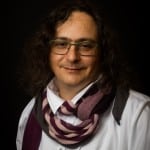
Anti-Zionist Jewish protestors speak with Deceleration on the occupation of Gaza, Abbott’s charges of antisemitism on campus, and the violent crackdown on pro-Palestine demonstrators at the University of Texas at Austin campus.
Kit O’Connell
“I asked a DPS officer who was part of my arrest where he was from,” Sam Law said. “He told me, ‘It was a long drive here from Houston.'”
Law, a graduate student in cultural anthropology at The University of Texas at Austin, was among those arrested at the campus on April 29. The arrests came after a group of pro-Palestinian activists attempted to erect a small group of tents on the University South Lawn, then defended those tents and the people inside from police.
While some—including an official UT press statement—have blamed outsiders for stirring up students for the cause of Palestine, Law believes the Texas Department of Public Safety Troopers attacks on protesters showed them to be the real “violent outside agitators” on campus.
“What I saw was students linking arms, hugging each other while being brutalized by the police,” Law told Deceleration. “I think the only violence we saw that day was from the police.”
“I think that these claims that the protesters were violent are patently absurd. There’s just no evidence.”
That’s what I saw too, when I witnessed on April 29 the arrests firsthand. There were no weapons used against police that I saw, no hurled rocks. Although one person has been charged for illegally bringing a firearm onto campus without a permit, there’s no indication he planned to use it during the protest. Instead, I saw Troopers and Austin Police Department officers violently dismantling a peaceful tent encampment that had been up for less than an hour. In all, there were more than 75 arrests that day.
Law is an anti-Zionist Jew who’s been closely involved in the campus protests for Palestine at UT Austin and continues to organize for resistance even after his arrest. I met with him in a basement meeting room at the University Baptist Church in downtown Austin about a week later. He praised the church—which has a long history of standing up for justice and civil rights—for creating a safe space for protesters and victims of police violence to take refuge during the tumultuous events of recent weeks.
Although students like Law were outnumbered by nonstudents when it came to those arrested on April 29, he emphatically rejected the narrative, put forth by the university’s president Jay Hartzell, which suggested the movement was being driven by outsiders who didn’t belong on campus.

On Tuesday, a group called Texas Faculty for Justice in Palestine issued a statement which condemned the March executive order issued by Governor Greg Abbott that ordered schools to crack down on the protests in the name of preventing antisemitism.
The group, which represents teachers at 18 of Texas’ state educational institutions, suggested that the state is cracking down on free speech under the guise of protecting Jewish students.
“The recent deployment of multiple police forces and state troopers against pro-Palestinian students at the University of Texas at Austin and the University of Texas at Dallas, among other campuses, has made brutally apparent a widespread effort to repress political speech with which the Governor disagrees and to terrorize those who practice it,” the group wrote.
Read in Full: “Texas Faculty for Justice in Palestine response to Abbott’s Order on Antisemitism“
Law believes that the police may have deliberately released students without booking them in order to tip the numbers in favor of so-called outsiders, a difficult-to-prove theory he recounted both to me and another journalist, Candice Bernd from Truthout, who included it in her excellent breakdown of the “outside agitators” claims. However, rather than looking at the raw numbers of arrests, I was more interested in a more philosophical question:
What makes someone an outsider to a campus like the University of Texas at Austin, which occupies hundreds of acres in the city and employs about 15,000 staff?
“The University of Texas at Austin is everywhere,” Law told me. “It has its tentacles in everything. If you live in Austin, Texas, you are [of necessity] affected by the University of Texas.”
Law suggested people can relate to the University in countless ways, from alumni to parents to workers to simply being neighbors of the school. He noted that during football games, the school welcomes city residents to come root for the school, but seemingly isn’t open to them when they oppose the way the school invests its money. Law told me it’s important to embrace both the good and the bad that the school does for the community and the world:
“It brings brilliant, smart, creative, energetic people to the city. It brings fascinating programming and it brings this deep energy of the youth and I think that people feel connected. UT Austin is also everywhere because it has the second largest endowment in the country and that endowment is directly involved in some of the most nefarious things going on in this world. It’s directly investing in Boeing, Lockheed Martin and other military contractors who are the people building the bombs and sending them to Israel that are being dropped on children and women and on universities.”

‘There’s nothing different happening today’
Indeed, there’s no way to know how many alumni were present at the school during the recent protests, or among those arrested. Gus Bova, the Interim Editor-in-Chief at the Texas Observer attempted to determine how many of those arrested had been alumni, only to be told that privacy regulations prevented the release of this information.
Alexander Blum, who spent many hours on the South Lawn with the pro-Palestinian protesters, is one of those who would have been labeled an outsider if he’d been arrested, since he graduated in 2014. When we spoke by phone, he said he frequently spends time at the University, from attending football games to mentoring students.
Blum runs Consequential, a nonprofit which, among numerous other projects, builds emergency shelters for refugees out of bioplastic.
“I have been a guest speaker on campus at least three times in the last four years,” Blum told Deceleration. “My company was on campus, not only recruiting, but we also have done a semester-long project with McCombs School of Business.”

Blum, like Law, is an Ashenkazi Jew who actively practices his faith. Both insisted that they had yet to experience any antisemitism from the pro-Palestinian protesters. Blum said he’s been welcomed on the lawn, even though he wears a yarmulke and has Hebrew tattoos.
In fact, Blum had just recently participated in an interfaith service on the lawn, where together with Muslims, Christians, and others, they’d mourned for the dead Palestinians. Blum had read from a piece called “Kaddish for the Soul of Judaism: Genocide in Palestine,” by Amanda Gelender, which reads in part:
“Can you hear me recite the Mourner’s Kaddish for every soul killed in Gaza? It may take me a moment, I have to say thousands of prayers, and each person has a name.”
To Blum, the South Lawn is a space “consecrated” by the generations of students that have gathered for outdoor classes, to hang out and take naps, and protest, as they’ve been doing there since the school began.
“Think about the anti war protests that happened at UT in the 60s. Think about the equal rights protests that have occurred there. Think about all the kids that have been beaten and sprayed and arrested on that ground over the decades and nearly a century at this point. There’s nothing different happening on campus today than has happened over the last 100 years.”
(“The Lawn is sacred the way an old battlefield is sacred,” he told me later by email.)
Blum walks with a cane and told me his health is fragile, so he can’t afford to risk getting into physical conflicts of any kind, but he’s always felt safe among the protesters, except when the Troopers showed up in riot gear looking for trouble. He said they deliberately tried to provoke the student body with violence and their general over-reaction to the peaceful protest, then used that as a pretext for dozens of arrests. At one point, an officer bumped into Blum then accused Blum of a deliberate “shoulder check,” only to back down when Blum revealed he was recording the incident.
“Their modus operandi is to promote contact and then overreact to the reaction,” Blum said.
Blum grew emotional when he spoke about his connection to UT Austin and the violent overreaction he saw from State Troopers:
“I love this university. If [UT President Jay Hartzell’s] going to call us outsiders, he is not the University and I think everybody needs to know that. The University of Texas is not a perfect school, but it’s a great school and post-Hartzell era, it is going to continue to be a great school. I look forward to his resignation.”
From sea to shining sea
“As a Jew, as a, as somebody who might have retired to Israel at some point, My God, am I ashamed of the government that claims to represent me,” Blum told me.
Another reason I wanted to speak to both Sam Law and Alexander Blum was to hear their perspective on the ongoing conflict as anti-Zionist Jewish poeple, whose presence at these protests—among many others like them—gives lie to the idea that they’re inherently antisemitic.
Contrary to the idea that Israel’s actions are done in the name of protecting global Judaism, Blum thinks they make the world less safe, even encouraging antisemitism from those who react badly to how Israel governs and wages war on the vulnerable.
“So much of the world is so ignorant about Judaism,” Blum told me. “The religion itself is really beautiful. And Israel is betraying the values that we hold most dear.”
He explained that Israel is betraying the core values of ‘Tikkun Olam,’ which means to repair or improve the world, and ‘Tzedekah,’ or the search for justice. “Do you see any of that happening in Palestine?” Blum asked rhetorically.
Sam Law recalled growing up in a family which attended a patriotic, Zionist temple, where both U.S. and Israeli flags were prominently displayed during services. His family were also liberals who came out against the Iraq War and other U.S. militarism, and eventually the cognitive dissonance became too much for him.




Peaceful protests at UT Austin on April 29, 2024, before Texas Troopers and Austin PD escalated the situation. Images: Kit O’Connell
“This doesn’t make sense to me,” he remembered thinking. “Why am I praying for the soldiers of one country when I am deeply and resolutely against all wars?”
Reflecting on his heritage, Law knows that many of his relatives were killed during the Holocaust, and fled to Europe and the United States from many other countries. Thanks to the way people in the United States value pluralism, freedom of religion and tolerance of people from different ethnic backgrounds, he said “In my own family the longest period of continual peace and stability and freedom from prosecution has been in the United States.”
But as a result, he can’t support an Israel which doesn’t uphold those same values for non-Jewish people.
“It’s appalling and disgusting, absolutely vile and repugnant that I as someone who has no connection to the State of Israel—I don’t have family from there—if I wanted to tomorrow, I could make a phone call, I would have a plane ticket paid for, I would have an apartment in a settlement in the West Bank in an illegal settlement that violates many international treaties. I would be paid well to do it for years. And meanwhile, my Palestinian-American friends who also live here who were forcibly displaced during the Nakba, cannot return to the place where their families live, where their grandparents told them stories about playing, working, living—their homeland, which they have a deep connection to.”
He concluded that “Israel is an apartheid racist state. Many Palestinians are not citizens of Israel, despite being born [there]. There are many Palestinians who cannot work without getting work permits. Many Palestinians cannot go back to the homes that their parents and grandparents were in for generations. They can’t see the olive trees that [they’ve been tending] for hundreds or 1000s of years.”
Law wants to see the same values upheld in that region which allowed his ancestors to peacefully settle in the United States. “I was asked whether I think that ‘from the river to the sea’ is an antisemitic statement.” To him, it’s no different than a song he grew up singing, which contains the words “from sea to shining sea.”
“I think that for me a free Palestine would be just like a free United States.”
Both Israel and the United States were the product of colonization and genocide against local populations, and both contain resurgent right-wing political forces that would further enhance their governments oppressive nature rather than working more deeply toward justice.
Law said he doesn’t believe Israel represents him as a Jew and, like Blum, he dreams of a world that’s been repaired:
“This same way that, as an American, I’m not responsible for the imperialist wars that are fought by a government that I don’t support or agree with, I, as a Jew, do not have to support a racist ethnostate. In fact, as a Jew, I have many reasons to be deeply suspicious of the idea that there should be ethnostates, of the idea that people of a single religious background should have the ability to oppress any other people. I believe that one day there will be a free Palestine and there will be liberation for all of us across the world and that liberation will be like the Zapatistas said, a world in which many worlds can fit, where many people can coexist.”
-30-
Kit O’Connell is a movement journalist from Austin, Texas. Find them at @KitOConnell or kitoconnell.com.

Like What You’re Seeing? Become a patron for as little as $1 per month. Explore ways to support our mission. Sign up for our newsletter (for nothing!). Subscribe to our podcast at iTunes. Share this story with others.