Climate denialists have long deployed the nefarious practice of ‘manufacturing doubt’ to undermine public understanding of the scientific consensus on global warming. Now anti-trans movements are borrowing the technique to poison trans healthcare research and ban care.
EDITOR’S NOTE: Part one of this series examined earlier intersections between organized transphobia and environmental movements, looking specifically at Deep Green Resistance. This week we focus on the curious case of Environmental Progress, a green-sounding group that in actual practice exemplifies new, insidious forms of climate disinformation and uses the well-worn tactics of climate deniers to push disinformation about trans health care.
Part One: Anti-Trans Disinfo Creeping on Climate Justice Spaces | Part Two: Manufacturing Doubt and the Case of Environmental ‘Progress’ | Part Three: Deceleration Guide to Anti-Trans & Anti-Climate Disinformation
Marisol Cortez
Forwarded by a well-meaning family member, the headlines flashed a warning.
A Major UK Report Says Trans Children Are Being Let Down by a Toxic Debate and Lack of Evidence
“Extreme Caution”: Cass Review Raises Red Flags on Gender-Affirming Care for Trans Kids
It was early April of 2024, two months after Nex Benedict’s death, and the UK’s National Health Service had released the Cass Review. Originally commissioned by the NHS in 2020, the Review undertook an evaluation of the evidence base for gender affirming care for trans youth, with the stated intention of making recommendations to ensure trans youth “receive a high standard of care … [which] meets their needs, is safe, holistic, and effective.” A 2022 Interim Report had raised anxieties but also a cautious hope among trans communities and their loved ones; waitlists for care at the country’s sole gender clinic were notoriously long, and NHS’s proposal to decentralize services via a network of regional clinics suggested the possibility of increasing access to care.
Now the final review had dropped, and from the other side of the pond, the headlines suggested a shifting scientific landscape marked not by consensus but “uncertainty” and “toxic debate.” According to the team of reviewers led by pediatrician Hillary Cass, the evidence supporting an affirmative approach to trans youth seeking transition-related care was “remarkably weak,” warranting “extreme caution” on medical and even social transition for youth (things like changing name, pronouns, and dress). In short order, the UK’s Conservative government banned and criminalized provision of puberty blockers to trans youth, and anti-trans organizations in the United States crowed, seeing a vindication of their own vicious campaigns to ban care. In these developments, trans journalists and multiple experts in trans health care recognized what much mainstream reporting missed: regardless of stated intentions, the Cass Review would make it materially harder for trans people, especially trans youth, to live. And it had done so via methodological choices that facilitated the claims and aims of those seeking to eliminate transness from public life.
Critiques of Cass raised a number of methodological concerns. In a joint statement, the World Professional Association for Transgender Healthcare (WPATH) and its U.S. counterpart (USPATH) pointed out that, although an NHS pediatrician, Dr. Cass had no specific expertise in treating trans youth or researching trans health care. According to this statement, the review team also dismissed much of the international evidence base supporting trans-affirming medical interventions, calling this research “low quality”–a technical term that refers not to shoddy research or unevidenced conclusions, but to the small sample size and observational nature of many studies on trans health. WPATH and USPATH also note that the Cass team of reviewers and their advisors intentionally excluded trans people and trans health experts. Most concerning, several advisors to the review team have close association with Society for Evidence Based Gender Medicine (SEGM), recently classified as an anti-LGBTQ hate group by the Southern Poverty Law Center precisely on the basis of their effectiveness at turning pseudoscience into anti-trans legislation.

As such, the Cass Review arguably says less about the existing scientific consensus, more about the success of a very old political strategy known as manufacturing doubt. This is not to call the Cass Review disinformation, or the deliberate sharing of erroneous information to achieve particular economic or political objectives. It is to say that through the influence of organizations known to disseminate disinformation, the Review has become a highly visible outlier to the broad medical consensus finding trans affirmative approaches to be effective and safe.
As evident in the concern and confusion of article-forwarding family members, what makes this tactic so dangerous is that it works. As noted by Alejandra Caraballo, civil rights attorney and Harvard Law School instructor, manufacturing doubt is in fact one of the well-worn strategies of climate denialists and tobacco companies, “employed in other contexts to stall public health efforts around smoking and government action in addressing climate change.” As has been well documented in the case of Exxon, corporate purveyors of this strategy kept fossil fuels flowing by first attacking scientific consensus on the reality of global warming, then obfuscating its roots in oil and gas extraction and combustion.
To more clearly see these parallels between anti-trans and climate disinformation campaigns, it might be useful to focus on the curious case of Environmental Progress (EP), a California-based nonprofit headed by Michael Shellenberger. According to independent trans journalist Erin Reed, Shellenberger is a “prominent right-wing activist known for pushing anti-scientific views,” which is how an ostensibly green group came to publish its own report on the dangers of trans health care. News of the “WPATH Files” circulated mostly in the conservative mediasphere, with mainstream outlets and legislators taking it far less seriously than they would the Cass Review. Still, its wingnuttery distills some broader tendencies: increasingly, anti-trans movements borrow strategy from climate denialists, and climate denial itself increasingly takes insidious new forms, accepting the reality of global warming while spreading “solutions disinformation.”
The WPATH What Now?
In March of 2024, just a few weeks before release of the Cass Review, EP published an intended exposé of what it breathlessly described as “a global medical scandal that compares to major incidents of medical malpractice in history.” The target of this exposé was WPATH, or the World Professional Association for Transgender Healthcare, which sets the standards of care for trans medical care internationally. Though not beyond valid critique by trans communities for its historical role in gatekeeping care, WPATH is a mainstream medical and psychological association, analogous to the American Heart Association for the field of cardiology, which embodies the current scientific consensus on trans healthcare research and its best clinical applications.
Authored by Mia Hughes, a British-Canadian anti-trans activist who has written regularly for the far-right Canadian news site The Post Millennial, the WPATH Files consists of 140 pages of internal posts to WPATH’s members-only online forum, plus a transcript from a 2022 workshop for WPATH members. Hughes also provides 66 pages of commentary on these internal discussions, which claims to expose a vast conspiracy at the heart of WPATH and “prove that sex-trait modification procedures on minors and people with mental health disorders are unethical medical experiments.”

Reed’s fact checking of the WPATH Files turned up 216 “errors, misrepresentations, and faulty citations.” More significantly, she says, “a closer inspection of the actual messages … reveals rather mundane and often almost dull exchanges between doctors, psychologists, and therapists … seeking advice from colleagues on patient circumstances.”
Evan Urquhart, a trans science journalist who founded Assigned Media to cover anti-trans propaganda in U.S. media, similarly reviewed the Files and concluded that nothing there “stood out as being particularly notable, defined as anything outside of what would be expected from a professional forum for specialists in a healthcare field.”
In that regard, the “WPATH Files” is not unlike another supposed scientific scandal from more than a decade ago, dubbed Climategate by far right media and movements. In that case, email servers at the University of East Anglia’s Climate Research Unit were hacked, and internal communications between climate scientists published by denialists eager to suggest climate change was all a hoax perpetrated by unethical, data-distorting scientists.
Wrote one commenter on Reed’s factchecking article:
“There too, so-called ‘leaked’ documents used misrepresented, twisted, out-of-context quotes from emails among scientists dealing with the topic to claim some sort of conspiracy to HIDE THE TRUTH double exclamation point. The topic has changed; the deceit and lies of the reactionaries have not.”
From Climate Denial to Solutions Disinformation
An additional parallel between the playbook of climate denialists and that of today’s anti-trans movements, most famously documented in Naomi Orestes and Erik M. Conway’s 2010 book Merchants of Doubt, is the opportunistic manufacturing of controversy where the scientific community really doesn’t have any. In the case of both climate change and trans health care, this strategy allows far right movements to steer policy toward particular economic or political ends—ensuring the expansion of fossil fuel profits, or enshrining Christian nationalist views on sex and gender within law—under the cover of scientific authority.
As described by Urquhart, Environmental Progress has long employed this tactic on climate; the main focus of EP as an organization, he writes, is “advocating in favor of industry and against the idea that climate change should be a source of alarm.”
A deeper dive into Environmental Progress’s position on climate is fruitful, then, not only to help environmental movements repel efforts to cloak anti-trans hate in green language, but also to help all of our movements recognize increasingly common new forms of climate denial.
Over an image of the “California Peace Coalition”—a multiracial group of activists standing before a big street sign reading “Skid Row”—Environmental Progress states on their website that the organization was founded in 2016 “with the mission of achieving nature, peace and prosperity for all. We believe everyone has a right to affordable energy, a healthy planet, and urban environments that enable citizens to thrive.”
It certainly sounds like environmental progress. “We are motivated by our care for people and nature,” begins a section titled “Our Values and Our Heterodoxy.” But then there’s the fine print: “And thus … [c]ivilization depends on cheap energy, economic growth … and individual responsibility.”
It’s an interesting nod to Reaganomics, which then informs what EP actually works on: defending the nuclear energy industry, pushing to remove unhoused people from public space (“California Peace Coalition”), and working to save the whales…from wind and solar energy, a campaign common to numerous anti-climate action initiatives. They don’t deny the reality of climate change. But they do deny it’s an emergency requiring immediate action. That’s just alarmist media spin unsupported by the science, they say. Look, see all their charts and graphs proving it?
It all looks reasonable, which is often the case with disinformation. Anti-LGBTQ hate groups, for instance, give themselves neutral-sounding titles like “Society for Evidence-Based Gender Medicine” or “American College of Pediatricians” all the time. Even TERFs (Trans-Exclusionary Radical Feminists, if you were wondering) rebrand themselves as “gender critical.” The environmental progress of Environmental Progress, then, is simply manufactured doubt warmed over—the same strategy used for decades by tobacco and fossil fuel companies to dissemble their actual impacts, all in the guise of “open dialogue” or “scientific inquiry.”
“We think about psychology,” writes Environmental Progress, “because it reminds us of our blind spots. Of how we are motivated to reinforce existing beliefs and are thus biased against evidence that disconfirms our beliefs. We thus seek to debate our opponents rather than seek to discredit, dismiss, or defame them.”
It sounds high-minded until one understands that the purpose is to present scientific consensus (the urgency of addressing climate change, the effectiveness and safety of gender affirming care) as far less certain than it is. Conveniently, this allows organizations like EP to frame critics of this tactic as the unscientific ones unwilling to engage in civil “debate” with “heterodox” points of view.
Consider, for instance, how EP’s position page on climate mishandles quotes from scientific experts to support their campaign to slow climate action:
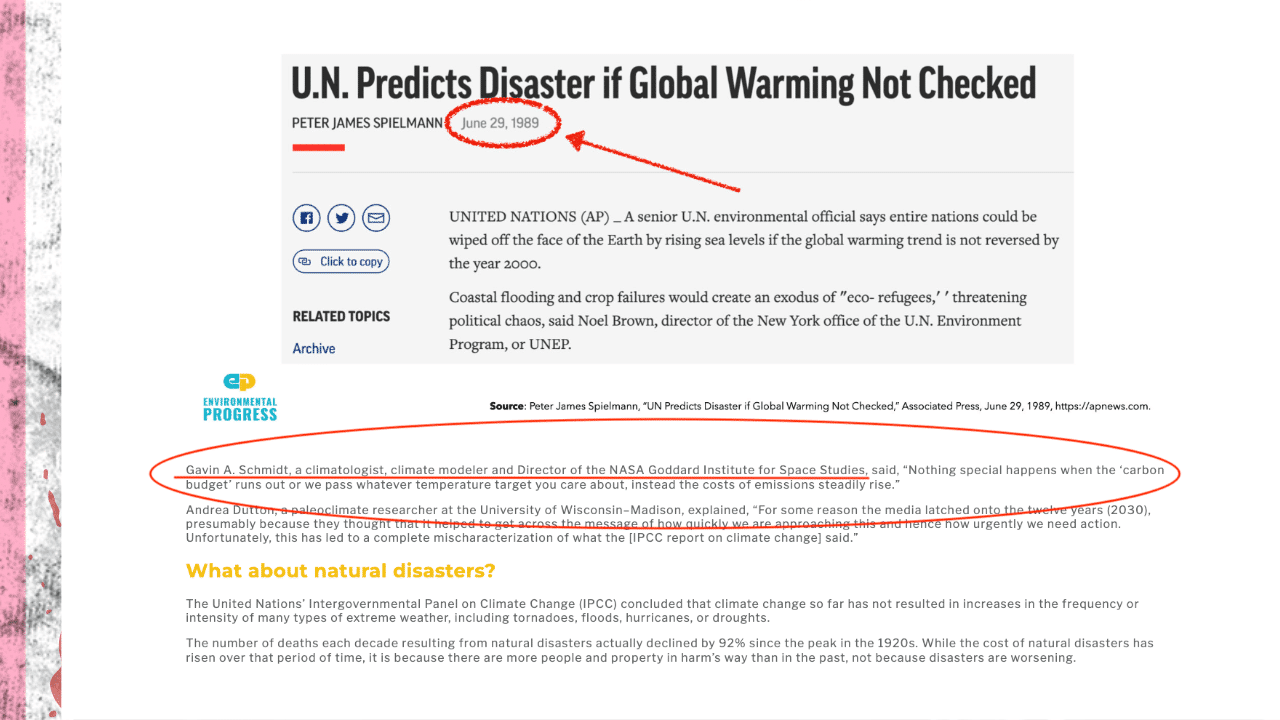
Gavin Schmidt, the director of NASA Goddard Center for Space Studies who we’ve quoted before at Deceleration, said that while his quote concerning arbitrary climate targets remains “valid,” the various conclusions EP draws from it range from erroneous to out of date to “just silly”:
“It’s perhaps worth pointing out that the last time the planet was 3ºC warmer than pre-industrial it was the Pliocene (some 3 million years ago), and sea level was 25 meters (you read that right!) higher than today (in a world without either the Greenland or WAIS icesheets). I have no idea why this should lead people to be complacent because we aren’t going to hit [even earlier, hotter] Miocene or Eocene levels of warmth!”
EP’s mission is thus a paradigmatic example of what the Center for Countering Digital Hate calls the emergence of a “new denial” that is far more insidious than older forms that rejected climate change outright, in that it seemingly accepts the scientific reality of global warming while denying the need to do anything about it. Cognitive scientist and disinformation researcher John Cook, in an interview with NPR, explains further:
“Climate misinformation is transitioning away from science denial. Now it’s (about how) climate policy will be harmful. It’ll hurt the economy. It’ll raise prices. Renewables don’t work. It’s about delaying the solutions, rather than arguing that it’s not a problem in the first place.”
To a lesser degree, a similar tactic plagues the common framing of climate change as a “wicked question” or “wicked problem,” meaning one too complex to be solved. As evidenced in an August 2023 climate science conference just up the road at Texas State University—which invited renowned climate scientist Michael Mann as keynote alongside non-climate scientist fundraisers from “anti-woke,” unaccredited University of Austin—the “wicked” framing allows a “both sides” sort of denialism to creep into discussions of what climate science actually has to say about emissions targets and timelines.
Just because the solution to climate change is politically unpalatable to fossil fuel interests and culture warriors doesn’t mean it’s a “wicked problem” too complicated to solve.
In fact, the solutions and timelines recommended by climate science are actually quite straightforward: we can’t open any new oil, coal, or gas fields and we must transition to a renewable and low-carbon economy—slashing current carbon emissions at least in half in the next few years.
Surprisingly—or not—CCDH’s case study for the new denial is Jordan B. Peterson, the Canadian psychologist influencer better known for his manosphere and anti-trans followings. Climate denial thus takes a page from the “just asking questions” doubt manufacturers of anti-trans spaces, even as anti-trans disinfo relies on “the climate change model,” as Urquhart notes, citing Caraballo’s phrasing.
The Rise of Diagonalism
And yet the science denial that these two movements hold in common is not just a far right strategy, though it often originates (or ultimately arrives) there. Increasingly—as with the very official, mainstreamed Cass Report—its talking points and tactics get laundered by the center and even draw support from some elements of the left (as in the case of Green TERFs or anti-vaxx crunchy mamas). Writing about COVID denialist movements in Germany—which “incorporat[e] a range of anti-government, anti-lockdown, anti-mask, and anti-vax positions”—political theorists William Callison and Quinn Slobodian have coined the term diagonalism to name this new paranoid political formation, which cuts across the political spectrum in its extreme distrust of “expert” knowledge and corresponding embrace of conspiracy thinking:
“[D]iagonalists tend to contest conventional monikers of left and right (while generally arcing toward far-right beliefs) … [and] trade in both familiar and novel fantasies about elite control. They attack allegedly ‘totalitarian’ authorities, including the state, Big Tech, Big Pharmaceutical, big banks, climate science, mainstream media, and political correctness. They are, in many ways, descendants of the extra-parliamentary New Social Movements of the 1970s, but with the idealism and desire for collective action or decommodification burned down to the wick of a defense of autonomous [or in the US, ‘sovereign’] decision-making.”
Applying Callison and Slobodian’s analysis stateside, Matthew Remski, Derek Beres, and Julian Walker have more colloquially referred to this toxic brew of conspiracy thinking and New Age wellness culture as “conspirituality.” Public intellectual Naomi Klein in her latest book Doppelganger popularizes the concept further, referring to diagonalism as “the mirror world” of leftist critiques of systemic power, which gets the “the facts wrong but often get[s] the feelings right.”
This is not fundamentally dissimilar from fascist movements generally, whose strongmen tap into legitimate distress about political and economic insecurity but then exploit that distress by projecting it onto vulnerable, scapegoated outgroups—Jewish people in 1930s Europe, migrants under the Trump administration, trans people right now—as a means of consolidating their own power. Conspiracy thinking can seem to rhyme with a substantive and well-researched analysis of capitalism or colonialism, but it misses the boat in punching down at vulnerable minorities rather than up against those with real economic and political power.
Pre-Bunking for Planetary Survival
Organizing for the protection of planet and people requires us, then, to resist the siphoning off of our limited reserves of intellectual and activist energy into conspiracy thinking. That in turn requires us to recognize the centrality of disinformation to anti-democratic and fascist movements. In fact, we need to recognize it before we encounter it, an idea that climate journalists and disinfo researchers have termed “pre-bunking.” Think of it as an inoculation or vaccine, absorbing a harmless dose of an illness so that when you encounter the real thing in the wild, at a concentration that can actually do harm, you know what it is and can fight it off. More importantly, you interrupt its social transmission.
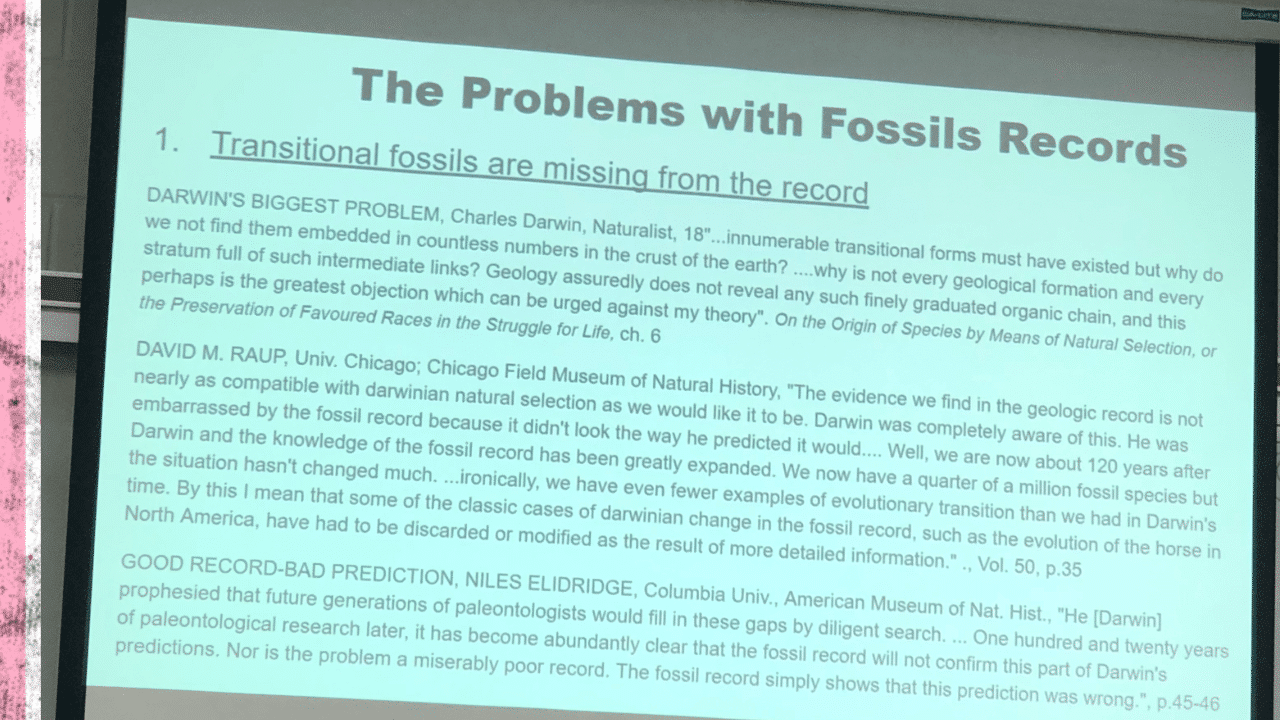
What’s needed, then, is community-level resources for pre-bunking both anti-trans and climate disinfo—given that these so often sip from the same well of science denial, relying on tactics and talking points also shared by anti-vaxxers, Flat Earthers, and the intelligent design crowd allowed to teach in Texas schools.
In How to Talk to a Science Denier, philosopher of science Lee McIntyre identifies five red flags common to those peddling disinformation:
1) Cherry picking evidence (i.e. quoting a climate scientist to argue against the consensus within climate science)
2) Belief in conspiracy theories (i.e. Climategate, the WPATH Files)
3) Reliance on fake experts (i.e, inviting credentialed but contrarian professionals who are not actually climate scientists to speak at a climate science conference; tapping a doctor who isn’t an expert in trans health care to head a systematic review of the evidence base on trans health care)
4) Committing logical errors (i.e. more trans people are coming out, so transness must be a social contagion spread by social media)
5) Insisting science must be perfect (i.e., until something has been 100 percent proven, everything is open for debate)
Fighting disinfo, then, is less about debunking or fact checking in real time than recognizing it in advance. Whether the issue is climate, trans health care, COVID, vaccination or evolution, it’s a matter of understanding what the scientific consensus actually holds so that we can more easily see through the pseudoscientific gloss of credentialed but fringe perspectives.
“It’s a question of scientific certainty,” Jael Holzman told Deceleration when asked about parallels between anti-trans and climate disinformation. We reached out to Holzman given her powerful investigative reporting on the damage organized transphobia has done to environmental and climate justice movements.
“The same percentage within the scientific community agrees climate change is real, and does damage that requires urgent action, as the percentage of trans people who feel they’ve benefitted from gender affirming care and medical transition. It’s something like 97, 98 percent,” she said, referring to studies that have attempted to measure levels of adult and adolescent satisfaction with trans-affirmative health care.
“We should be talking about the parallels there in the levels of consensus. That we’re not is the result of a shadow campaign, a psyop. Until people realize this is part of efforts to legalize conversion therapy and that it will kill people, we are doomed to make the same mistakes we made with climate.”
That consensus itself, all scientific knowledge, inescapably takes shape amid a field of political struggle does not obviate the need for a clear-eyed understanding of where claims come from, who is making them, and to what end. If anything, this makes recognizing the difference between scientific consensus and slick pseudoscience even more urgent.
Nor is this task mere theoretical exercise. For those whose very right to exist the merchants of doubt would have us question, it is a matter of life or death. What’s at stake in recognizing the tactics and talking points of fascist movements whenever they come calling—sometimes dressed in the language of feminism, sometimes environmentalism, sometimes wellness, sometimes protection—is nothing less than survival. The survival of the planet and all planetary beings, the survival of the most vulnerable and sacred who walk among us. The coral in the reef in every color under the sun. A Two Spirit child in a Slipknot t-shirt who loves his cat.
In words of remembrance for Nex Benedict offered by the Indigenous Environmental Network:
“The undeniable connection between the violence against Mother Earth and violence against Two Spirit relatives and the LGBTQIA+ community is not coincidental. Along with the dehumanization of Two Spirit individuals, that same perspective is perpetuated against our lands, territories and waters, making room for extraction and the commodification of the sacred.”

We remember you, Nex. We remember you, coral, cormorant, blind salamander. Your lives are the warp and woof of the beautiful mosaic of this fragile world—for which we will never stop fighting.
-30-
In our third and final installment of this series, we’ll provide a resource page for prebunking common forms of anti-trans and climate disinformation. Watch for it!
Marisol Cortez is Deceleration’s co-editor. She writes across genre about place and power for all the other borderwalking weirdos out there, and has previously taught decolonial, environmental, and feminist studies at the university level. She is author of the award-winning South Texas cli-fi novel Luz at Midnight (FlowerSong Press 2020). For more info, visit mcortez.net.

Like What You’re Seeing? Become a patron for as little as $1 per month. Explore ways to support our mission. Sign up for our newsletter (for nothing!). Subscribe to our podcast at iTunes. Share this story with others.