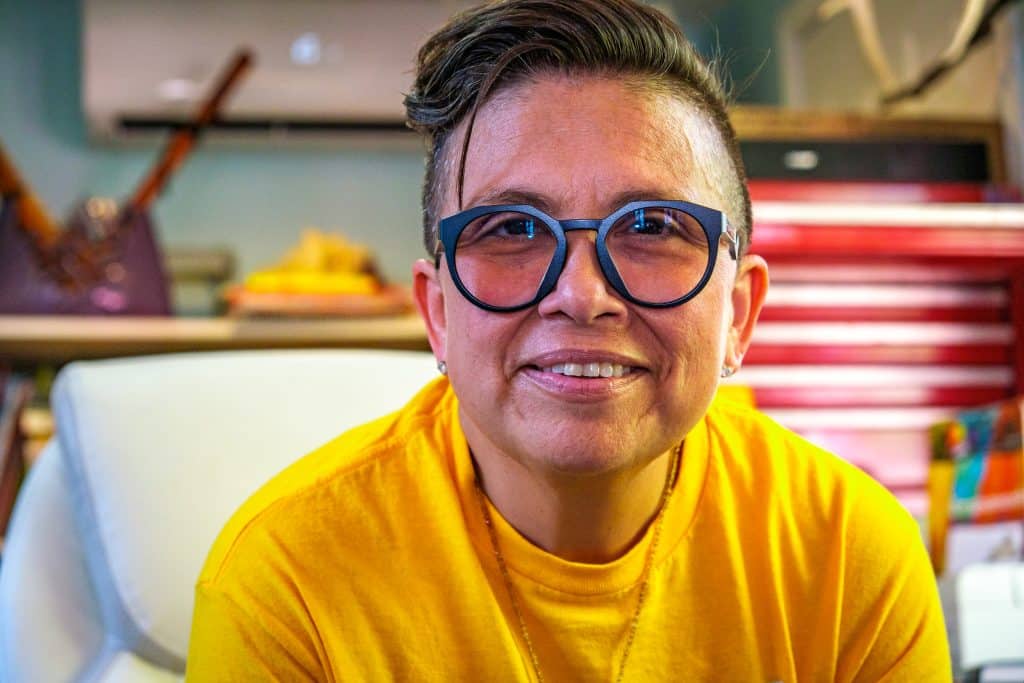
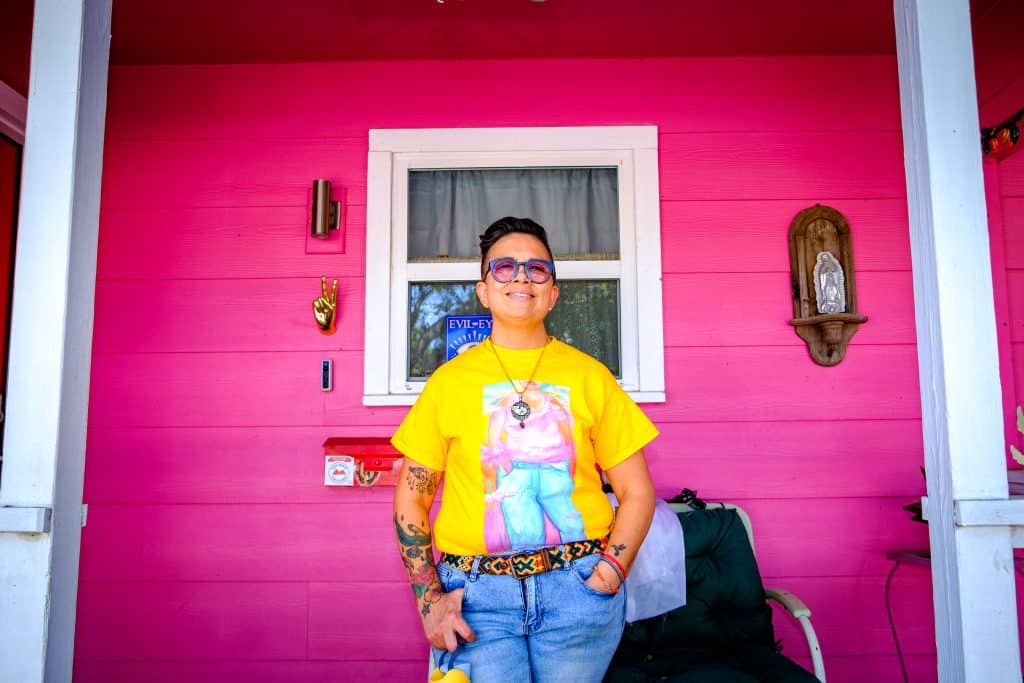
As both a writer and visual artist, Anel Flores is well known in San Antonio’s arts and queer communities. Originally from the Rio Grande Valley, they describe themselves as a trans, queer, lesbiane and Xicane creative whose work explores intersectional feminism, queer politics, and resistencia across genres and media—from poetry to fiction to graphic memoir and painting. With an MFA in Creative Writing from Goddard College, their best known written work is the Lambda Literary Award-nominated Empanada: A Lesbiana Story en Probaditas, which was adapted into a performance piece for stage that continues to exhibit across the United States. Flores’s visual art is also widely recognized across San Antonio, from the street art of International Women’s Day events to the McNay Art Museum and Centro Cultural de Mexico at UNAM San Antonio.
Flores’s latest novel is Curtains of Rain, a queer bildungsroman that explores how homophobia and transphobia have tangled with environmental racism in South Texas, specifically for residents of Mission, Texas, who for decades were contaminated by chemical companies like Monsanto.
Flores, who like their protagonist Solitaria Gaviota-Alaniz grew up in Mission, recalls how this legacy of contamination impacted their extended family. “I’ve watched it, I’ve witnessed it,” they said.
“And first hand, my mother is one of the women who received an $800 [settlement] check. Because Hayes-Sammons [pesticide plant], or what we know as Monsanto, was emitting the eight most deadliest chemicals into Mission, Texas, for many years, too many years, while my mother and my six uncles and aunts, my tías and my tíos, my grandparents, all my cousins were all inhaling, drinking, eating, sleeping those pollutions. On top of also witnessing the pollution of the fruits … the oranges, the onions, everything. I’ve witnessed, I’ve watched, and I’ve seen us all get sick.”
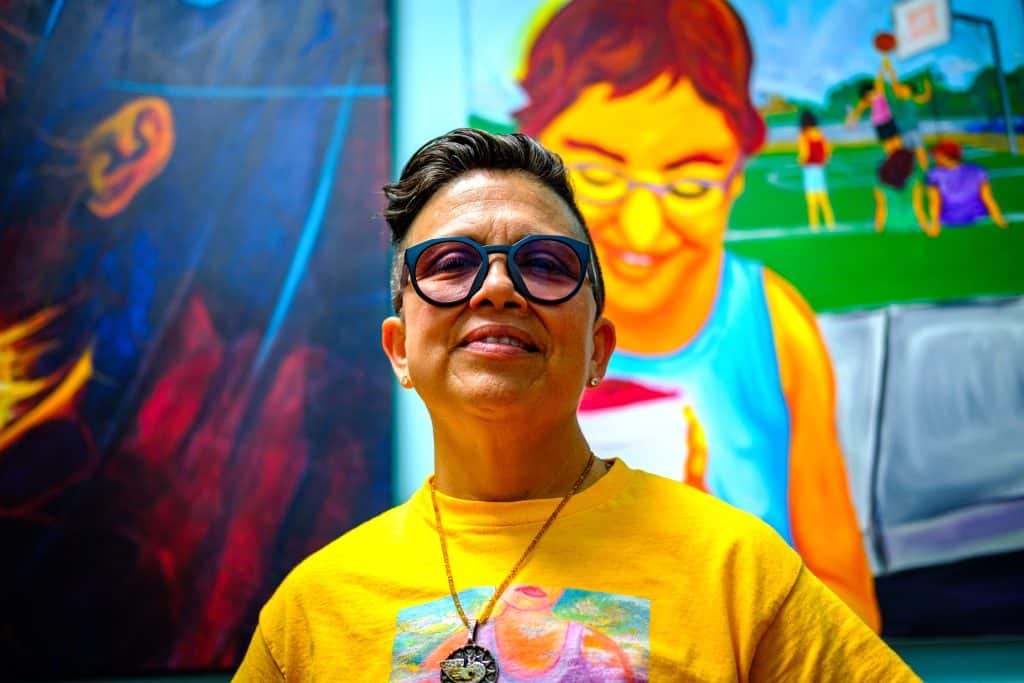
Flores’s mother thus had an intimate understanding of both environmental racism and sexism. “And, also, I live as a queer person, and as a trans person” in South Texas, Flores said, which meant “working with my mother on the other intersection [with those injustices], which is my queerness.”
As with too many young queer and trans folks, home and family have been fraught concepts—places we’re supposed to belong most but which sometimes become places we’re forced to flee, as Sol’s gay tíos Fito and Reme do following an incident of homophobic vandalism, followed not long after by Sol and her nonbinary best friend Toni. All four are pushed out of the Valley and into the arms of San Antonio—“the New York City of Texas!” Sol’s sister Luci gushes, in a gut-wrenching scene that finds her pushing her own little sister to leave home at 17 for her own safety.
And so Curtains is a book about the beauty and sacredness of found familia, but undeniably it is also about the beauty of the South Texas landscapes—el rio, las moras, las hierbas, el mesquite, el maguey y nopal, las cortinas de lluvia—that hold us all, in all our relations, in spite of these histories of violence.
“At the end of the day,” Flores said, “I’m crying, yes, and it’s sad, and there’s trauma. But my god what a beautiful place. Once I leave the San Antonio skyline…like, if I don’t see San Antonio anymore in my rearview and I’m driving home to the Valley…my shoulders drop, the windows I feel like I can open…it’s just a whole energy. It’s a whole energy when you’re over by the water, when you’re closer to México. … It’s beautiful and kind and loving and funny and fun and joyous and there’s a lot of music and everyone has the best mariachi team in every high school—it’s a beautiful place. I wanted to show that.”
Flores originally wrote the book, they said, as a way of healing from their own experiences of familial rejection and having to flee home. “And then I rewrote it,” they said, “and that’s when I was able to pick up—like, oh okay, let me add what I understand about what has happened to women. And let me add what has happened to men and people and trans people and grandparents and uncles and aunts. Now it was beyond looking at, ‘my mother hurt me’—which was my own personal thing I needed to heal from, in getting the story out. Because [in writing the book] I was also healing my mom from her environmental pain and suffering that she had been going through.”

In Curtains, Sol’s father Chon, a longtime worker at the neighboring chemical plant, ascribes the family’s unexplained environmental illnesses to the “curse” of Sol’s queerness, which he suggests has spread from her Mami’s gay friends to Sol to her friends Paloma and Toni—just as transness today is constructed by far-right movements and their liberal launderings as a kind of “social contagion.” And yet what the novel reveals by the end—what Flores implicitly suggests in the story—is that he’s gotten the relationship backwards and inside out. It’s not queerness that contaminates like a sickness, it’s the intimate family violence of homophobia and transphobia. But that violence stems from a wider violence that is in no small part environmental, a projection outward of the violence inflicted on the land and its peoples by companies that profit from their exploitation and actual pollution.
But although Fito and Reme, Sol and Toni, all flee the Valley to find themselves and each other in queer community, that’s not where Curtains ends. A generation later, Sol and Toni both come home to the Valley—to find their families and communities of origin changed, though that resolution is never perfect or final, nor can it be.
“We’re still building those relationships,” said Flores of the book’s final scene, in which Sol finally learns from her Tía Chita how it was for Mami Flora the night Sol fled town, the grief she felt and shared only with the earth—and the faith that somehow her daughter would be okay.
“We’re still learning. I still have one family member I’m deeply working on, [who] was an ex-police officer. But I’m working on him. And he loves me. And if something happened today he would be here in an instant. But he’s got a little bit of a way of thinking we don’t all agree with.
“And so I just wanted to end there and say the conversation is still gonna happen. We always wanna learn. We always wanna keep understanding the Earth more. Understanding our mother more, our sister more, our uncle more, our friend more, our family more. Listening.”